

Land disturbance in Minnesota is governed as much by the calendar as by the permit. Ground can be opened almost any month the machine can work; it can only be properly closed while things still grow. Those two windows are not the same length, and the gap between them is where the exposure lives.
What follows works through the permit itself, which is a more elegant instrument than most states manage, and then through the part it cannot help with — a winter spent bare and a melt that arrives all at once. Undercarriage life, blade loading and how a tracked machine travels are constant wherever it works and belong to the dozer insurance pillar.
What dozer insurance costs in Minnesota
There is no premium on this page. On a Minnesota fleet the meaningful inputs are seasonal before they are anything else: how many working months you compress the year into, whether ground you open late can still be closed, where the iron sits from freeze-up to thaw and whether anybody looks at it while it is there, how far and how often it is moved, hours and undercarriage condition, the valuation basis, and your record. A fleet that overwinters behind a fence in the metro and one that overwinters on a job north of the lakes are not the same risk on paper or off it.
Minnesota dozer regulations: stormwater and land disturbance
Minnesota administers the program itself through Minnesota Pollution Control Agency (MPCA), and does it with a single permit that carries both federally delegated and state authority — NPDES/SDS Construction Stormwater General Permit MNR100001 — reaching a land disturbance of one acre or more. The agency publishes the material directly: Construction stormwater.
Having one permit and one agency is a genuine administrative advantage, and it is worth saying so because most of this page is about a harder problem the permit cannot solve for you. Stabilization is the mechanism by which a disturbed site stops being a disturbed site, and stabilization in this climate is seasonal — you cannot establish cover on frozen ground, so a site opened late is a site that stays open, held only by temporary measures, through months of freeze, thaw and snow load with nobody adjusting them. Then the melt runs across a frozen profile that cannot absorb a drop of it. The commercial line underneath all of that is fixed and worth stating without softening: a penalty from the agency is a regulatory cost that no equipment policy answers for, whereas material leaving your ground and reaching a lake, a wetland, a public ditch or the parcel next door is third-party damage arising out of your work. That belongs to liability and pollution wordings. The floater repairs the dozer, and in a state where the nearest water is usually within sight of the machine, the dozer is very often the cheaper of the two problems.
Common dozer risks in Minnesota
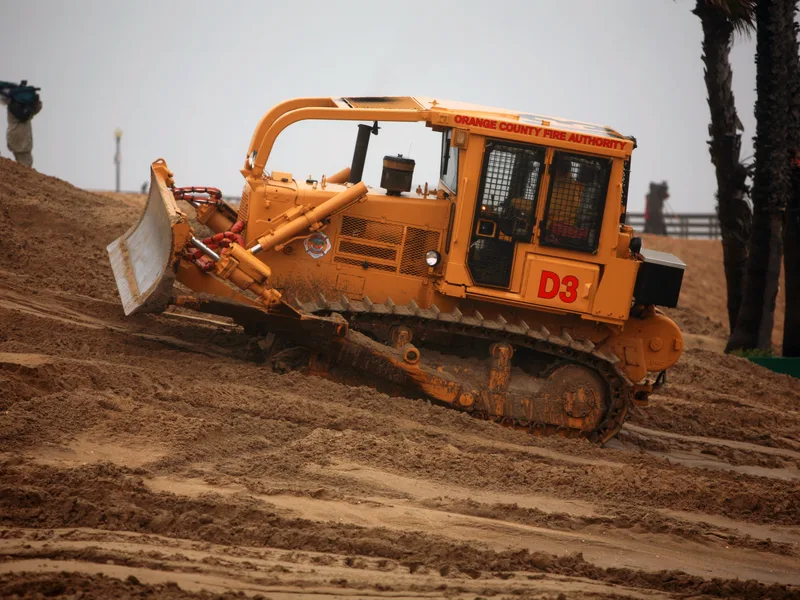
The machine’s own risks here are shaped by a compressed season and a long dormancy. Working months are intense, so service intervals slip and small faults are run through rather than fixed; then the unit sits for a long stretch during which theft of components, freeze damage and quiet fluid problems all have time to develop unobserved. In the ground itself the state offers boulder-bearing till in the north, heavy clay in the west and south, and peat and organic soils that will not carry a track machine at all in places it looks like they should. Fire risk peaks in dry late summer. And through all of it runs the land-disturbance exposure, which does not require anything on the machine to fail.
Common Minnesota dozer claims we see
- Melt runoff carrying a winter of loose material into a lake or wetland. The signature Minnesota event, and a third-party matter rather than a floater one.
- Loss discovered at thaw that began at freeze-up. A machine left where it finished, unvisited for months, with the damage dated only by guesswork.
- Track machine bogged in peat or organic ground. The surface reads as solid and is not, and the recovery does its own damage.
- Undercarriage and blade damage in boulder till. Northern ground breaks components rather than wearing them, which is a different claim from wear and worth separating early.
- Transport damage during a compressed season. More moves in fewer months, on schedules with nothing spare in them.
Why Minnesota dozer owners choose Equipment Guard Insurance
The reason to place this machine on purpose is that its two halves belong to different policies, and on a Minnesota dozer the half that is not on the equipment schedule can outlast the job by a whole season. We write equipment monoline, so the iron is valued and scheduled on its own without reopening the rest of your arrangements, and we ask the questions that actually matter here — when ground gets opened, whether it can be closed before freeze, and where the machine sleeps between November and April. The markets we place through — set out on our homepage — underwrite earthmoving as its own trade rather than as an accessory to a package.
Major Minnesota dozer markets
- Minneapolis. Dense redevelopment and infill where sites are small, adjacent owners are close, and the drainage system leads to the river quickly.
- Saint Paul. River-bluff and institutional work with real grade, on ground where slope and a major watercourse sit in the same view.
- Bloomington. Commercial and logistics build-out on flat metro ground, with large footprints opened in phases.
- Rochester. Sustained medical-campus and supporting development on karst-influenced ground, where what goes down does not always stay put.
- Duluth. Steep hillside sites draining hard toward the lake, with the shortest usable season in the state.
- St. Cloud. Central Minnesota commercial, granite-country and highway-corridor work, with long hauls out to rural jobs.
Related
- Dozer insurance — the machine physics that hold in every state.
- Backhoe insurance in Minnesota — the special mobile equipment definition that decides how a machine may travel between Minnesota sites.
- All equipment insurance in Minnesota — the state hub.
- Equipment floater · Rented & leased equipment
Primary sources
- Construction stormwater — Minnesota Pollution Control Agency (stormwater and land disturbance)
- Residential contractor licensing | Minnesota Department of Labor and Industry — Minnesota Department of Labor and Industry (DLI) (contractor licensing)
Minnesota dozer insurance FAQs
Why does the Minnesota permit carry two sets of initials?
Because it is doing two jobs at once. NPDES/SDS Construction Stormwater General Permit MNR100001 is a single instrument carrying the federally delegated discharge authority and the state’s own disposal-system authority together, rather than stacking a state approval on top of a federal one. It attaches to a land disturbance of one acre or more, and the practical benefit is that there is one document, one administering agency and one file — which is not something every state can say.
What does frost do to the obligation?
It removes your best tool for meeting it. Stabilizing disturbed ground normally means establishing cover on it, and frozen ground will not accept seed or hold a growing thing. So a site stripped in late autumn cannot be closed the way a site stripped in June can, and whatever temporary measures you leave have to survive several months of freeze, thaw and snow load without anyone adjusting them. The right time to think about that is when the work is scheduled, not when the ground has already been opened.
Why is spring the dangerous part of the year?
Because the melt collects a whole winter of consequences and delivers them over a short period, onto ground that is frozen underneath and saturated on top. Water cannot infiltrate a frozen profile, so it runs, and it runs across bare material that has had months to loosen. The dozer that created that surface may have left in November. The exposure arrives in March, and it arrives all at once rather than storm by storm.
How close is the nearest receiving water, really?
Closer than most site plans acknowledge. Minnesota drains three separate ways — north to Hudson Bay, east through the Great Lakes, and south down the Mississippi — and it is threaded with lakes, wetlands and ditches for essentially its whole area. On a great many sites the honest answer is that the nearest water is within sight of the machine. That changes how quickly a control failure becomes somebody else’s problem, and it changes who notices.
Is an enforcement action against us an insured loss?
No. A penalty is a regulatory cost carried by the company, and no equipment policy was ever designed to absorb it. What can be insured is the physical harm: material off your site into a lake, a wetland, a public ditch or a neighboring parcel, and the cost of removing it and putting things back. That is third-party damage arising out of your work, answered by liability and pollution wordings rather than by the floater covering the machine.
What happens to the machine over a Minnesota winter?
Frequently nothing, and that is the problem. A short working season means the iron earns hard for part of the year and then sits, often where it finished rather than in a yard, through months when nobody looks at it. Losses discovered in April routinely began in December — theft of components, water and freeze damage, a fluid problem that had time to become a bigger one. Where a machine overwinters, and whether anyone checks it, is a real underwriting question here and not a formality.