
Two things about Montana shape every dozer account in it. The work happens in and around river valleys, because that is where the ground is workable and where people live, and those rivers are clear, cold and watched. And the distances are real: the machine that stops is a long way from the person who fixes it.
What follows is the Montana side of the picture — who issues the permit that attaches to a disturbed acre, why sediment is the load these particular waters care about, and where the exposure genuinely sits once the blade has done its job. The machine itself is covered on the dozer insurance pillar, which does not change with the state line.
What dozer insurance costs in Montana
We do not publish premiums for this class and would not trust one if we saw it. A Montana figure comes from the machine and its running gear, the terrain you contract for, how much ground stays open across a long melt season, how close the work sits to a stream, the elevation and slope you work at, how far the iron travels and how long a breakdown strands it, and your own record. A subdivision contractor in a valley bottom and a reclamation crew working high ground in a short window are different accounts on the same equipment list.
Montana dozer regulations: stormwater and land disturbance
Montana administers the discharge permit program itself. The state environmental quality department issues MPDES General Permit for Storm Water Discharges Associated with Construction Activity, MTR100000, and it attaches at one acre or more of total land disturbance.
What that means for an earthmoving contractor here has less to do with filing than with what is downstream. The receiving water in most of this state is a cold, clear river system, and fine sediment is the load such a system tolerates least — it settles into gravel beds and stays. Add snowmelt, which delivers high water over weeks rather than in an afternoon, and ground left open at the end of a season is ground committed to a long spring rather than to a single storm. The result is that erosion control here is a scheduling decision made months in advance, not a set of measures installed at the end. On the commercial boundary, be clear-eyed: a penalty from the department is regulatory and stays with the contractor, and no equipment policy was written to answer it. What becomes an insurance claim is material that leaves your disturbance and does damage — onto a neighbor’s land, across a county road, or into a stream where the consequence is visible to everyone who uses it. That is a third-party matter arising out of your operations, it answers under liability and pollution wordings rather than under the floater, and on this machine it is the exposure with the greater capacity to hurt.
Common dozer risks in Montana
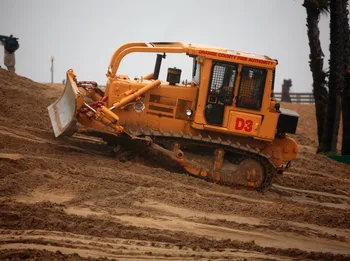
Isolation is the multiplier on every machine risk in Montana. Overturn on steep or benched ground, engine-bay fire on a machine working dry summer material, and running-gear damage in rock all happen here as they do anywhere — but each is worse because recovery equipment, a mechanic and parts are hours away, and because a machine left on location is a machine nobody is watching between shifts. Winter adds cold-start and seal failures on iron that overwinters where it finished. Around all of it is the land-disturbance exposure, which is not a failure mode at all: it is the byproduct of doing exactly what the dozer was hired to do.
Common Montana dozer claims we see
- Sediment reaching a stream from an open slope. The defining Montana exposure, highly visible in clear water and a third-party question rather than an equipment one.
- Overturn on steep or benched ground. Terrain-driven, and severe because help is far away when it happens.
- Engine-bay fire in dry summer conditions. A machine working cured grass and brush with nothing nearby to fight it.
- Transport damage over passes and long hauls. Route, grade and weather all bear on a low-bed move in this state.
- Extended downtime after a mechanical loss. The repair is ordinary; the wait for the mechanic, the parts and the recovery is not.
Why Montana dozer owners choose Equipment Guard Insurance
Placing a dozer well in Montana means underwriting the geography rather than ignoring it. We write the equipment monoline, so the machine goes on its own schedule without reopening the rest of your program; we ask where the iron works and sleeps rather than assuming a yard; and we treat the runoff exposure as the liability conversation it is instead of leaving you to assume the floater covered it. The markets we place through are named on our homepage, and they read earthmoving as its own class rather than as oversized compact equipment.
Major Montana dozer markets
- Billings. The state’s largest industrial and commercial earthwork market, in a broad river valley where refining and distribution sites sit close to open water.
- Bozeman. The fastest sustained residential and commercial growth in Montana, on valley ground crossed by streams and irrigation.
- Missoula. Confined valley development where slope, river proximity and limited buildable ground concentrate the work.
- Great Falls. Agricultural, industrial and public earthwork on open plains ground with wind as well as water moving loose material.
- Kalispell and the northwest. Resort and residential construction on forested slopes with a short season and long approaches.
- Butte and Helena. Reclamation, mining-legacy and public works, where disturbed ground and water quality have a long and closely watched history.
Related
- Dozer insurance — the machine physics that hold in every state.
- Skid Steer insurance in Montana — the machine that does the finish work behind the blade and travels back to the yard when this one does not.
- All equipment insurance in Montana — the state hub.
- Equipment floater · Rented & leased equipment
Primary sources
- Surface Water Discharge Permitting (MPDES) — Montana Department of Environmental Quality (stormwater and land disturbance)
Montana dozer insurance FAQs
Which permit covers construction stormwater in Montana, and who issues it?
The state issues it. Montana administers the discharge program itself through the state environmental quality department, under MPDES General Permit for Storm Water Discharges Associated with Construction Activity, MTR100000, and it reaches a land disturbance of one acre or more of total land disturbance. This is one of the minority of states in our data where the document we hold genuinely contains the permit identifier recorded for it, so this page links it rather than describing it at second hand.
Why is sediment treated so seriously against Montana rivers?
Because of what those rivers are. Cold-water river systems here support fisheries with an economic and cultural weight far beyond their flow, and fine sediment is one of the loads they are least tolerant of — it settles into the gravel that everything else depends on. A plume that would be unremarkable in a muddy lowland river is highly visible in clear water, and it will be noticed by people who are not inspectors long before it is noticed by anyone who is.
How does snowmelt change the runoff picture?
It makes the high-water season long and largely predictable rather than sudden. Runoff here is driven by snowpack releasing over weeks, so ground opened late in the year is carried into a spring where the water table, the streams and the saturated subsoil all arrive together. That predictability is an advantage if the season is planned around it and a serious liability if the schedule assumes rain is the only water that matters.
What does the distance do to an equipment claim?
It stretches every step of it. A machine that stops in a remote valley waits for a mechanic who may be several hours out, a low-bed that has to be routed around terrain, and parts that arrive on a schedule nobody controls. That turns a moderate mechanical loss into a significant business interruption, and it is the reason we ask where the machine actually works rather than where the business is registered.
Does the equipment policy respond to a stormwater violation?
No. Enforcement is between the contractor and the department, and no equipment form pays a penalty. Where insurance comes in is the physical consequence — material off a disturbed slope into a neighbor’s ground, onto a county road, or into a stream. Sediment reaching a watercourse here is a third-party matter with an audience, and it belongs to liability and pollution wordings rather than to the schedule the dozer sits on.
Will you write the dozer on its own?
Yes. Equipment Guard Insurance writes equipment monoline in Montana, so a machine can be scheduled without disturbing anything else you carry. On accounts working this far from support, the questions worth spending time on are where the iron sits, how far help is, and how much ground is open when the melt starts.