

Nebraska gives an operator a false friend. The silt that covers much of the state cuts like nothing else, holds a face that looks engineered, and lets a good hand make a bank stand up without a single control measure. It behaves that way for as long as it is dry, and it stops behaving that way all at once.
What follows is the Nebraska side of running a blade: who permits the disturbance, what the state does and does not check about the person doing it, and where the exposure sits once ground is open on material like this. The machine itself — blade and ripper work, undercarriage cost, moving a tracked machine between jobs — is on the dozer insurance pillar, which does not change from state to state.
What dozer insurance costs in Nebraska
There is no useful premium to publish for this class, and the machine is seldom the deciding input. A Nebraska account moves on how much ground you have open and for how long, how steep the cuts are and in what material, the distances between jobs across a very wide state, whether the work is metro subdivision, terracing and agricultural earthwork, or highway and utility corridor, the age, hours and undercarriage condition of the iron, where it sits when nobody is on site, and your own record. The difference between a careful crew and a fast one is visible in the loss history long before it is visible in the equipment list.
Nebraska dozer regulations: stormwater and land disturbance
Nebraska administers the national discharge program itself: Nebraska Department of Environment and Energy (NDEE) issues NPDES Construction Storm Water General Permit NER210000, reaching a land disturbance of one acre or more. That is stated from our own verified record rather than from a document we can link on this page — what we hold for it is a program page rather than the permit — and the note beneath the sources block says so instead of letting a nearby citation imply otherwise.
The Nebraska point is what the state checks and what it does not. It does not license general contractors; it registers them, through the labor department, as a filing rather than an examination of anyone’s ability to hold a slope together. So nothing in the credentialing layer asks whether you can leave a cut safely, which puts the whole weight of that question on the environmental permit and on liability — and it puts it on material that is unusually good at hiding the answer. Loess stands vertically, looks solid, and fails without a preliminary. A face that has been open since spring is not evidence of anything except that it has not rained hard yet. Where that lands commercially is the same boundary that governs every state, drawn a little sharper here. A penalty or a notice is a regulatory outcome and no equipment policy answers it. Soil that leaves an opened site and reaches a neighboring operation, a county road or a watercourse is third-party damage arising out of your work, insured under liability and pollution coverage rather than the floater — and on a machine whose entire purpose is moving material, that is where the large number lives.
Common dozer risks in Nebraska
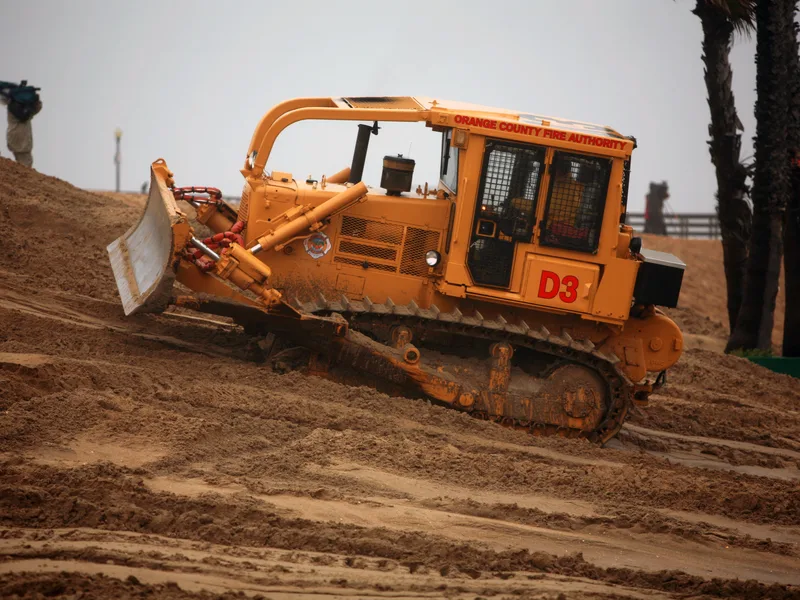
The iron itself has a modest and predictable loss record: undercarriage and blade-edge wear that no floater pays for, fire in packed debris on a machine working far from help, damage during loading and the long hauls this state demands, and theft of components from sites nobody visits at night. The serious physical risk is the cut. On loess a bank collapse takes the machine and the operator with it, and it happens on a face that gave no warning. Around that sits the land-disturbance exposure, which is not caused by an error at all — it is created by the job, and it compounds for every day the ground is open and every storm that arrives while it is.
Common Nebraska dozer claims we see
- Bank or cut failure in dry-standing silt. The material gives no warning, and the machine is usually at the toe of it.
- Soil off an opened site into a drainage or river system. A third-party matter rather than a floater one, and the largest number on this page.
- Machine fire on a remote job. Distance from help is what converts an incident into a total loss.
- Loading and long-haul transport damage. A wide state means more moves, and moves are where tracked machines get hurt.
- Component theft from an unattended site. The dozer is not going anywhere, but everything unbolted from it is.
Why Nebraska dozer owners choose Equipment Guard Insurance
A dozer is easy to place badly, because the schedule looks simple and the real exposure is invisible on the application. We would rather be direct: the machine is the cheaper half of what you are carrying, and the ground you moved is the half that produces a bad year. Writing equipment monoline lets a Nebraska crew have the dozer valued and scheduled on its own without reorganizing everything else first, and it leaves room to talk honestly about cuts, open acreage and which policy would actually respond if a bank ends up somewhere it should not be. We place through markets — named on our homepage — that read earthmoving as a class in its own right.
Major Nebraska dozer markets
- Omaha. The state’s deepest concentration of commercial and subdivision earthwork, on bluff ground with real fall toward the river.
- Lincoln. Steady institutional and residential grading, with sites large enough to sit inside phased developments.
- Bellevue. River-terrace work close to the floodplain, where the receiving water is near and the ground is soft.
- Grand Island. Central-valley industrial and agricultural site preparation, with long haul distances between jobs.
- Kearney. Corridor and utility earthwork along the Platte, much of it open country with nothing to slow the wind.
- North Platte. Rail, ranch and highway work in the west, where a machine can be a very long way from the nearest help.
Related
- Dozer insurance — the machine physics that hold in every state.
- Backhoe insurance in Nebraska — the machine a Nebraska crew drives between jobs rather than floats, and the one the vehicle code treats oddly.
- All equipment insurance in Nebraska — the state hub.
- Equipment floater · Rented & leased equipment
Primary sources
- Contractor Registration — Nebraska Department of Labor (contractor licensing)
We do not link a Nebraska stormwater permit document here. The land-disturbance threshold and permit class described above follow Nebraska’s own record as our data layer holds it; where the state publishes a document that states it directly, this page links it.
Nebraska dozer insurance FAQs
Which agency permits construction earthwork in Nebraska?
Nebraska Department of Environment and Energy (NDEE) runs the delegated program and issues NPDES Construction Storm Water General Permit NER210000, which reaches a land disturbance of one acre or more. Delegation matters practically rather than philosophically: the permit, the conditions and the inspector are all state, so this obligation sits inside the rest of your Nebraska paperwork instead of running alongside it through a federal region office.
Am I licensed or registered to do this work here?
Registered. Nebraska does not issue a statewide general contractor license; contractors and subcontractors working on real property register with the state labor department, and registration is a filing rather than a competency examination. Nobody has assessed whether you can build a stable slope. The state’s real check on earthmoving quality arrives afterwards, through the environmental permit and through liability, which is a good reason to treat both as part of the job rather than as paperwork.
What is different about Nebraska soil?
Much of the state is loess — silt laid down by wind rather than deposited by water. It is remarkable material to work: it cuts cleanly, holds a near-vertical face and gives an operator enormous confidence. It is also structurally reliant on staying dry, and once water runs into or behind it, it does not fail gradually. That combination, a soil that looks stable and fails suddenly, is the single most useful thing an owner working here can understand.
Does that change how a site should be left overnight?
It changes how a site should be left at all. A face that has stood untouched for weeks is not evidence that it will stand through a storm, and the ordinary practice of leaving a cut open until the next phase is a different decision on this material than on clay. The same property that makes loess pleasant to move makes an opened site a liability that accumulates for as long as it is open.
Would a policy respond to a state enforcement action?
No, and the distinction is worth holding. A penalty or a notice from the state is regulatory, and no equipment policy contemplates paying it. What insurance answers is the physical consequence when it lands on somebody else — a slope that lets go and buries a neighboring access, silt into a drainage or a river, material on a county road. That is third-party damage arising out of your work, and it belongs to liability and pollution coverage rather than to the equipment floater.
Will you write a single machine for a rural outfit?
Yes. Equipment Guard Insurance writes equipment monoline in Nebraska, so one dozer can be scheduled properly without moving anything else first. That matters here because a lot of the state’s earthmoving is done by small crews a long way from a metro, and they are the ones most often told to buy a package before anyone will look at the machine.