
Nevada earthmoving is done at scale and in a hurry, on ground that offers no help. There is nothing growing to hold a slope together, the soil in much of the south is cemented hard enough to need ripping, and the year’s rain can turn up in an afternoon.
This page covers the state around the machine: who issues the permit and what pulls a job under it, what this ground does to an undercarriage, and where the exposure actually sits once a valley floor has been re-shaped. Blade capacity, ripper technique and track life are the same in every state and live on the dozer insurance pillar.
What dozer insurance costs in Nevada
No premium is published on this class and none could honestly be. In Nevada the terms that move a number are the volume you move and how much of the site is open at any one time, whether you are ripping cemented ground or working alluvial material, the distance between a disturbed area and the nearest drainage channel, the machine’s hours and undercarriage state, how far it travels between remote jobs, and your own record. Mass grading a master-planned parcel and cutting a bench above an established neighborhood are different files, even when the equipment list is word for word the same.
Nevada dozer regulations: stormwater and land disturbance
Nevada holds delegation for the national program and issues its own instrument: Construction Stormwater General Permit NVR100000, from Nevada Division of Environmental Protection (NDEP), Bureau of Water Pollution Control. It reaches a land disturbance of one acre or more (or smaller if part of a larger common plan disturbing one acre or more).
The delegation is administratively straightforward — a state bureau, in state, handling notices and inspections — and the interesting part is what the desert does with the underlying obligation. Arid ground is not low-risk ground. It is sparsely vegetated, frequently cemented or crusted so that water runs across it rather than into it, and it receives much of its annual precipitation in a small number of intense cells. That combination moves material faster than a wet climate does, and it moves it into channels that are dry, unremarkable and easy to dismiss right up until the hour they are not. Where that becomes an insurance question is the same everywhere and worth stating exactly: a penalty for absent or failed controls is a regulatory cost that sits with your business, while sediment leaving the site and reaching a neighboring parcel, a highway, a detention basin or a wash that runs through somebody’s subdivision is third-party property damage arising out of your operations. That belongs to liability and pollution coverage rather than to the floater that repairs the dozer, and on a Nevada mass-grading job it is comfortably the exposure with the greatest capacity to outrun the value of the machine.
Common dozer risks in Nevada
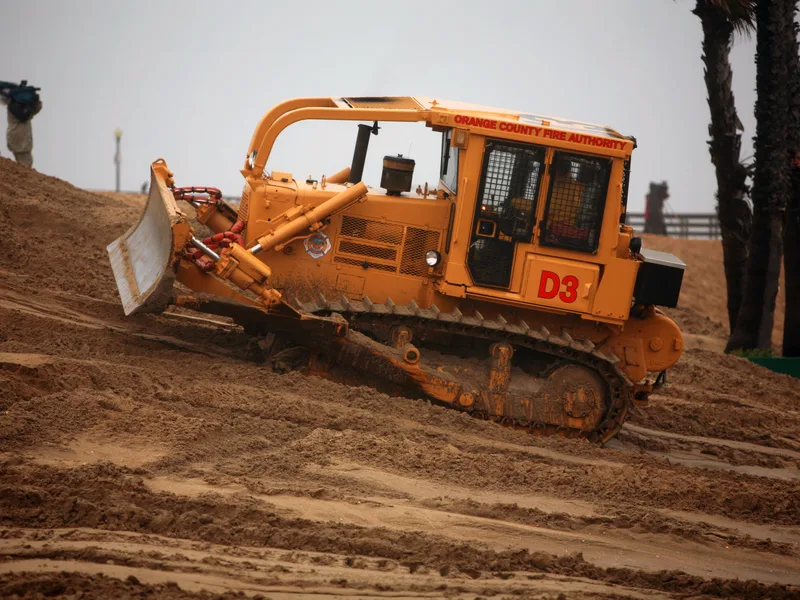
This is hard country on iron. Ripping cemented ground shock-loads the frame and the undercarriage in a way that steady pushing never does, abrasive fines get into every seal and pin, and sustained summer heat works on cooling systems, hoses and hydraulic oil at the same time as it works on the operator. Long hauls between remote sites make transport a bigger share of the exposure than it is in a compact state, and machines that stay out on unattended ground for weeks at a time are exposed to theft and to component stripping. Sitting over all of it is the land-disturbance risk, produced entirely by the machine doing precisely what it was brought in to do.
Common Nevada dozer claims we see
- Material carried into a wash or drainage channel by a single storm cell. The defining Nevada exposure on this class, and it is settled outside the equipment policy.
- Ripper and undercarriage damage in cemented ground. Shock loading rather than gradual wear, and the two are worth separating before a claim is filed.
- Heat-related engine and hydraulic failure in high summer. Often argued as sudden where the cause was a cooling system slowly losing the argument.
- Theft or stripping from an unattended remote site. Distance is the real control failure here, not the lock.
- Transport and low-bed damage over long desert hauls. More miles between jobs means more of the year spent on the riskiest part of the work.
Why Nevada dozer owners choose Equipment Guard Insurance
Nevada gives an underwriter something real to read in a contractor’s license classification, and the sensible move is to build on that rather than around it. Writing equipment on its own means the machine can be scheduled at an honest value, with hours and undercarriage condition described as they are, and nothing else in your arrangements has to be disturbed to do it. It also leaves room for the conversation this class actually needs, which is about where material goes rather than what the iron cost. We place through markets — named on our homepage — that treat mass grading as its own trade.
Major Nevada dozer markets
- Las Vegas and North Las Vegas. Master-planned valley build-out at volume, in cemented ground, with washes running through the middle of the development pattern.
- Henderson. Bench and hillside grading above the valley floor, where slope work and runoff control are the same operation.
- Reno and Sparks. Industrial and logistics build-out on the valley floor, with sharp seasonal swings and a river through the middle of the market.
- Carson City. Sierra-front alluvial fans — coarse, steep and quick to shed water when a storm parks on the range.
- Elko. Mining-adjacent earthmoving with long hauls, remote sites and machines that stay out for weeks at a time.
Related
- Dozer insurance — the machine physics that hold in every state.
- Forklift insurance in Nevada — the machine whose Nevada question is who inspects the operator rather than where the water goes.
- All equipment insurance in Nevada — the state hub.
- Equipment floater · Rented & leased equipment
Primary sources
- Construction Sites - 1 acre or more | NDEP (Construction Stormwater General Permit NVR100000) — Nevada Division of Environmental Protection (NDEP), Bureau of Water Pollution Control (stormwater and land disturbance)
- License Classifications — Nevada State Contractors Board (NSCB) — Nevada State Contractors Board (contractor licensing)
Nevada dozer insurance FAQs
Does a stormwater permit really matter in a state this dry?
More than the rainfall figures suggest. Nevada holds delegation and runs its own construction stormwater general permit through the environmental protection division, and the threshold is the same statutory acreage used nationally, with smaller parcels counted in when they belong to a larger common plan. The reason it bites here is physical rather than legal: there is little vegetation to hold soil, the ground often sheds water instead of taking it, and the rain that does fall tends to arrive in one concentrated burst.
What is caliche, and why does everyone here complain about it?
It is a hardpan of soil cemented together by carbonate, common through the southern valleys and stubborn enough that a blade cannot simply push it. The machine rips it first and then moves the pieces, which means shock loading through the frame, heavy wear on rippers and cutting edges, and undercarriage hours that run down faster than a calendar-based maintenance plan expects. It also makes the resulting surface poor at absorbing anything, which pushes water sideways rather than down.
A wash is dry most of the year. Is it still a problem?
It is the problem. An ephemeral drainage that carries nothing for months is still the route by which your disturbed material reaches somebody else — a downstream property, a highway, a detention basin, a neighborhood built around the channel. When it does run, it runs hard and fast and carries far more than a perennial stream of the same size would. Treating a dry wash as empty ground is the single most expensive misreading available on a Nevada site.
How does Nevada licensing affect an equipment submission?
Favorably, in most cases. Nevada runs a classified A, B and C contractor licensing system through its state contractors board and applies it with more rigor than most states do, so there is a real credential attached to your business that an underwriter can look up and read. That does not touch the land-disturbance duty at all — the two are unrelated regimes — but it does mean a Nevada contractor starts a submission with more third-party evidence about itself than a contractor in a registration-only state.
Where does insurance actually attach in all this?
Not to the paperwork. If the state assesses a penalty because controls were missing or unmaintained, that is a regulatory cost your business carries. The claim arises when the material moves: sediment leaving your site and reaching an adjoining property, a public road or a drainage channel is physical damage to somebody else arising out of your work. That is a liability and pollution question, and it is not what an equipment floater was built to answer.
Can the machine be scheduled on its own?
Yes. Equipment Guard Insurance writes equipment monoline, so a Nevada owner can put a dozer on a schedule at a defensible value — hours, undercarriage condition, serial numbers, where it sleeps between jobs — without reopening anything else in the program. On this class we would rather spend the extra ten minutes on the boundary above than let a tidy schedule imply the whole exposure has been dealt with.