
On a Nevada site the reach machine is the one that never makes the schedule meeting. It stages material on a podium deck, lifts block up a wall, carries whatever the crew needs across a graded pad, and takes up no attention at all — until the shift it sets a load down somewhere the chart never sanctioned.
What makes Nevada distinct is not the standard but the concentration of authority. One state government licenses the contractor and enforces the safety rule over the operator, which is a tighter arrangement than most of the country runs. For the machine physics that do not change anywhere — capacity at reach, load charts, bearing, the forward-tip pattern — start at the forklift insurance pillar.
What forklift insurance costs in Nevada
A number on a web page would be a fiction for this class, because the rating tracks operators and records rather than the unit. In Nevada what genuinely moves it is how many people run the machine and whether each is evaluated against the specific model, whether the work is vertical resort and podium construction or open desert site development, how much of the season runs through the worst of the heat, how far the machine travels from a yard, and your own loss record. The telehandler’s own value is a minor term, and rarely the one an underwriter asks about first.
Nevada forklift regulations: who enforces operator safety
Nevada operates its own OSHA-approved State Plan covering private-sector employers, so powered-industrial-truck operator training, evaluation and enforcement run through the state program rather than federal OSHA directly.
The first consequence is the familiar one for a state program, and it is worth stating so nobody reads it hopefully: an approved plan must be at least as effective as the federal standard, so operator training, evaluation on the specific machine and refreshers are no lighter here. What changes is the identity of everyone involved — a state inspector, a state citation, a state appeal. The second consequence is the one particular to Nevada. This is also a state that licenses contractors itself, through its own board, in classified categories with bid limits set against demonstrated financial capacity. Those are separate processes and this page is not claiming one automatically feeds the other. The point is simpler: both live with the same government, which is a narrower posture than a contractor in a federal-enforcement state experiences, and it makes operator documentation something you keep for an authority you already deal with rather than for a stranger who might never appear. One boundary is worth settling in advance. Work performed on a mine property sits under a separate federal regime rather than under the state occupational program, and in the northeast of this state that distinction is not academic. Ask the site operator which authority governs before the machine goes to work there.
Common forklift risks in Nevada
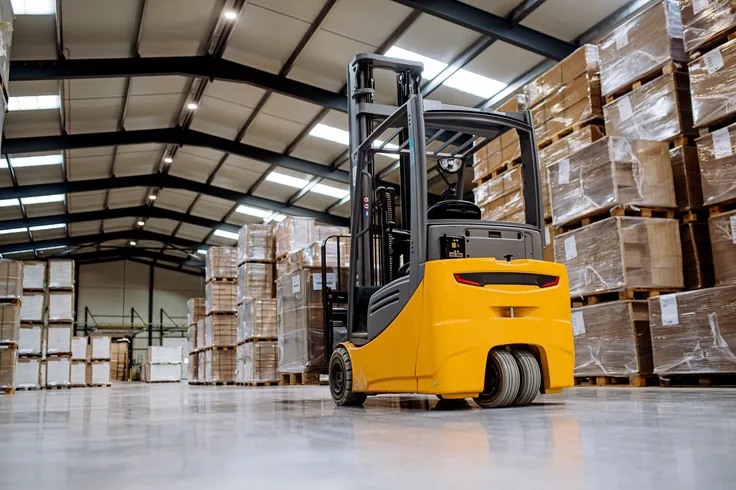
Everything expensive about this machine happens to something other than the machine. A load released at height injures whoever was below and destroys material already delivered, and a boom working into a partly finished resort or podium structure damages work that is finished, invoiced and on a schedule. Nevada contributes heat and ground. Sustained summer temperatures erode the judgment a load chart assumes an operator is exercising, and the desert surface is deceptive in a specific way — undisturbed caliche carries beautifully, while the cut, filled and recompacted ground that surrounds every new building looks identical and does not.
Common Nevada forklift claims we see
- Material lost while landing on a podium or upper deck. The load and the structure beneath it dominate the cost, and the machine takes an inspection.
- Tip forward at full reach. The rating falls away with extension, and the chart is consulted least when the reach is longest.
- Worker struck beneath a placement. The largest outcome on this class, and one the equipment schedule does not answer for at all.
- Bearing failure on cut-and-fill ground. The surface around a new building is not the surface the pad was tested on.
- Heat-related error late in a summer shift. Not a mechanical failure, and the most preventable claim on the list.
Why Nevada forklift owners choose Equipment Guard Insurance
We would rather be straight with you than sell the floater as the whole answer. The equipment policy repairs a telehandler that is usually repairable; it does nothing about the injured worker, the material on the ground or the finished structure a boom went into. In a state that runs its own program and issues your license, the documentation that keeps you clean with the regulator is also the documentation that defends the claim, and that is worth building deliberately. We write equipment monoline so the machine sits on its own schedule, and we place through markets — named on our homepage — that will underwrite jobsite lifting rather than pricing a boom machine off its serial plate.
Major Nevada forklift markets
- Las Vegas. Vertical resort and podium construction where booms place material over occupied property and machines are set where they fit rather than where they should be.
- Henderson. Institutional, medical and master-planned build-out where documented operator evaluation is checked before a unit is allowed inside the fence.
- North Las Vegas. Large-footprint industrial construction on graded desert pads, with long hours, high machine utilization and operator turnover.
- Reno. Technology and industrial campus work on the northern side of the state, with a cold season the southern market does not have to plan around.
- Sparks and Carson City. Plant, municipal and regional work where a single machine covers several sites and gets little scheduled downtime.
- Elko. The northeastern mining district, where the governing authority on a given property is a question to answer before the machine works, not after.
Related
- Forklift insurance — the machine physics that hold in every state.
- Excavator insurance in Nevada — the machine whose notice clock starts running before anyone touches the ground.
- All equipment insurance in Nevada — the state hub.
- Equipment floater · Rented & leased equipment
Primary sources
- State Plans — Occupational Safety and Health Administration (operator safety)
- License Classifications — Nevada State Contractors Board (NSCB) — Nevada State Contractors Board (contractor licensing)
Nevada forklift insurance FAQs
Who enforces forklift operator safety in Nevada?
The state. Nevada runs its own approved occupational safety program covering private-sector employers, so the inspector who attends a serious incident is a state employee, the citation is a state citation, and the appeal is heard through a state process. The substance of the operator training and evaluation requirement is not lighter for that; the administration of it is simply Nevada rather than federal.
Nevada also licenses contractors — are the two connected?
They are separate proceedings, and we are not going to claim one automatically triggers the other. What is true is that both files belong to the same state. Nevada issues classified licenses through its own contractors board — general engineering, general building and a long list of specialty classifications, with bid limits set against demonstrated financial capacity. So an equipment contractor here carries a state license and answers to a state safety inspector, which is a narrower posture than most of the country.
Why does having both files with one government matter to me?
Because it removes an excuse and adds a discipline. In a federal-enforcement state a contractor can treat safety records as somebody else’s paperwork, kept for an agency that rarely appears. Here the records sit alongside a license that is renewed, reviewed and scoped by the same state, and the practical effect is that operator documentation is easier to keep current when it is not being kept for a stranger.
Does a machine working on a mine property fall under the same rules?
That is exactly the boundary worth settling before an incident rather than after one. Work on a mine property sits under a separate federal regime rather than under the state occupational program, and northeastern Nevada has a lot of that work. If a telehandler moves between commercial construction and mine-property work in the same season, confirm with the site operator which authority governs it there, and keep the training records that satisfy both.
What does the desert climate do to a lifting operation?
It works on the operator before it works on the machine. Sustained summer heat shortens attention and slows decisions, and a load chart quietly assumes an operator who is making good ones. The ground contributes its own version: caliche and compacted desert surface look like excellent bearing and are unforgiving where they have been disturbed, cut or backfilled, which describes most of the pad a new building sits on.
Can you write the machine and nothing else?
Yes. Equipment Guard Insurance writes equipment monoline in Nevada, so the telehandler and its attachments go on their own schedule without touching the rest of your program. We will still be direct about the liability and injury half, because on this machine that is where the size of a bad year is decided.