
Dry country is misleading about water. New Mexico ground goes months without rain, hardens into something a blade has to break rather than push, and then takes a summer storm all at once — across a surface with nothing left in it to absorb anything, and down channels that were dry earlier the same day. A dozer is the machine that decides where that water will go next.
The regulatory picture here is unusual as well, and it is worth getting exactly right rather than half-right. The permit over a disturbed acre is issued federally, while the approvals that determine whether ground may be opened at all belong to the state, the county, the municipality and — on some sites — to authorities older or more sovereign than any of them. For the machine itself, see the dozer insurance pillar.
What dozer insurance costs in New Mexico
A page cannot price this machine, and here it would not even be close. The New Mexico inputs are the machine and its running-gear condition; the ground you contract for, since caliche and rock consume undercarriage at a different rate from valley soil; how much area you open at once and how long it stays open before the monsoon; elevation and slope; the distance between jobs across a very large state; how many authorities have to be satisfied before a site starts; and your own record. Two crews on matching iron can be entirely different accounts.
New Mexico dozer regulations: stormwater and land disturbance
New Mexico is a non-delegated state for the national discharge permit program. Coverage over a land disturbance of one acre or more (or smaller if part of a common plan disturbing one acre or more) runs through the federal construction general permit, issued by the federal environmental agency itself rather than through a state permit of the same kind. We name that arrangement without linking a document for it: what we hold is an agency explainer rather than the permit, and this page links only what it has opened and read.
Now the half that gets dropped, and it is the half that costs money. Non-delegated does not mean unregulated, and it does not mean New Mexico has no say. The state sets and administers its own surface-water quality program, and it licenses the contractors doing the work through its construction industries division. Counties and municipalities issue the grading, drainage and floodplain approvals that decide in practice when a machine may start. An acequia association has standing over work touching the ditch it maintains, which is a legal relationship rather than a courtesy. And a site abutting tribal land sits beside a sovereign government whose authority is its own. So the accurate statement is a split, not an absence: the discharge permit has a federal address, and the permission to disturb the ground is local and state business. Where insurance sits in all of that does not move. A penalty under any of those regimes is a regulatory matter and stays with the contractor. Material that leaves your disturbance and reaches a neighboring property, a road, an irrigation ditch or a watercourse is third-party damage arising out of the work — liability and pollution wordings, not the floater that repairs the blade.
Common dozer risks in New Mexico
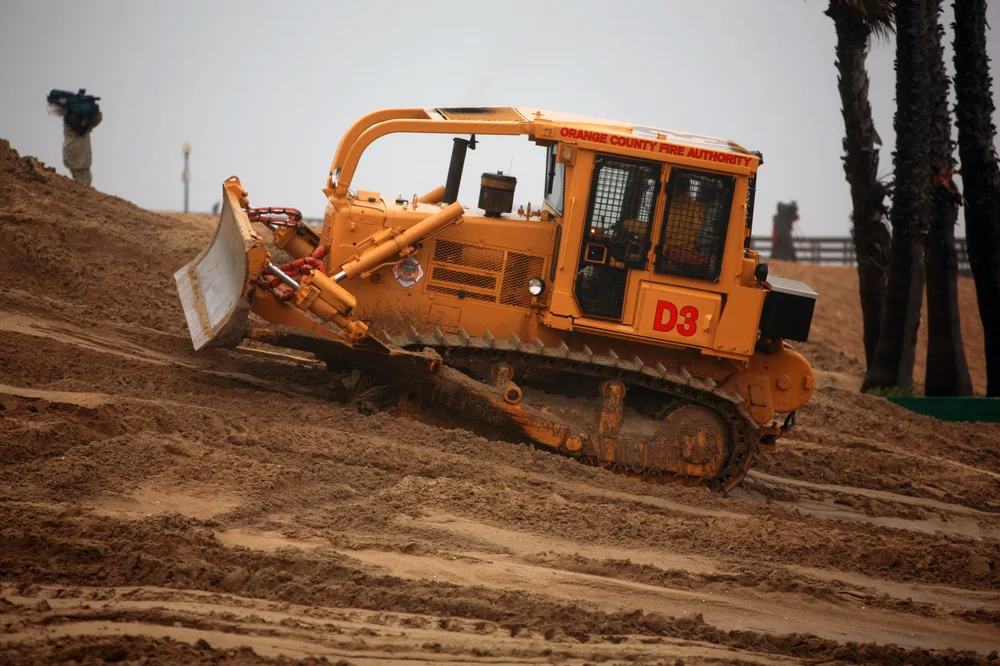
The machine takes its punishment from the ground and the air. Caliche and rock load the undercarriage, the blade and the push-arms in a way soft ground never does, and abrasive dust gets into everything that turns or seals. Heat and elevation work on cooling systems, and fire risk on a machine pushing dry material through brush is genuine in a state with very little standing water to put anything out with. Around the machine sits the land-disturbance exposure, which behaves differently here from almost anywhere else: nothing appears to be happening for weeks, then one storm moves months of accumulated loose material down a channel and across whatever is at the bottom of it.
Common New Mexico dozer claims we see
- Material moved down an arroyo in a monsoon event. The defining New Mexico exposure, concentrated into a few hours and rarely stopping at the property line.
- Machine fire in dry brush and packed debris. Ignition against hot components on ground where there is nothing available to fight it.
- Undercarriage and blade damage in caliche and rock. Part wear, part sudden, and the two need separating well before a claim is made.
- Overturn on an arroyo bank or a cut edge. Terrain that looks stable when dry and is not once it has been saturated.
- Transport damage over long hauls between regions. The distances here mean more road time per working hour than most states demand.
Why New Mexico dozer owners choose Equipment Guard Insurance
The reason to place this machine with someone paying attention is that New Mexico splits the obligations around it across more governments than most contractors are used to, and an equipment policy answers for none of them. We write the coverage monoline so the dozer can be scheduled without reopening the rest of what you carry, we are explicit about which duty is federal and which is not, and we treat the runoff exposure as a liability conversation rather than pretending the floater has absorbed it. The markets we place through are named on our homepage.
Major New Mexico dozer markets
- Albuquerque. The largest concentration of commercial and institutional earthwork, on sites draining toward a river corridor and an urban arroyo system.
- Rio Rancho. Continuous residential and commercial expansion onto open mesa ground, the state’s longest-running large disturbances.
- Santa Fe. Hillside and foothill development where slope, drainage and a demanding local review process all arrive on the same job.
- Las Cruces. Valley agricultural and commercial work threaded through an irrigation network with authorities of its own.
- Farmington. Energy and utility site work in the northwest, frequently adjacent to tribal jurisdiction.
- Hobbs and the southeast. Oilfield pad, road and reclamation earthwork on open, dry ground a long way from support.
Related
- Dozer insurance — the machine physics that hold in every state.
- Excavator insurance in New Mexico — the other tracked machine on the same low-bed, and the one that meets caliche head-on rather than pushing across it.
- All equipment insurance in New Mexico — the state hub.
- Equipment floater · Rented & leased equipment
Primary sources
- 2022 NPDES Construction General Permit (CGP) for Stormwater Discharges from Construction Activities, Parts 1-9 (as modified) — U.S. EPA (stormwater and land disturbance)
- Construction Industries - NM Regulation and Licensing Department — New Mexico Regulation and Licensing Department (RLD), Construction Industries Division (CID) (contractor licensing)
New Mexico dozer insurance FAQs
Who issues the construction stormwater permit for a New Mexico site?
The federal environmental agency does, directly. New Mexico is one of a small group of states that never took delegation of the national discharge permit program, so a contractor here seeks coverage under the federal construction general permit rather than under a state permit of the same kind. The obligation is identical in weight to a delegated state’s; only the address on the correspondence is different.
So does the state have no say over what my dozer does?
That conclusion is wrong, and it is the expensive one. New Mexico sets and administers its own surface-water quality program, licenses the contractors doing the work through its construction industries division, and leaves the grading, drainage and floodplain approvals that actually decide when a site may open in the hands of counties and municipalities. The discharge permit is federal. The permission to disturb the ground is emphatically not.
What is an acequia, and why does it appear on a construction page?
It is a community irrigation ditch and the association that maintains it, and in New Mexico that association is a body with genuine legal standing rather than an informal arrangement between neighbors. Work that crosses, diverts, undercuts or discharges toward a ditch is a conversation with that association, and a crew that treats a small channel as scenery because it did not appear on the utility plan has misjudged both the water and the institution behind it.
How is erosion control different on dry ground?
The hard part is not holding the material during a storm — it is establishing anything that will hold it afterward. Vegetation is slow and uncertain here, so stabilization leans on physical measures and on limiting how much ground is open at a time rather than on seeding and waiting. Then the rain arrives as a short, violent monsoon event over ground with no absorption left in it, and a channel that has been dry for months runs hard enough to move material a long way in an afternoon.
What happens when a site sits next to tribal land?
You have crossed into a different jurisdiction, not a different county. Tribal governments are sovereign, their environmental and land-use authority is their own, and neither the state nor the county speaks for them. That is a question to settle before a machine is mobilized rather than after material has moved, and it is one of several reasons a New Mexico site plan can involve more separate authorities than a contractor from a delegated state expects.
Can you write the dozer on its own here?
Yes. Equipment Guard Insurance places equipment monoline in New Mexico, so the machine goes on its own schedule. Given how many different authorities can have a view on one site here, we would rather map which obligation belongs to whom with you than let the equipment policy be mistaken for an answer to any of it.