
Most of what an excavating contractor relies on in this state is written on the ground in paint, and the ground does not cooperate. Sun takes the color out of it, wind takes the flags, and the surface itself moves. The law here responds by making the locate something you renew rather than something you receive.
What follows is about that: the reaffirmation cycle and what it implies for a job that runs, why this page states the rule without citing a document, how a licensing classification is read by the people who hire you, and what caliche, sand and monsoon runoff do to a machine and an open cut. For the excavator considered as a machine anywhere — swing and reach, undercarriage, attachments — see the excavator insurance pillar.
What excavator insurance costs in New Mexico
There is no defensible number to put on this page. What decides a New Mexico excavator premium is the work: how much of it is energy-support versus municipal or commercial site, how far the typical job is from your yard, how deep the cuts run, how much of the material is caliche and rock rather than soil, and how often the machine works beside live facilities. The unit then contributes its size, age and attachment list, along with where it sits between jobs, and your record settles the rest. Two crews with matching equipment lists — one in a city street, one on a basin lease road — are priced apart, and should be.
New Mexico excavator regulations: dig notice and the one-call duty
Excavator must give telephonic advance notice and request reaffirmation of line location every ten working days after the initial request.
Read that as a description of a duty that repeats, because that is the distinctive feature here. Advance notice by telephone opens the job a couple of working days ahead; from there, work that continues requires the excavator to go back and ask that line locations be reaffirmed on a recurring cycle of working days. The practical reason is visible on any site in this state — paint on caliche fades, flags in loose sand do not stay where they were put, and blown material covers both — so a locate is a perishable thing rather than a permanent record. We state that rule from our own verified lens data and cite nothing on this page, because the reference we hold points to the final version of a bill from a legislative session a quarter of a century ago rather than to the section in force; that is evidence of what passed, not of what the law now provides, and presenting it as a citation would be worse than offering none. What does not change is the far end: marks are approximate positions for facilities the participating operators own, they never amount to a survey, and the consequence of what a bucket finds stays with the contractor operating it.
Common excavator risks in New Mexico
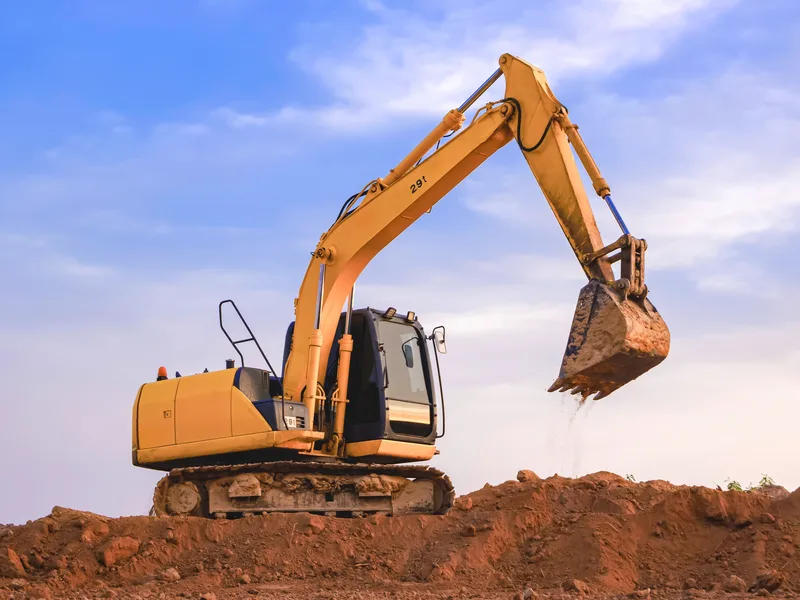
The strike remains the largest single exposure and behaves the way it does in every state — a machine that survives, a facility owner’s restoration bill, service lost to whoever was downstream, and a site that stops until it is safe. New Mexico’s contribution is that the marks guiding the crew degrade while the job is still open, so the risk is not only what was never located but what was located and is no longer legible. Around that, the environment. Caliche turns planned digging into breaking, which loads the arm, the pins and the undercarriage cumulatively rather than dramatically. Dry alluvium and sand give trench walls very little to hold on to. Arroyo systems can carry water from a storm nobody on site saw, which is a hazard to an open excavation and to anything parked in a channel. And on the dispersed jobs the state is full of, a machine left between rotations is a long way from anyone who might notice something wrong with it.
Common New Mexico excavator claims we see
- Strike where the marks had faded. The distinctly local version of this loss — the locate was right when it was made and unreadable by the time the trench arrived.
- Consequential loss on a high-consequence line. Restoration and interruption on facilities serving a field, a community or a corridor, well past the value of the machine.
- Wall failure in dry, cohesionless ground. Sand and alluvium that stand briefly and then do not, taking shoring and spoil with them.
- Flash-flow damage to an open cut or parked machine. Water arriving through a dry channel from weather that never crossed the site.
- Hammer and abrasion wear surfacing as failure. Caliche and rock breaking, plus fine blowing grit, working steadily on pins, seals and the undercarriage.
Why New Mexico excavator owners choose Equipment Guard Insurance
A placement built without asking about the work is a placement built on assumptions, and on this class the assumptions are usually wrong in the same direction: too much attention on the value of the iron, not enough on what happens downstream of a cut. Writing equipment monoline lets the conversation start where it should — what you dig, how far out, how often beside live facilities, and how your locate discipline holds up on a job that runs for months. The machine and the underground exposure then go to markets, named on our homepage, that will underwrite excavation on its merits. Since your classification is already part of how owners read you here, the rest of the file should match that standard.
Major New Mexico excavator markets
- Albuquerque. The state’s heaviest utility congestion and its steadiest replacement workload, with genuine urban constraint on staging and swing.
- Rio Rancho. Sustained residential and commercial expansion on mesa ground, where caliche turns a lot of planned digging into breaking.
- Santa Fe. Institutional, government and historic-district work with tight sites and older service networks under narrow streets.
- Las Cruces. Border-corridor growth and irrigated valley ground, where the water table and agricultural infrastructure both shape the dig.
- Farmington. Northern basin energy-support work, with dispersed sites, lease roads and buried facilities that are industrial rather than municipal.
- Hobbs. South-eastern oilfield country, long hauls between jobs, and the highest concentration of high-consequence lines in the state.
Related
- Excavator insurance — the machine physics that hold in every state.
- Backhoe insurance in New Mexico — the machine whose classification question is about the highway rather than the hole.
- All equipment insurance in New Mexico — the state hub.
- Equipment floater · Rented & leased equipment
Primary sources
- Construction Industries - NM Regulation and Licensing Department — New Mexico Regulation and Licensing Department (RLD), Construction Industries Division (CID) (contractor licensing)
We do not link a New Mexico dig-notice section here. The notice duty described above follows New Mexico’s own one-call statute as our data layer records it; where the state publishes a document that states it directly, this page links it.
New Mexico excavator insurance FAQs
What is the reaffirmation duty, and why does this state have one?
Because a mark is a physical object with a short life. On work that continues past the initial request, the excavator has to go back and ask for the line locations to be reaffirmed on a repeating cycle of working days rather than relying on what was put down at the start. Anywhere with wind, blowing sand, intense sun and unpaved working surfaces, paint fades and flags migrate or vanish, so a locate that was accurate at mobilization can be unreadable long before the trench reaches it. The cycle exists because the record on the ground decays.
How much notice does the work need before it starts?
Advance notice runs a couple of working days ahead, given by telephone to the notification system, and it is the beginning of an obligation rather than the whole of it. Crews who treat the call as a box to tick at mobilization miss the shape of the requirement here: the initial notice buys you a starting position, and staying legal on a job that runs means going back for reaffirmation as the work continues.
Do you link the statute on this page?
No, deliberately. The reference we hold for this rule points to the final version of a bill from a legislative session a quarter of a century ago, not to the section as it currently stands. Enacted legislation of that age is good evidence of what was passed and poor evidence of what the law says today, so linking it would dress up a stale document as a current citation. The rule is described here from our own verified lens data instead, and no source is named until we have a current one we have actually opened.
Does New Mexico license the contractor running the excavator?
Yes, and the classification matters more than the fact of the license. The Construction Industries Division issues contractor licenses under classifications — GB-98 general building, GA general engineering, a residential class and a range of specialty categories — so the question an owner asks is not only whether you are licensed but whether your classification covers the work in front of you. That makes your licensing record and your certificates a matched pair, and it is worth knowing that both are being read.
What does the ground itself do to an excavation here?
It alternates between too hard and too loose, sometimes on one site. Caliche can be dense enough to need breaking where the plans assumed digging, which puts hammer shock through the arm and undercarriage; blown sand and dry alluvium give trench walls almost no cohesion. Arroyos add a scheduling hazard rather than a soil one — a storm miles upstream can put water through a dry channel with very little warning, which is a problem for an open cut and for a machine parked in the wrong place.
Can you write the excavator on its own?
Yes. Equipment Guard Insurance places equipment monoline in New Mexico, so the machine and its attachments sit on their own schedule and the underground exposure is handled beside them — without moving the liability or comp you already have.