
New York arranges its authority over earthmoving the opposite way round from most states. The permit that follows a disturbed acre is a single statewide document, uniform from the ocean to the north country. The permission to be the company doing the disturbing is entirely local, and downstate it is the harder of the two to obtain.
That arrangement, and what it means when a control fails on a site with neighbors on three sides, is what this page is for. It also covers what the state’s very different ground does to a machine that pushes for a living. Blade physics, undercarriage life and slope limits do not vary by jurisdiction and live on the dozer insurance pillar.
What dozer insurance costs in New York
No figure is published here, and on a New York schedule that restraint is warranted: this is a state where two contractors with the same machine list can face genuinely different risk. What matters is where the iron works — a constrained downstate lot and an upstate corridor job are not one exposure — how the machine is moved and how often, whether it is left on site overnight in a dense area, the age, hours and undercarriage condition of the unit, the valuation basis you want, and your record. Transport alone can be the largest single variable in the file.
New York dozer regulations: stormwater and land disturbance
New York administers the national discharge program under its own state system, and the construction instrument is SPDES General Permit for Stormwater Discharges from Construction Activity, GP-0-25-001, held by New York State Department of Environmental Conservation (NYSDEC), reaching a land disturbance of one acre or more.
Two features of that are worth pulling out. The first is that a single statewide permit has to answer for wildly different sites, so the plan behind it carries all the weight — a template that worked on a flat upstate corridor is not a plan for a lot with a storm inlet at its boundary, and the state is entitled to expect that the document describes the actual site. The second is the divided authority. Because contractor licensing is municipal here, the body that decides whether you may work is not the body that decides what your ground may release, and neither will tell you about the other’s expectations. Where insurance fits is unchanged by any of it, and it is the point most worth taking away. A penalty from either level is a regulatory cost and no equipment policy responds to it. What becomes a claim is the physical consequence: material that leaves your control and reaches a neighboring property, a public roadway, a storm system that has to be cleaned out, or a watercourse. That is third-party damage arising out of your work — liability and pollution wordings, not the equipment schedule — and on a crowded site it is very hard for the machine itself to be the larger number. We state the permit from New York’s own verified record and link no document for it; the note below is there rather than a citation this page cannot stand behind.
Common dozer risks in New York
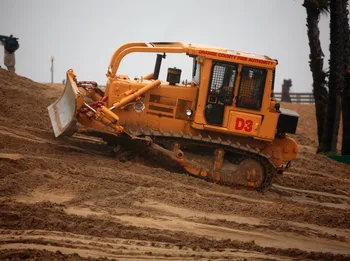
The machine’s own exposure divides by geography as cleanly as everything else here. Downstate the dominant risks are transport, confined-site contact damage, and theft or vandalism where iron sits overnight in a place people can reach; the work itself is often demolition-adjacent grading on ground that has already been built on twice. Upstate the machine meets boulder-laden till that hammers the undercarriage and the blade, freeze that shortens the season at both ends, and slopes and wooded sites where overturn risk is terrain-driven. The land-disturbance exposure sits over both, and it is the one that does not need anything to go wrong before it exists.
Common New York dozer claims we see
- Sediment into a storm inlet at the edge of a dense site. Traceable, quickly noticed, and a third-party question rather than a floater one.
- Transport damage on a constrained approach. The scheduled move into or out of a downstate site is regularly the least forgiving hour of the whole job.
- Contact damage on a boxed-in lot. A blade and a structure sharing a boundary line, with no room to reposition.
- Undercarriage and blade damage in boulder till. Upstate ground breaks components rather than wearing them evenly, and wear claims fail where damage claims succeed.
- Theft or vandalism from an unattended urban site. Attachments and components disappear more often than whole machines do.
Why New York dozer owners choose Equipment Guard Insurance
A New York contractor is usually already carrying liability, workers compensation and whatever the local licensing body requires, assembled over years and not lightly disturbed. Asking an owner to reopen all of that so one machine can be valued properly is a bad trade, so we do not — equipment monoline means the dozer is scheduled on its own, at a number we can defend, and everything else stays where it is. We will also tell you plainly which part of the land-disturbance exposure the floater does not touch, which is not a conversation everyone volunteers. The markets behind the placement — named on our homepage — read heavy civil work as its own class.
Major New York dozer markets
- New York City. The densest earthmoving in the country and a licensing regime of its own, where the move onto site is planned as carefully as the work.
- Yonkers. Steep river-slope redevelopment on old industrial ground, with neighbors above and below the work at the same time.
- Buffalo. Lake-plain industrial and infill development on heavy clay, with a drainage picture that runs straight to the lake.
- Rochester. Commercial, campus and corridor work on till and lake sediment, with real freeze-season compression on the calendar.
- Syracuse. Central-corridor logistics and highway work, where large footprints stay open across long stretches of the year.
- Albany. State institutional and capital-district commercial work, with the permitting department headquartered in the same city.
Related
- Dozer insurance — the machine physics that hold in every state.
- Skid steer insurance in New York — the compact machine that finishes what the blade started, and the ownership record standing behind it.
- All equipment insurance in New York — the state hub.
- Equipment floater · Rented & leased equipment
Primary sources
- Statewide SPDES General Permit for Stormwater Discharges from Construction Activity, Permit No. GP-0-25-001 (NYSDEC Environmental Notice Bulletin) — New York State Department of Environmental Conservation (NYSDEC) (stormwater and land disturbance)
- CONSUMER ALERT: NYS Department of State's Division of Consumer Protection Provides New Yorkers with Tips for Avoiding Home Improvement Scams — No statewide licensing agency — the New York Department of State does not license contractors; licensing is by local jurisdiction (e.g., NYC Department of Consumer and Worker Protection and various counties). (contractor licensing)
New York dozer insurance FAQs
What permit attaches to a New York dozer job?
SPDES General Permit for Stormwater Discharges from Construction Activity, GP-0-25-001, administered by New York State Department of Environmental Conservation (NYSDEC), over a land disturbance of one acre or more. It is one instrument covering the whole state, which sounds simpler than it is: the same document has to work on outwash sand, on lake-plain clay, on glacial till and on a Manhattan-adjacent lot with no soil left to speak of, so what satisfies it varies enormously by where you are standing.
Who actually licenses me to do the work?
Not the state, which surprises contractors arriving from elsewhere. New York has no statewide general-contractor license — that authority is municipal, and in New York City it is a substantial regime in its own right. So the state holds the permit that governs what leaves your site, while a city or county decides whether your company may be on the site at all. Two separate approvals, neither of which substitutes for the other, and the more demanding one is usually local.
Downstate my site is surrounded. Does that change the exposure?
It compresses it. On a dense site the receiving water is not a creek on the far side of a field; it is a storm inlet at the edge of the work, connected to a system with a known outfall and an owner who can be identified quickly. The distance between a control failure and a third party is measured in feet, the evidence is on camera somewhere, and the complaint arrives the same week rather than the following season. Tight sites also leave nowhere to stage spoil, which is its own control problem.
And upstate?
The opposite geometry with a sharper point on it. Ground opened west of the Hudson can sit inside a watershed that supplies drinking water to the city downstate, and elsewhere the drainage runs to the Finger Lakes, to Lake Ontario or Erie, or down the Hudson itself. The consequence of losing material is not that somebody notices it at the fence line; it is that the receiving water is one a great many people care about, and the scrutiny reflects that.
If we are penalized, does the policy pay?
It does not. A penalty is enforcement against the company and it has never been an equipment-policy exposure. What can become a claim is the damage itself — silt into a neighboring basement excavation, across a public road, into a storm system that then has to be cleaned, or into a stream that somebody has standing to protect. That is third-party property damage arising from your work, answered by liability and pollution wordings. The equipment floater deals with the machine and stops there.
What does New York put a dozer through?
Glacial till packed with boulders through much of the state, which loads a blade and works an undercarriage hard; sand on Long Island that moves easily and holds nothing; and clay in the lake plain that turns greasy in spring. Transport is the other half of the story and is worse here than almost anywhere: getting a tracked machine into a constrained downstate site is a planned operation with escorts, timing constraints and no margin, and the move is frequently the riskiest hour of the job.