
Ask a North Carolina grading contractor what its hardest week looks like and the answer is rarely about the machine. It is about a forecast, an open slope and a deadline that will not move — three things that only become a problem together, and that a dozer arranges into position by doing its job well.
This page is about the state around that machine: the two regulatory instruments pointed at the same disturbed acre, the office that administers them, and the way soil changes character three times between the coast and the mountains. The physics of blade capacity, slope work and undercarriage life stay constant and live on the dozer insurance pillar.
What dozer insurance costs in North Carolina
There is no published rate on this class, and anyone who offers one from a web page is guessing with a decimal point attached. The North Carolina variables that genuinely matter are the region you work and therefore the soil you fight, how much area you keep open at once and what sits downhill of it, the machine’s age, hours and undercarriage condition, whether it travels the state or stays inside a county, and your own claims record. Two owners with the same model on the schedule can sit a long way apart if one is stripping flat sand and the other is cutting benches above a trout stream.
North Carolina dozer regulations: stormwater and land disturbance
North Carolina runs the construction discharge program itself. The instrument is NPDES Construction General Permit NCG010000, administered by the state environmental department’s land-resources division, and it reaches a disturbance of one acre or more (or part of a common plan of development of that size).
What makes this state distinctive is not the threshold, which is federal in origin and familiar everywhere, but the fact that the permit does not stand alone: it is coupled to North Carolina’s own sedimentation statute, so erosion and sediment control here is a state subject with its own standing rather than a clause inside a discharge filing. Two practical things follow. First, the expectations around what you install and maintain on an open site are treated as primary obligations, and an inspector arrives with that framing rather than a discharge-monitoring one. Second — and this is the part that decides money rather than paperwork — none of it is an insurance question until material moves. A penalty assessed against your company for a control that failed or was never installed is a regulatory cost you carry yourself. The insurable event is what the sediment then does: reaching a neighboring property, coating a public road, or entering a stream that somebody else has standing to protect. That is third-party damage arising out of your work, it sits in liability and pollution coverage rather than in the equipment floater, and on a dozer it routinely dwarfs the value of the machine that produced it. The permit does not create the risk; it marks the line where the risk starts.
Common dozer risks in North Carolina
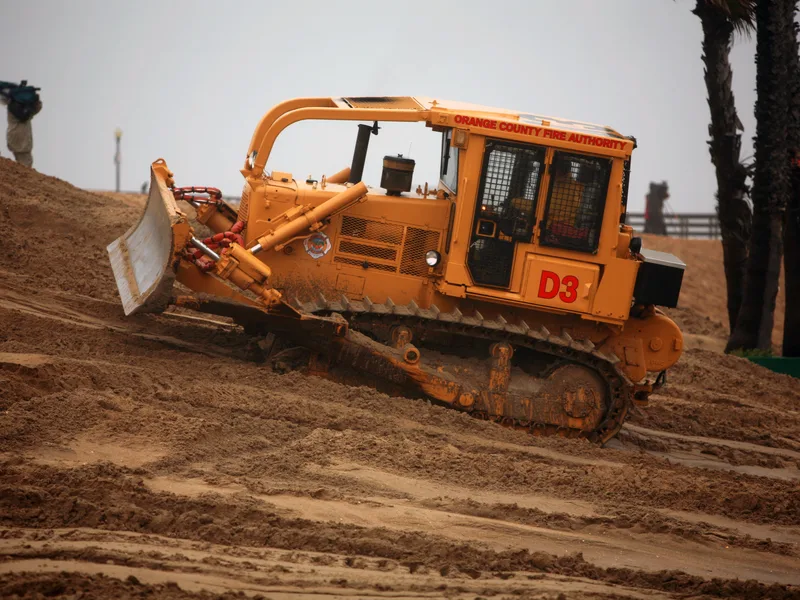
The machine’s own losses here track the geology. Piedmont clay is the undercarriage’s enemy — heavy, adhesive, and brutal on rails and sprockets once it packs — while coastal sand is abrasive in a different register and finds its way into every seal it can reach. Grade is the mountain problem: benching on steep ground where an edge can give way is the ordinary condition of a Western North Carolina job, not the unusual one. Transport damage is constant statewide because a tracked machine never drives itself anywhere worth going. And behind all of it sits the exposure created by the work itself, in a state that gets its rain in intense, convective bursts and, more than once a generation, in tropical quantities.
Common North Carolina dozer claims we see
- Sediment reaching a stream or an adjoining lot after a convective storm. The defining North Carolina claim on this class, and it is answered outside the floater.
- Slope or bench failure under the machine on mountain grade. Terrain-driven, and generally on ground that had already been crossed that day.
- Undercarriage packed and worn by piedmont clay. Frequently presented as sudden damage, and much better separated from a covered peril in advance.
- Loading and tie-down damage on a narrow rural approach. Getting the machine to the job is often the riskiest twenty minutes of the day.
- Mud carried onto a public road from a site access. Small, routine, and squarely a third-party matter rather than a repair to the iron.
Why North Carolina dozer owners choose Equipment Guard Insurance
The reason to place this machine deliberately is that its two halves are not underwritten in the same place, and only one of them is on the equipment schedule. We write equipment on its own, so a North Carolina owner can get valuation, hours and serial detail right without reopening the liability and work comp already in force, and we say out loud which exposure the floater does not reach rather than letting a clean schedule imply otherwise. We place through markets — named on our homepage — that will read a grading contractor on its own record instead of on a class code.
Major North Carolina dozer markets
- Charlotte. The heaviest sustained build-out in the state, on red clay slopes where cut-and-fill and erosion control are the same operation.
- Raleigh and Durham. Research, campus and institutional site work across the fall-line transition, where sand and clay show up on one job.
- Greensboro and Winston-Salem. Distribution pads and mill-town redevelopment, with older fill and unrecorded ground under a lot of it.
- Fayetteville. Sandhills work in soil that will not hold a face, so slopes get flattened and material travels on wind as well as water.
- Asheville. Mountain benching where grade, rainfall and a stream at the bottom of the cut all arrive together.
Related
- Dozer insurance — the machine physics that hold in every state.
- Backhoe insurance in North Carolina — the machine that has to answer a road-use question the dozer never faces.
- All equipment insurance in North Carolina — the state hub.
- Equipment floater · Rented & leased equipment
Primary sources
- NPDES Construction Program — North Carolina Department of Environmental Quality (stormwater and land disturbance)
- Chapter 87, Article 1 — General Contractors — North Carolina General Assembly (contractor licensing)
North Carolina dozer insurance FAQs
Why do people here talk about sedimentation and stormwater as separate things?
Because in North Carolina they are separate instruments pointed at the same acre. The state runs the national discharge permit itself, and it couples that permit to its own sedimentation statute — so erosion and sediment control is not merely a condition buried in a federal form, it is a state subject in its own right with its own history. For a contractor the practical reading is simple enough: the ground-control expectations are a first-order obligation here, not an afterthought bolted onto a discharge filing.
What size of job brings the permit into play?
Disturbance at or above the statutory acreage, and — importantly — a smaller area that forms part of a common plan of development reaching that size. The second limb is what surprises people. A crew shaping one lot can be inside the requirement because of the eleven lots either side of it, and the machine most likely to put you across that line is the one whose entire purpose is opening ground.
Who administers it, and what else does that office touch?
The state environmental department, through its division covering energy, mineral and land resources. The name is worth reading, because it tells you the office looking at your erosion controls is the same one whose remit runs across land-quality matters generally rather than a stormwater desk in isolation. Correspondence, inspections and enforcement all stay inside the state rather than routing to a federal region office.
Does the license I hold as a contractor interact with any of this?
Only indirectly, but it is worth knowing they are different systems. North Carolina ties general-contractor licensing to a defined project-cost threshold with three financial tiers, so the credential speaks to the scale of work you may undertake. Nothing in it discharges the land-disturbance duty, and no underwriter treats it as evidence about erosion control. The two documents answer to different bodies and are read separately.
How much does the soil really change from one side of the state to the other?
Enough that the same operator changes technique. Sandhills and coastal-plain sand will not hold a face and drains fast, so slopes want flattening and material moves in wind as readily as water. Piedmont clay holds a cut beautifully and then turns slick and unworkable for days after rain, loading the undercarriage on every pass. Mountain work near Asheville adds grade and rainfall together, which is the combination that puts the machine and the exposed ground at risk in the same afternoon.
If the ground is the bigger risk, why insure the machine carefully at all?
Because the two are underwritten by the same conversation and one of them is easy to get right. Equipment Guard Insurance writes equipment monoline, so a North Carolina owner can put honest hours, an honest valuation basis and an accurate serial list on a schedule without touching anything else. Doing that well is also what buys the credibility to be taken seriously on the harder half — where the earth goes after the blade has finished.