
Two facts govern a dozer in North Dakota, and neither is about the machine. The first is the freeze: for a large part of the year the ground will not accept work, will not hold seed and will not be stabilized, so an entire season of earthwork is squeezed into what is left. The second is distance — the nearest mechanic, low-bed or replacement part can be a very long drive from where the blade actually is.
This page is about how those two facts interact with the state land-disturbance rules, and about which of the resulting exposures an insurance policy is capable of answering. For blade and ripper behavior, undercarriage economics and transport, which are the same in every state, the dozer insurance pillar has that.
What dozer insurance costs in North Dakota
We will not print a premium here, and on this class the machine is only one input among several. What moves a North Dakota figure is size, age and running-gear condition; how much ground is open at once and for how long it stays open across a freeze; whether the work is municipal grading, road building, farm and drainage earthwork or oilfield pad and reclamation; how far the iron travels and whether it returns to a yard at all; and the loss record behind it. A crew working two counties out of one yard and a crew living on location for weeks at a time are not comparable, whatever the equipment list looks like.
North Dakota dozer regulations: stormwater and land disturbance
North Dakota administers the national discharge permit program itself. The state environmental quality department issues NDPDES Construction Stormwater General Permit NDR11-0000 through its water quality division, and the requirement reaches a land disturbance of one acre or more.
What that means in practice here has more to do with the calendar and the map than with paperwork. A delegated program keeps the correspondence in state, which is worth something on multi-site work, but the obligation it imposes — keep disturbed ground under control until it is stabilized — collides with a climate that removes the ability to stabilize for months at a stretch. Ground left bare in late fall is ground you have committed to carrying through the melt, and that is a decision made during the season rather than after it. On top of that, this is one of the few states where the wind moves as much loose material as the water does, and a deposit that arrived on a neighbor’s field dry is no less a deposit. Where insurance enters is unchanged by any of it: a citation is regulatory and stays with the contractor, while material that leaves the disturbance and reaches a road, a ditch, a field or a watercourse is damage to someone else arising out of the work — liability and pollution territory, not the equipment schedule. On a machine whose own repair bill is modest by comparison, that is the exposure worth structuring the account around.
Common dozer risks in North Dakota
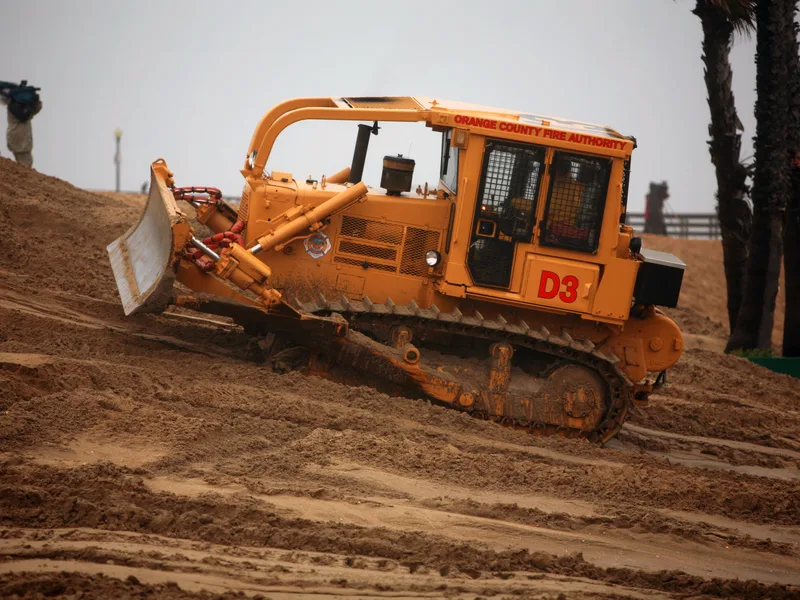
The machine’s own risks are shaped by remoteness more than by the work. Cold starts, hydraulic and seal failures in extreme temperature swings, and fire on a machine working dry stubble and prairie material all appear in the loss runs. Overturn is a spoil-edge and ditch-bank event rather than a mountain one. What makes each of them worse is that recovery, repair and replacement are all slow at this distance: an incident that would cost a day near a metro area can cost a week out west. Around all of it sits the land-disturbance exposure, which no maintenance program touches, because it is created by successfully doing the job rather than by anything breaking.
Common North Dakota dozer claims we see
- Runoff from unstabilized ground at spring melt. The signature failure in this climate, and a third-party question rather than an equipment one.
- Wind-borne material off a large open pad. The exposure contractors from wetter states do not expect to have.
- Machine fire in dry prairie material. Debris against hot components, on a site with no water and no help nearby.
- Overturn on a ditch bank or spoil edge. Usually on ground the operator had already crossed safely the same day.
- Transport and recovery damage over long hauls. Loading, tie-down and the recovery itself, all done far from anyone who does it for a living.
Why North Dakota dozer owners choose Equipment Guard Insurance
Most equipment submissions for this state are priced as if the machine were parked in a city. We would rather ask the questions the geography actually raises — where the iron sleeps, how far help is, how much ground you expect to still have open when the freeze comes — and then place the schedule accordingly. Writing equipment monoline means the dozer can be handled on its own without unpicking a program built around your North Dakota work, and the markets we use are named on our homepage.
Major North Dakota dozer markets
- Fargo and West Fargo. The fastest continuous commercial and residential growth in the state, on flat valley ground where spring water is a design condition rather than an event.
- Grand Forks. Institutional, airport and flood-protection earthwork, on sites where the drainage question is examined more closely than anywhere else.
- Bismarck. Public and capital works with river-adjacent grading, and the practical center of the state for machine logistics.
- Minot. Municipal and flood-control construction where large volumes of material move within the built-up area itself.
- Williston. Oilfield pad building, access roads and reclamation, at the far end of every supply line in the state.
- Dickinson. The southern half of the same energy work, plus the aggregate and road building that supports it.
Related
- Dozer insurance — the machine physics that hold in every state.
- Skid Steer insurance in North Dakota — the small machine that finishes behind the blade, and the one that actually disappears off a remote location.
- All equipment insurance in North Dakota — the state hub.
- Equipment floater · Rented & leased equipment
Primary sources
- NDPDES Construction Stormwater General Permit NDR11-0000 (North Dakota DEQ, Division of Water Quality) — North Dakota Department of Environmental Quality, Division of Water Quality (stormwater and land disturbance)
- Contractors — North Dakota Secretary of State (contractor licensing)
North Dakota dozer insurance FAQs
Who issues the construction stormwater permit in North Dakota?
The state does. North Dakota took delegation of the national discharge program, and the state environmental quality department administers NDPDES Construction Stormwater General Permit NDR11-0000 through its water quality division. That keeps the authorization, the notices and the inspections inside the state system rather than routing them through a federal region office, which matters most on the kind of multi-site work that would otherwise need two sets of correspondence.
How does frost change land-disturbance risk here?
It moves the risk out of the working season and into the shoulder. Ground that is frozen cannot be seeded or effectively stabilized, and material left bare when the freeze arrives simply waits. Then the melt runs off subsoil that is still frozen and absorbs nothing, so a spring thaw moves material off a site with a force that the same volume of summer rain would not. The failure is decided in October and discovered in April.
Is wind actually a compliance problem, or just a nuisance?
It is a genuine one on open prairie sites. Dry, exposed fine material on a large graded pad does not need water to leave the property — a sustained wind will take it across a section road or onto a neighboring field, and the fact that it traveled dry does not make the deposit somebody else’s problem. Dust and material control on large open pads is one of the few places where earthmoving in this state differs plainly from earthmoving anywhere wetter.
What does working the oil counties do to an equipment schedule?
It stretches every assumption about support. Pad building, access roads and reclamation work put machines a long way from a dealer, a mechanic or a low-bed, so downtime is measured in days rather than hours and a recovery is a project of its own. It also means machines stay out on location instead of returning to a yard, which changes both the theft conversation and the question of who is actually watching the iron overnight.
Does a stormwater penalty go on my insurance?
No. A penalty is an administrative consequence between the contractor and the regulator, and no equipment or liability form was built to reimburse it. What insurance answers is physical damage to someone else — material off your disturbance into a section-line road, a drainage ditch, a neighboring field or a watercourse. That is third-party damage arising out of the work, and it is a liability and pollution matter rather than anything the equipment schedule reaches.
Will you write the dozer by itself?
Yes. Equipment Guard Insurance places equipment monoline in North Dakota, so a machine can be scheduled on its own without moving the rest of your program. On accounts working this far out we would rather spend the conversation on where the iron sits overnight and how far help is than on bundling.