
An Ohio dozer can work three different states without leaving one. A season of stripping farmland for large flat pads, a stretch of pulling apart what an earlier industry left standing, and a run of drainage and corridor work out in the counties — three trades, one machine, one permit.
This page is about the state rather than the iron: which agency holds the permit, what pulls a job under it, how differently the same obligation lands across those three economies, and where the exposure sits once the ground has been re-shaped. Blade capacity, track life and slope technique are constants and live on the dozer insurance pillar.
What dozer insurance costs in Ohio
We do not publish a number for this class, and on a dozer the reason is that the machine is not the main term in the equation. What genuinely moves an Ohio figure is which of the three markets you work, how much surface you keep open at once and what sits below it, whether the ground is farmland or a redevelopment parcel with an undocumented history, the machine’s hours and undercarriage condition, how it overwinters, and your own record. An owner stripping a section of level farmland and an owner cutting into an old industrial site are asking an underwriter two different questions.
Ohio dozer regulations: stormwater and land disturbance
Ohio holds delegation and runs the program itself. The instrument is OHC000006 — NPDES Statewide Construction Stormwater General Permit, issued by Ohio Environmental Protection Agency, and it applies to a land disturbance of one acre or more.
One permit covering three economies produces three quite different practical experiences of the same rule. On a greenfield pad the issue is scale: very large flat areas open at one time, with topsoil stripped off ground that used to be farmed and drained, and nothing much between the site and the tile network it inherited. On a redevelopment parcel the issue is what the material is — fill, slag, rubble and made ground whose behavior in water is not the behavior of soil. On rural drainage and corridor work the issue is proximity, because the whole point of the job is that a ditch or a watercourse is right there. What does not change across any of them is where insurance attaches, and it is worth stating without hedging: a penalty for control measures that were missing, inadequate or unmaintained is a regulatory cost your business absorbs, and no equipment policy was ever intended to pay it. The claim arrives at the next step, when sediment leaves your acreage and reaches a neighboring property, a public road or a watercourse. That is third-party damage arising out of your work, it is answered by liability and pollution coverage rather than by the floater, and on this machine it is the exposure with the clearest capacity to exceed what the iron is worth. The permit is not the risk — it is the state marking where the risk starts.
Common dozer risks in Ohio
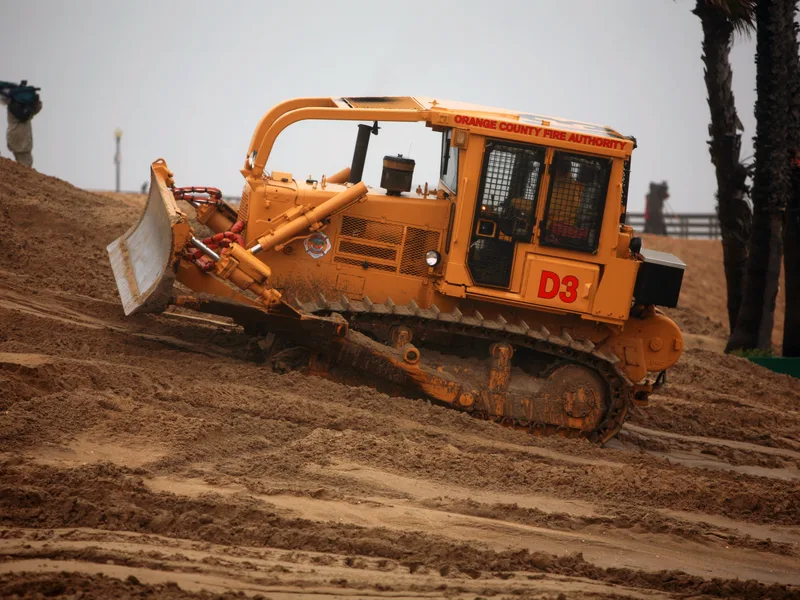
The machine’s own losses split along the same three lines. Greenfield work is comparatively kind to iron and hard on schedules, so the exposure is volume and hours rather than impact. Redevelopment ground is the opposite: buried concrete, reinforcement, slag and foundations that a blade finds by hitting them, with damage concentrated on the cutting edge, the push-arms and the undercarriage. Rural work adds distance, soft field ground and long unattended periods. Across all three, the winter does its own damage — freeze-thaw undoes the surfaces the machine works on and the controls protecting the site, and salt and persistent moisture shorten the life of everything exposed on a machine that lives outdoors.
Common Ohio dozer claims we see
- Sediment off a large open pad into an inherited field drainage network. The characteristic central-Ohio loss, and it is answered outside the equipment policy.
- Blade and undercarriage impact damage in redevelopment fill. Buried structure that nobody recorded, found the hard way.
- Ground giving way under the machine on made or filled land. The surface and the bearing are two different things on an old industrial parcel.
- Spring release from a site left open over winter. Freeze-thaw wrecks controls quietly, and the bill arrives with the melt.
- Theft or vandalism on a rural site left unattended between phases. Distance and time, rather than the lock, are the real controls that failed.
Why Ohio dozer owners choose Equipment Guard Insurance
Ohio gives an underwriter no statewide credential to look up for this trade, so the equipment schedule is the document doing the talking — and it deserves to be built deliberately rather than carried over. Writing equipment on its own lets us set the valuation basis honestly on machines that age fast in this climate, record hours and serial detail properly, and leave the liability and work comp already arranged around your operations exactly where they are. It also leaves room to say clearly which half of the risk the floater does not reach. We place through markets — named on our homepage — that will read an Ohio earthmoving account on its own record.
Major Ohio dozer markets
- Columbus. The state’s greenfield engine — very large pads stripped out of former farmland, with more surface open at one time than anywhere else in Ohio.
- Cleveland. Industrial redevelopment on made ground, short drainage runs, and a lake at the end of most of them.
- Toledo. Flat, poorly drained ground near the water where the field tile network is the drainage system and reaches open water quickly.
- Akron. Steeper terrain and utility reconstruction, where grade turns a modest open area into a fast one.
- Dayton. Institutional and corridor work on river-valley ground, with floodplain constraints shaping how much can be opened at once.
Related
- Dozer insurance — the machine physics that hold in every state.
- Excavator insurance in Ohio — the machine that has to ask what is under an Ohio site before the blade decides what the top of it looks like.
- All equipment insurance in Ohio — the state hub.
- Equipment floater · Rented & leased equipment
Primary sources
- Stormwater Discharges from Small and Large Construction Activities - … — Ohio Environmental Protection Agency (stormwater and land disturbance)
- Section 4740.01 - Ohio Revised Code | Ohio Laws (Construction industry licensing board definitions) — No statewide general contractor license; the Ohio Construction Industry Licensing Board (OCILB), within the Ohio Department of Commerce, licenses five commercial trades (contractor licensing)
Ohio dozer insurance FAQs
What governs a disturbed acre in Ohio, and who runs it?
A statewide construction stormwater general permit issued by the state environmental protection agency, which holds delegation for the national program. Disturbance at or above the statutory acreage brings a site under it, and a smaller area still counts when it forms part of a larger common plan of development. Nothing about the ordinary construction case routes to a federal office — the authorization, the inspection and any enforcement are all in state.
Why do people describe Ohio earthmoving as three different businesses?
Because a machine here can spend the year in three genuinely unrelated markets. Central Ohio is building large flat pads on farmland at a pace that makes it a greenfield mass-grading market. The northern industrial belt is doing the opposite work — taking apart what a previous century built and dealing with whatever is under it. And across the rural east and northwest there is drainage, aggregate and utility corridor work that has run steadily for decades. The permit does not care which one you are in. Your risk profile very much does.
Does it matter which way my site drains?
It affects who is watching more than what the rule says. A divide runs across the state: sites north of it send runoff toward the lake, sites south of it into the river valley, and both destinations have long-standing water-quality constituencies. The obligation on your acre is the same either way. What changes is how much attention a receiving water is already under before your site contributes anything to it.
Ohio has no general-contractor license. Does that touch this at all?
The two systems are unrelated, but the gap has a practical effect on your insurance. The state licenses a short list of commercial trades and leaves general contracting to cities and counties, so an earthmoving outfit here often has no statewide credential an underwriter can look up. That pushes the burden onto the documents you produce yourself — the equipment schedule, the maintenance record, the loss history — which are the things a submission lives or dies on anyway.
Does the equipment policy respond to a stormwater enforcement action?
No, and the distinction is worth holding onto because it decides which policy you need. A penalty for absent or failed control measures is a regulatory cost carried by the business. The insurable event is what happens physically afterward — sediment reaching a neighboring parcel, a public road or a watercourse is damage to somebody else arising out of your work, and it belongs to liability and pollution coverage. The floater repairs the machine and does nothing else.
Can you schedule the dozer without touching everything else?
Yes. Equipment Guard Insurance writes equipment monoline in Ohio, so the machine goes on its own schedule at a value you can stand behind, and the rest of your program stays where it is. On this class we will always spend some of the conversation on the boundary above, because a well-built schedule can quietly give an owner the impression that the whole exposure has been handled when only half of it has.