

A locate ticket is usually described as permission. In Ohio it is better understood as a dated instrument with a shelf life and a paper trail attached — and the contractors who lose money on this machine are almost always the ones who treated it as the first thing rather than the second.
This page works through the Ohio version: how far ahead the ticket can be pulled and when it stops counting, what the response system records and why that record matters later, what none of it transfers to the utility, and how differently the same machine behaves on glaciated ground and on the plateau. For the machine physics that hold anywhere — reach and swing, undercarriage, attachment work — see the excavator insurance pillar.
What excavator insurance costs in Ohio
You will not find a rate on this page, because the rate is mostly a statement about your work rather than your machine. What moves an Ohio excavator placement: trench depth, how much of the year is spent inside a live utility envelope, whether you take street and main work or stay on building pads, how much rock and legacy ground is in the mix, and then unit size and age, attachments carried on the schedule, where the machine sits between jobs, and your record. A firm opening street beside occupied buildings and a firm shaping detention basins on a greenfield pad are quoted from different questions, and any number offered before those questions is decoration.
Ohio excavator regulations: dig notice and the one-call duty
Notice must be given not more than sixteen calendar days before excavation; utilities must locate and mark within two working days and report to the positive-response system.
The duty is set out in section 3781.28 of the Revised Code, and the two numbers in it pull in opposite directions. On the front end a crew needs only two working days, which is quick. On the back end the ticket may be placed as much as sixteen calendar days before the dig — long enough that a phased contract can be sequenced properly, and long enough that a careless job runs off the end of its own ticket while the marks are still faintly visible. Between those, the operators owe you a locate and a mark within two working days plus a status posted into the positive-response system, which produces something most states do not: a timestamped record of who answered and what they said. Keep it. What none of it does is shift the risk. The notice compels marking of registered facilities and nothing else — no depth warranty, no reach into abandoned or private plant, and no protection for excavation carried out carelessly beside a correct mark. Everything in that gap remains the contractor’s, and it is written as its own exposure for exactly that reason.
Common excavator risks in Ohio
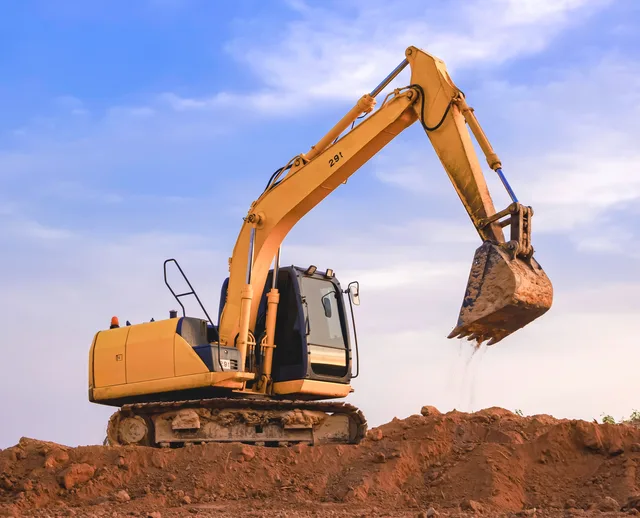
The strike leads and its economics are lopsided: the machine is frequently undamaged while the third-party file grows for a year. Ohio then supplies two distinct backdrops. In the industrial north and the older central wards, the danger is accumulated history — generations of utility installed, abandoned and rerouted under the same streets, with each era’s recordkeeping as good as that era thought necessary. In the south-east it is geology and extraction: rock work, grade, and a landscape carrying old wells, mine works and pipe that were left in place with paperwork that has not survived. Sitting under both are the machine’s ordinary failure modes — the slide at a trench edge or on a bank, the counterweight finding a structure behind the operator, and the loading damage that accumulates on short moves.
Common Ohio excavator claims we see
- Strike on an expired or superseded ticket. The distinctly Ohio version — the marks were real once, and the calendar had quietly overtaken them.
- Abandoned or forgotten plant encountered in the plateau counties. Nobody owns it, nobody marks it, and the crew that finds it inherits the argument.
- Utility strike with consequential loss. Restoration plus interruption, routinely a multiple of what the excavator itself is worth.
- Trench-edge slide beside an open cut. Undercut wall, spoil stacked too close, or ground that had been holding until the machine tracked across it.
- Swing contact on constrained street work. Counterweight against a parked vehicle, a pole or a building face, in the tight jobs these markets are full of.
Why Ohio excavator owners choose Equipment Guard Insurance
With general contracting regulated town by town rather than by the state, there is no license class doing the vouching for an Ohio excavation firm — the certificates are. That is a good argument for building them on purpose. We place the equipment on its own, treat the below-grade question as a decision with its own answer instead of a footnote, and go to markets willing to underwrite street-opening and legacy-ground work rather than declining it on sight. Those markets are named on our homepage, and using them costs you nothing on the liability or comp already behind your crews.
Major Ohio excavator markets
- Columbus. The state’s busiest growth market, where continuous infill and campus work runs over utility corridors that keep getting denser.
- Cleveland. Lakefront industrial ground with the longest layered buried history in Ohio, much of it privately installed and privately recorded.
- Toledo. Port, rail and heavy-industry work in flat, wet ground where trench behavior and the buried record are both unforgiving.
- Akron. Older factory corridors under sustained redevelopment, with sewer and main replacement running constantly beneath them.
- Dayton. Institutional, aerospace-adjacent and municipal work on sites where utility density and old drawings meet.
Related
- Excavator insurance — the machine physics that hold in every state.
- Backhoe insurance in Ohio — the machine the state has to exclude from the definition of a motor vehicle before it can legally move itself.
- All equipment insurance in Ohio — the state hub.
- Equipment floater · Rented & leased equipment
Primary sources
- Section 3781.28 - Ohio Revised Code | Ohio Laws — Ohio 811 (dig notice and one-call)
- Section 4740.01 - Ohio Revised Code | Ohio Laws (Construction industry licensing board definitions) — No statewide general contractor license; the Ohio Construction Industry Licensing Board (OCILB), within the Ohio Department of Commerce, licenses five commercial trades (contractor licensing)
Ohio excavator insurance FAQs
How far ahead can I pull a locate ticket in Ohio?
Notice must be given at least two working days ahead and no more than sixteen calendar days before the excavation. That outer figure is generous by national standards and it is the practical planning tool on a phased job — you can stage tickets across a long contract instead of pulling one and hoping. The discipline it demands is arithmetic: sixteen calendar days is not sixteen working days, and a crew still opening ground in week three on a ticket from week one is working unmarked whatever the paint still shows.
What does the positive-response system actually give me?
A record. Utilities are required to locate and mark within two working days and to report their status into the response system, so instead of inferring from paint whether everyone has been out, you can see which operators have answered and what they said. That record is worth more after an incident than during the job. When a strike is investigated, the question is rarely whether a ticket existed; it is what you had been told at the moment the bucket went in, and the response log is the only thing that answers it precisely.
Every response says clear. Can the machine go?
It can go, and the operator should still dig as though it cannot. A clear status means a member utility has no registered facility inside the area you described. It is silent on abandoned plant, on private service beyond a meter, on anything a previous owner installed without telling anyone, and on depth. In older Ohio ground all four of those categories are populated. The response gives you a defensible process; it does not give you an empty trench, and treating the two as the same thing is the most expensive habit on this machine.
Does Ohio license excavation contractors?
Not for general or site work. The state industry licensing board covers five commercial trades — electrical, plumbing, heating and cooling, hydronics and refrigeration — and general contracting is regulated by cities and counties instead, so the requirements move when you cross a jurisdiction line. An excavation firm therefore has no statewide license class to present. The certificate of insurance ends up doing that work, which is a reason to have it built deliberately rather than assembled from whatever renewed last.
How much does the ground change across the state?
Enough to change the claim. The glaciated north and west give you till, sand and gravel over a subsurface that has been dug and redug through a long industrial history. The unglaciated south-east is bedrock and grade, where excavation becomes rock work and where a century and a half of oil, gas and mining activity left wells, works and pipe that were often plugged, abandoned or simply forgotten without a usable record. A firm that works both halves is running two different risk profiles under one policy.
Can you write the excavator on its own?
Yes. Equipment Guard Insurance places equipment monoline throughout Ohio. The machine and its attachments go on their own schedule, the underground exposure is addressed with them, and nothing you already have in force has to move to make it work.