
An erosion control is a bet about weather. In most of the country it is a reasonable bet, because rain arrives at a pace that gives a site time to shed it. Oklahoma does not really work that way — the water comes in concentrated, fast-moving events, and a control that would be generous elsewhere can be asked to handle a month of runoff between lunch and dark.
This page is about what that does to a dozer operation: which permit follows the disturbed acre, why the plan behind it has to be sized for intensity, and what happens when red material ends up somewhere it can be traced from. The machine’s own behavior — blade loading, undercarriage life, how it moves — is the same in every state and belongs to the dozer insurance pillar.
What dozer insurance costs in Oklahoma
We do not print a rate here. What actually moves an Oklahoma number is exposure to severe weather and how you manage it: whether machines can be moved or sheltered when a warning goes out, how much ground you keep open through the spring storm season, whether the work is compact or strung out along a corridor, how far the iron travels and where it sits between jobs, plus hours, undercarriage condition, the valuation basis and your record. A fleet with a written plan for a severe-weather day is a different proposition from one without, and it shows.
Oklahoma dozer regulations: stormwater and land disturbance
Oklahoma runs the national discharge permit program itself. Construction coverage is OPDES General Permit OKR10 for Stormwater Discharges from Construction Activities, held by Oklahoma Department of Environmental Quality (ODEQ), and it attaches to a land disturbance of one acre or more.
The requirement is straightforward; meeting it in this climate is not, and the reason is worth being specific about rather than general. A stormwater plan is a set of assumptions about how much water will arrive and how quickly, and Oklahoma routinely violates the second assumption while staying within the first. Intensity is the variable — sheet flow turns into concentrated flow in minutes, filtration measures load faster than they can pass water, and a temporary basin that was adequate on paper simply overtops. Sequencing so that less ground is bare during the volatile months does more good than any individual measure. Underneath that sits the commercial split, which does not shift no matter how exceptional the storm was. A penalty from the agency is enforcement against your company, and the equipment policy is not the instrument that responds to it. What becomes a claim is the physical damage somebody else suffered: material across a county road or a highway, into a drainage channel, over a neighboring property, into a pond that now has to be dredged. That is third-party damage arising out of your work and it belongs to liability and pollution wordings. In a state where the soil identifies its own source on sight, that conversation tends to start sooner and end less ambiguously than owners expect.
Common dozer risks in Oklahoma
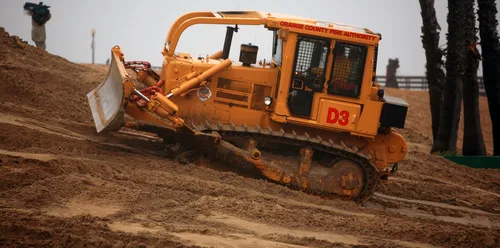
Two risk families overlap here, and they peak in the same season. The first belongs to the ground: bare red soil that moves readily, gullying that develops in a single event, and slopes that were stable until an hour of rain reshaped them. The second belongs to the machine and is unusually severe in this state — hail on glass, lights, panels and cooling packages; wind bringing debris and timber across an open site; lightning on high, exposed ground; and water reaching a machine parked low overnight. Ordinary earthmoving perils sit underneath both: overturn at a spoil edge, fire in dry vegetation, transport damage, and undercarriage wear that is a running cost rather than a loss.
Common Oklahoma dozer claims we see
- Red sediment across a road or into a pond after a squall line. Visible, traceable, and a third-party matter rather than a floater one.
- Hail damage to machines that had nowhere to go. Glass, lamps, panels and cooling packages, usually across several units at once.
- Gullying through a graded slope in a single event. A surface that was correct at the end of the shift and cut through by morning.
- Flood damage to a machine left on a low pad. The overnight parking decision made before anyone was watching the radar.
- Theft from a remote corridor job. Strung-out work with no fence line and long gaps between visits is where components disappear.
Why Oklahoma dozer owners choose Equipment Guard Insurance
Placing a dozer well in Oklahoma means underwriting the weather honestly instead of pretending a schedule of iron is the whole story. We ask what happens to the fleet on a warning day, how much ground you hold open in spring, and whether your serial numbers and values would stand up if a claim had to be proved — which matters in a state where the ownership record is filed centrally and looked at closely. Equipment monoline keeps the machine on its own schedule without reopening the rest of your file, and the markets standing behind that placement — named on our homepage — write earthmoving as its own class rather than as an add-on.
Major Oklahoma dozer markets
- Oklahoma City. Sustained metro build-out with large sites open through the most volatile months of the year.
- Tulsa. Industrial, river-corridor and redevelopment work on ground with more relief than the central plains offer.
- Norman. University-adjacent and residential expansion on red-bed soils, with sites close enough to neighbors for anything that leaves to be noticed.
- Edmond. Continuous phased residential development north of the capital, where the disturbed area is spread over many small parcels of one larger scheme.
- Broken Arrow. Commercial and light industrial growth on the metro edge, with short hauls and repeat clients.
- Lawton. Southwest corridor, institutional and rural work, with long travel between jobs and thin local support for a machine that stops.
Related
- Dozer insurance — the machine physics that hold in every state.
- Excavator insurance in Oklahoma — the notification duty that attaches before ground is opened rather than after it has moved.
- All equipment insurance in Oklahoma — the state hub.
- Equipment floater · Rented & leased equipment
Primary sources
- OKR10 Construction Stormwater — Oklahoma DEQ, Water Permits / Stormwater Permitting — Oklahoma Department of Environmental Quality (ODEQ) (stormwater and land disturbance)
Oklahoma dozer insurance FAQs
What brings an Oklahoma dozer job under the state permit?
Coverage under OPDES General Permit OKR10 for Stormwater Discharges from Construction Activities attaches at a land disturbance of one acre or more, administered by Oklahoma Department of Environmental Quality (ODEQ). The threshold is the easy part. The harder part is that a great deal of Oklahoma earthmoving is linear — corridor work, access roads, pad strings out in the country — and linear work accumulates disturbed acreage in a way that a single glance at any one section of it will not suggest.
Our controls match the plan. Why do they still get overrun?
Because what matters here is the shape of the rainfall rather than the total. Oklahoma collects much of its water from convective storms and squall lines that deliver in an hour what a gentler climate spreads across weeks, and a control designed against an average behaves very differently against a burst. Sheet flow becomes concentrated flow within minutes, a silt fence loads faster than it can filter, and a basin that was adequate on paper simply fills. Sizing for intensity rather than for totals is the difference.
Does the red soil actually matter?
Commercially, more than people expect. Sediment from these Permian red beds is unmistakable — it stains pavement, discolors a pond, and traces a visible line from where it landed back up to where it was loosened. That removes most of the ambiguity that protects contractors elsewhere. A neighbor, a municipality or a highway crew does not need an expert to identify the source, so complaints arrive quickly and with confidence, and the argument you might otherwise have about causation largely does not exist.
Is a penalty from the state something insurance responds to?
It is not, and the two outcomes should be kept apart in your own thinking well before anyone else has to. A penalty is enforcement directed at your company and no equipment policy has ever answered for it. The insurable event is physical: material off your site onto a road, into a drainage channel, across a neighboring property or into a pond, together with the cost of removing it. That is third-party damage arising out of your work, sitting in liability and pollution wordings rather than on the equipment schedule.
What does Oklahoma weather do to the machine itself?
The same storms that overwhelm a control also work on the iron. Hail damages glass, lights, panels and cooling packages on machines that live outdoors and cannot be put anywhere; straight-line wind moves anything not tied down and brings debris and timber across a site; lightning is a real risk on open ground. Flash flooding can reach a machine parked on a low pad overnight. Where the fleet sits when a warning is issued is a question worth having an answer to in advance rather than at two in the morning.
We have no state contractor license. Does that change how you write us?
Not in the way owners expect. Oklahoma leaves general contracting unlicensed at state level and routes equipment lien filings through a single central county office, so the paper trail proving what you own matters more here, not less. Equipment Guard Insurance writes equipment monoline, so the schedule stands on its own with serial numbers and values that actually match the iron — which is exactly the record you want to already have when something is taken or destroyed.