

The hardest part of moving earth in western Oregon is not moving it. It is deciding how much bare ground you are willing to have standing open when the weather turns, because once it does, the ground stays wet for a long time and every exposed face is being worked on by water whether anybody is on site or not.
This page covers the Oregon side of the machine — which agency issues the permit that attaches to a disturbed acre, what the state’s climate and terrain do to a working year, and how the exposure divides between policies once material starts to move. The blade, undercarriage and transport picture that holds anywhere lives on the dozer insurance pillar.
What dozer insurance costs in Oregon
There is no honest published price for this class and no useful one either, because the same machine behaves like two different accounts on opposite sides of the state. What shapes an Oregon figure is which side of the Cascades you actually work, how much area you keep open during the wet months, the machine’s size, hours and undercarriage condition, whether the work is prepared-site grading or clearing on steep forested ground, how far the iron travels and over what kind of access, where it stands when the site is closed, and your loss record. A coast-range clearing crew and a valley-floor pad crew are not the same submission.
Oregon dozer regulations: stormwater and land disturbance
Oregon administers the national discharge program itself. The construction stormwater permit is issued by the state through its environmental quality department’s 1200-series construction stormwater program, not by a federal regional office, and the obligation attaches at a land disturbance of one acre or more (or smaller if part of a common plan disturbing one acre or more).
The threshold, though, is rarely the interesting constraint here — the calendar is. In a climate that delivers steady rain across a long season rather than in isolated storms, an open site is not exposed to an occasional event; it is exposed continuously, for months, and the practical management of a job becomes a question of how little ground you can afford to have bare at any moment. That reality also sharpens the commercial boundary, which deserves stating without euphemism. A penalty over inadequate controls is a regulatory matter and is not what an equipment policy answers. Material that leaves your site and reaches a neighbor’s land, a public road, a ditch or a creek is third-party damage arising out of your work, carried by liability and pollution wording rather than by the floater. And this is a state with an unusual density of running water and an unusual level of public attention on what ends up in it, so the gap between a control failing and somebody else being affected is short. Worth adding: the discharge permit sits alongside, not underneath, the state license an earthmoving firm already holds — two separate obligations from two separate parts of state government, each capable of going wrong on its own.
Common dozer risks in Oregon
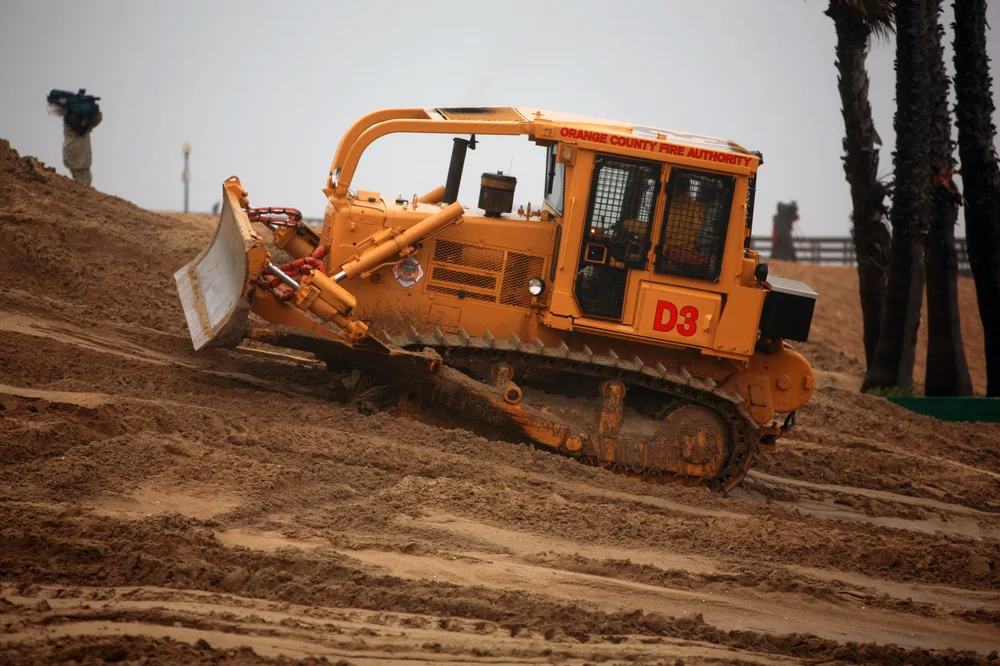
The machine’s own losses divide with the geography. West of the mountains the work is wet, steep and wooded: saturated ground bogs machines, slopes and soft edges drive the overturn exposure, and clearing work puts a blade into stumps and root balls that load the iron unpredictably. East of them the ground is dry, rocky and abrasive, undercarriage life is shorter, frost closes the season hard, and the distances between jobs are long enough to make transport a routine rather than occasional exposure. Fire risk on a machine pushing dry material is a real summer concern statewide. And running through all of it is the land-disturbance exposure, produced by the work itself and worst in exactly the months when the site cannot be finished quickly.
Common Oregon dozer claims we see
- Sediment leaving a site during a prolonged wet spell. The defining third-party exposure here, and it accumulates across weeks rather than arriving in one storm.
- Machine bogged or slid on saturated ground. Recovery costs, and damage caused during the recovery, on slopes that were firm two weeks earlier.
- Blade, push-arm and undercarriage damage in clearing work. Stumps and buried root systems load a machine in ways prepared ground never does.
- Engine-bay fire in dry summer material. Debris against hot surfaces, often on ground where a fire will not stay small.
- Transport damage on long or restricted access. Coast-range and eastern hauls concentrate loss on the ramp, the deck and the approach.
Why Oregon dozer owners choose Equipment Guard Insurance
An earthmoving account here already carries two state obligations before anybody discusses insurance, and the machine is the smaller half of what it creates. We write the equipment monoline, so an Oregon schedule can be built properly without reopening arrangements that already work, and we are explicit about where the floater stops and the liability and pollution side begins. We place through markets — named on our homepage — that will underwrite clearing and grading work on its own terms instead of treating it as generic contractors business.
Major Oregon dozer markets
- Portland. The densest site-development market in the state, with constrained urban pads, steep west-side slopes and drainage that reaches open water quickly.
- Hillsboro. Large campus and industrial earthwork on the valley floor, where single sites open substantial acreage at once.
- Salem. Institutional, public-works and agricultural-edge earthmoving on soft, wet, low-relief ground.
- Eugene. Southern valley development running into forested and hillside margins, where clearing and grading arrive on the same job.
- Medford. Warmer, drier southern country with steeper terrain and a summer fire exposure the north of the state does not share.
- Bend and central Oregon. High-desert work on rock and pumice, a short season, hard frost and long distances between sites.
Related
- Dozer insurance — the machine physics that hold in every state.
- Skid steer loader insurance in Oregon — the machine that keeps working the site through the weeks a dozer cannot be justified on it.
- All equipment insurance in Oregon — the state hub.
- Equipment floater · Rented & leased equipment
Primary sources
- Department of Environmental Quality : 1200 Series Construction Stormw… — Oregon Department of Environmental Quality (stormwater and land disturbance)
- CCB License — Oregon Construction Contractors Board (contractor licensing)
Oregon dozer insurance FAQs
Which permit covers construction stormwater in Oregon?
A state one. The Oregon Department of Environmental Quality (DEQ) issues the 1200-C Construction Stormwater General Permit — part of a 1200-series family of construction stormwater documents — rather than leaving the permit to a federal regional office, and the obligation attaches at a land disturbance of one acre or more (or smaller if part of a common plan disturbing one acre or more). Oregon earthmoving contractors therefore answer to the state twice over: once for the license to trade and once for the discharge from the site.
How much does the wet season really change the job?
West of the Cascades it organizes everything. Rain here is not an event that interrupts a schedule, it is a condition that persists for months, so exposed soil is under continuous rather than occasional attack. The result is that the sequencing of a job — how much you strip, when, and how quickly it gets stabilized again — carries more weight than almost any other decision on the site.
Is a site in Bend the same risk as a site in Portland?
Barely comparable. The Cascades divide the state into a wet, densely vegetated west with soft soils and long overcast winters, and a dry, high east with rock, frost and a genuinely short building season. A contractor operating on both sides is running two different erosion-control problems, two different machine wear patterns and two different working calendars with the same iron.
We hold a state contractor license. Does the stormwater permit sit under it?
No, and treating them as one obligation is a mistake worth avoiding. The license is a credential attached to the business and its endorsement class; the discharge permit is attached to the site and its disturbed area. They are issued by different parts of state government, they are renewed on different logic, and losing sight of one does not become visible through the other.
If mud from our site reaches a creek, what responds?
Not the equipment policy. A penalty over control measures is a regulatory matter rather than property damage, and the floater exists to repair a machine. Material that leaves your ground and reaches a neighboring property, a public road or a watercourse is third-party damage arising out of your work, and it is answered in liability and pollution wording. In a state where water is abundant and moving nearly all year, the distance between an open site and something that carries what leaves it is usually short.
Can the machine be written on its own?
Yes. Equipment Guard Insurance writes equipment monoline in Oregon, so the dozer goes on its own schedule with nothing else needing to be disturbed. What we will not do is leave you thinking the floater has quietly picked up the land-disturbance side — it has not, and on this machine that side is usually the bigger one.