
A skid steer is the machine an Oregon crew uses to work ground that is wet for much of the year. It loads, grades, digs, breaks and lifts, it gets between a house and a fence line, and with the right attachment it does erosion control, clearing and cleanup that would otherwise need something much larger. It is also the easiest machine on any site to load onto a trailer and drive away.
What follows is specific to Oregon: a licensing regime with no cost threshold to duck under, whose endorsement levels each carry their own bond and insurance obligation; and a state split down the middle by a mountain range, so the same loader meets saturated valley soil and high-desert dust in the same season. The machine-wide material — attachment ecosystem, skid steering, the forward-tip pattern — sits on the skid steer insurance pillar.
What skid steer insurance costs in Oregon
No premium is published here, because a real one is built from your machine, your ground and your record. The Oregon lever worth raising first is which side of the Cascades the loader works, and whether it works both: wet-ground operation, rutting exposure and outdoor corrosion price differently from dry-side dust and summer fire season. Storage comes next — indoors, on a gated yard, or on the site until the job ends — then the value and number of attachments on the schedule, the valuation basis you choose, whether a tracking unit is fitted, how much wildland-adjacent or post-fire work you take, and your own loss history. It is also worth reviewing the coverage your endorsement level obliges you to carry at the same time, because the two are usually looked at years apart.
Oregon skid steer regulations: title, lien and ownership
A skid steer is untitled construction equipment; a lender perfects its security interest by filing a UCC-1 financing statement with the Oregon Secretary of State.
The ordinary consequence: with no certificate of title in existence, the financing statement and the serial number are jointly the ownership record, and a lender on a financed loader is added to the policy as loss payee against the scheduled unit, so a loss payment is issued to both parties. Keep the records aligned — a lienholder still named against a machine you paid off is the clearest sign a schedule has not been reviewed. Where Oregon genuinely adds something is at the licensing layer, and it is the reason this state rewards doing the paperwork properly. Because the board licenses everyone working for compensation on real property, and because each endorsement level carries its own bond and insurance requirement, the entity on your license, the entity named on your certificate of insurance and the owner of record on the loader are all part of one connected record. A mismatch between them is not merely untidy here; it is the sort of thing that surfaces when a general contractor or a homeowner checks the license before a machine is unloaded.
Common skid steer risks in Oregon
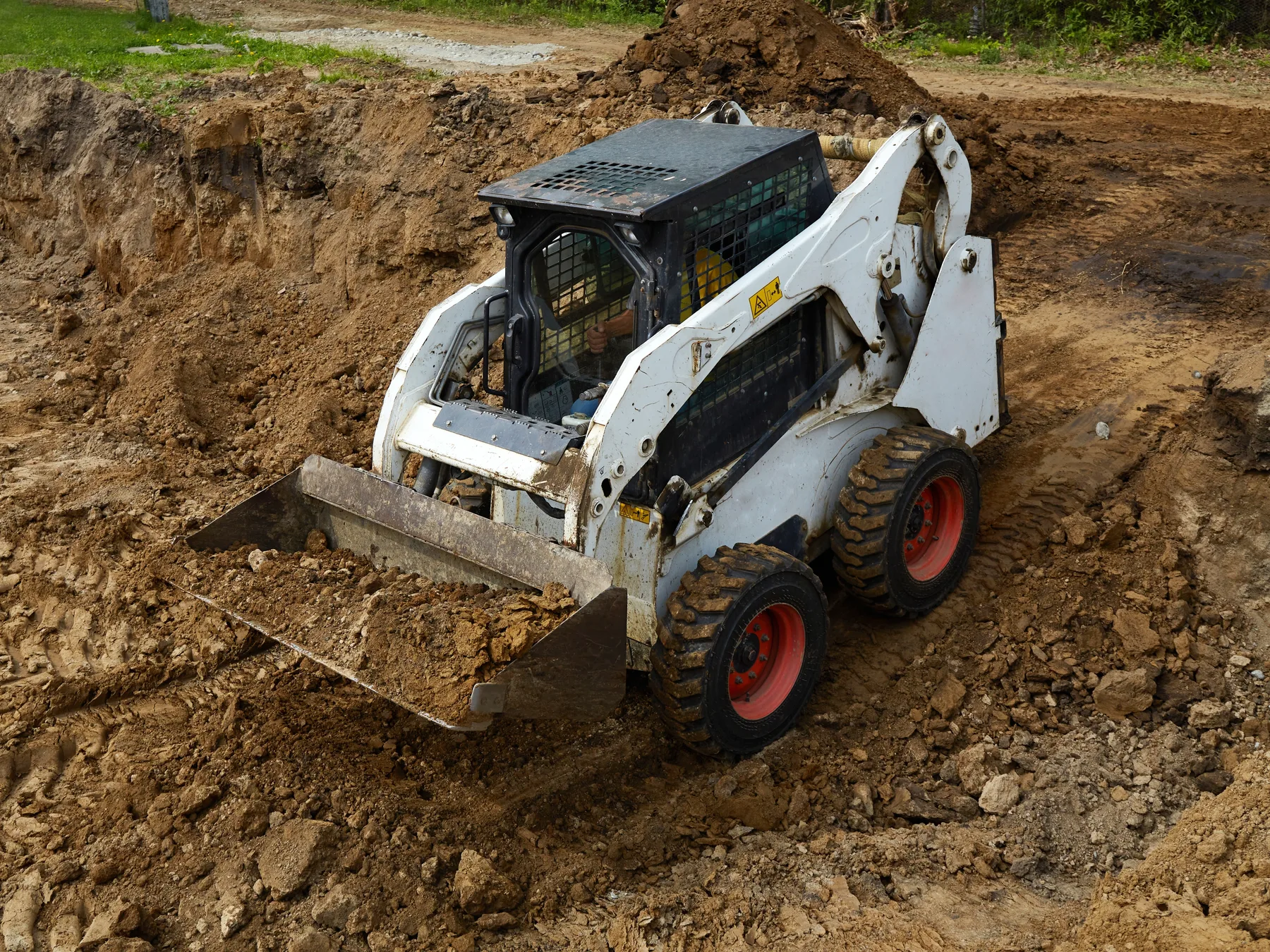
Theft is the leading loss on this class in Oregon as everywhere, and the local shape of it is a single long corridor: the interstate runs the length of the state between two state lines, and a trailered loader taken from a valley site is unremarkable traffic in either direction. Wet ground is the second exposure and it is the one that generates the most claims that are not thefts — rutting and damage to finished surfaces, machines bogged on saturated soil, and steady corrosion on anything stored outdoors through a valley winter. Wildfire is the third and it is seasonal and geographic rather than statewide, concentrated in the south and east and on wildland-adjacent work. What remains is machine-shaped: the forward tip with a raised load, and damage taken loading onto a trailer on a slope in the rain.
Common Oregon skid steer claims we see
- Overnight theft from a valley jobsite. The most frequent claim, often taking the trailer as well, and settled against the serial number because no certificate of title exists.
- Rutting and finished-surface damage on saturated ground. The characteristic wet-side claim: lawns, drives and hardscape damaged by a machine that was heavier than the soil could carry that day.
- Corrosion and water ingress after outdoor storage. Bearings, pins and electrical connections on a loader that spent a wet winter uncovered, discovered as a breakdown rather than as an event.
- Wildfire loss at a rural site. A machine left at a wildland-adjacent job in late summer and lost to a fire that had nothing to do with the work.
- Attachment stolen on its own. A breaker, grapple or mulching head taken off a yard rack while the loader stays put, then found to sit under a blanket per-item cap rather than scheduled by name.
Why Oregon skid steer owners choose Equipment Guard Insurance
We write equipment monoline, and in Oregon that matters in a particular way. Your endorsement level already obliges you to hold liability coverage and a bond, and that arrangement is not something to disturb in order to get a loader scheduled correctly — yet being told to move everything is precisely why so much equipment here sits on a limit set when the machine was new. We do not ask for that. Attachments go on by name as a matter of course, because on a skid steer the attachments hold value out of all proportion to their size, and we place through markets — named on our homepage — that will read an Oregon equipment schedule, wet ground and fire season included, on its own merits.
Major Oregon skid steer markets
- Portland. The largest and densest jobsite market in the state, with infill work on constrained lots, almost no yard space, and the deepest rental capacity in Oregon.
- Hillsboro. Large-site industrial and technology construction on the west side, where certificate and license scrutiny at the gate is as strict as it gets here.
- Salem. State institutional, municipal and agricultural work on valley ground that stays soft well into the season.
- Eugene. Campus, residential and forestry-adjacent work at the south end of the valley, with clearing attachments doing much of the earning.
- Bend. Fast growth on the dry side of the Cascades — a different climate, different soil and a different set of claims from anything west of the mountains.
- Medford. Southern Oregon site work in the market most exposed to fire season, where the choice of where a loader spends its August nights becomes a genuine underwriting question.
Related
- Skid steer insurance — the machine physics that hold in every state.
- Forklift insurance in Oregon — the machine whose operator training here is enforced by the state program rather than federally.
- All equipment insurance in Oregon — the state hub.
- Equipment floater · Rented & leased equipment
Primary sources
- CCB License — Oregon Construction Contractors Board (contractor licensing)
We do not link an Oregon filing document here. The ownership and lien rules described above follow Article 9 as Oregon has adopted it; where a state publishes a document that states the rule directly, this page links it.
Oregon skid steer insurance FAQs
Does a skid steer carry a title in Oregon?
No. It is construction equipment, so the Driver and Motor Vehicle Services side of the state never issues a certificate for it and there is nothing to hand over at a sale. Ownership rests on the serial number, the bill of sale and the financing record — which is worth keeping properly, because a loader is the piece of iron most likely to leave a site on somebody else’s trailer.
Do I need a Construction Contractors Board license to run a loader here?
Almost certainly yes, and Oregon is unusually broad about it: the requirement reaches anyone working for compensation on the improvement of real property. There is no project-cost threshold to sit beneath, which is exactly the opposite of how several other states handle it. Your license then carries an endorsement — residential or commercial, at a level — and the endorsement is what defines the work you may take.
Why does the endorsement level matter to my equipment coverage?
Because in Oregon the license and the insurance are linked by design. Each endorsement level carries its own bond and its own insurance requirement, so moving up a level is simultaneously a licensing decision and a coverage decision. It is one of the few states where an honest answer to “what insurance do I need?” starts with “which endorsement do you hold?” Equipment coverage is a separate matter from the liability the board requires — the loader is an asset you own rather than a third-party risk — but the two need to be arranged with each other in view rather than years apart.
What does the wet side of the state do to a loader?
It changes the work and the damage. Months of steady rain mean saturated ground, so a wheeled machine ruts what it drives across and a tracked one is chosen precisely to avoid that. Erosion control becomes part of the job rather than a formality. Standing water and mud reach bearings, pins and electrical connections, and a machine that overwinters outdoors in the Willamette Valley corrodes in a way a dry-climate machine never does. Most of the damage claims we see west of the Cascades trace back to ground that could not take the weight that day.
Is wildfire a real exposure for equipment in Oregon?
Yes, and in two directions. A machine parked at a rural or wildland-adjacent site in late summer can be lost to a fire it had nothing to do with, particularly in the south and east of the state. Separately, compact loaders get used on fuel-break, clearing and post-fire cleanup work, which places them close to burned ground and hot debris by design. Both are worth naming explicitly when the schedule is written, rather than discovering the distinction afterwards.
Can you write the loader without touching the rest of my program?
Yes. Equipment Guard Insurance writes equipment monoline, so the machine and its attachments sit on their own schedule while the liability policy your endorsement depends on stays exactly where it is.