
Grading in Middle Tennessee means working on top of rock that water has been eating for a very long time. Shallow limestone, joints wide enough to swallow a stream, springs that appear in the middle of a field: the surface a dozer reshapes is only the visible part of a system that continues underneath it.
This page deals with the Tennessee side of the machine — which agency administers the permit attaching to a disturbed acre, what the ground does with the water leaving your site, and which policy answers when material ends up somewhere it was not meant to be. Blade loads, undercarriage economics and moving a tracked machine belong to the dozer insurance pillar and read the same in any state.
What dozer insurance costs in Tennessee
We do not publish rates for this class, and on a dozer that is a statement about the risk rather than about our willingness to talk. The Tennessee inputs that count are which division you actually work in and what that ground is made of, the machine’s size, hours and undercarriage condition, how much area stands open at any one time and what receives the water leaving it, how frequently the iron moves and over what kind of roads, whether the calendar is steady or driven by a single large project, and your loss history. A karst-country site crew and a delta-country crew price differently on identical iron, for reasons that have nothing to do with the iron.
Tennessee dozer regulations: stormwater and land disturbance
Tennessee holds delegation for the national discharge program, so construction stormwater runs through the Tennessee Department of Environment and Conservation under a state general permit rather than through a federal regional office, and the obligation attaches at a land disturbance of one acre or more.
What makes that ordinary trigger behave unusually here is geology. Erosion and sediment control is designed around surface flow — you intercept water on its way to a low point and give the load somewhere to settle out. Karst removes the low point. Water reaching a sinkhole, a swallet or an open joint leaves the surface entirely and travels through rock at speed, which means a control plan can be installed exactly as drawn and still deliver material to a spring or a cave stream some distance away. That is not a reason to treat the permit as futile; it is a reason to treat the receiving feature, not the property line, as the real boundary of the job. The commercial consequence follows plainly. A penalty over a failed control measure is a regulatory matter and is not what an equipment policy answers. Sediment that leaves your ground and reaches a neighbor’s land, a public road or water — surface or otherwise — is third-party damage arising out of your work, carried by liability and pollution wording rather than by the floater that repairs the machine. On this class that second half is routinely the larger number.
Common dozer risks in Tennessee
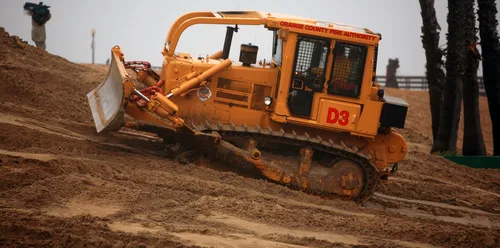
The machine’s own losses split along the same geological lines. In the middle of the state shallow rock punishes undercarriage, blade and ripper, and ground-collapse under a heavy machine is a genuine possibility rather than a curiosity. In the east, sidehill and bench work on ridge-and-valley terrain supplies the overturn exposure. In the west, deep soft soils and a high water table mean a machine gets stuck, sinks or works itself into trouble in a different way entirely. Fire in the engine bay is a constant on a machine pushing dry material in a hot summer. And around all three sits the land-disturbance exposure, which exists because the job was done rather than because anything failed.
Common Tennessee dozer claims we see
- Sediment reaching a creek, spring or cave stream after a storm. The defining third-party exposure in limestone country, and often discovered downstream rather than on site.
- Ground collapse under the machine on karst. A sudden accidental event on the iron, and one of the few losses genuinely characteristic of this state.
- Overturn on a cut bench in the eastern ridges. Terrain-driven, on an edge that did not exist that morning.
- Machine bogged or sunk on soft western ground. Recovery costs and damage during recovery, both worth agreeing in advance.
- Undercarriage destroyed by shallow rock. Ordinarily wear rather than a peril, and best separated from a covered loss before either happens.
Why Tennessee dozer owners choose Equipment Guard Insurance
Placing a dozer well means understanding that the machine and the ground it moved sit in different policies, and that in Tennessee the second one has a habit of turning up further from the site than anyone predicted. We write the equipment monoline, so the iron can be scheduled properly without rebuilding a program constructed around Tennessee work, and we would rather have the land-disturbance conversation openly than watch it get filed under the floater by default. We place through markets — named on our homepage — that read earthmoving as its own class instead of as heavy compact equipment.
Major Tennessee dozer markets
- Nashville. The busiest grading market in the state, on shallow limestone where sinkholes and springs sit inside ordinary commercial subdivisions.
- Murfreesboro. Continuous phased development spreading across the central basin, with a lot of open acreage standing at once.
- Memphis. Distribution and river-industrial earthwork on deep, soft, wind-laid soils above a shallow water table.
- Knoxville. Ridge-and-valley site work where slope, rock and drainage all argue with each other on the same lot.
- Chattanooga. Constrained valley-floor industrial ground with steep terrain immediately above it and the river immediately below.
- Clarksville. Fast institutional and residential expansion on rolling karst ground near the northern state line.
Related
- Dozer insurance — the machine physics that hold in every state.
- Backhoe insurance in Tennessee — the machine that has to answer for itself on the public road between the same two jobs.
- All equipment insurance in Tennessee — the state hub.
- Equipment floater · Rented & leased equipment
Primary sources
- NPDES Stormwater Construction Permit | Tennessee Department of Environment and Conservation — Tennessee Department of Environment and Conservation (stormwater and land disturbance)
- Contractor (Tennessee Board for Licensing Contractors, Dept. of Commerce & Insurance) - raw <title> is 'Contractor' — Tennessee Board for Licensing Contractors, Department of Commerce and Insurance (contractor licensing)
Tennessee dozer insurance FAQs
What is karst, and why does it matter on a grading job?
Karst is landscape built on rock that dissolves — limestone riddled with joints, voids, caves and sinkholes. It matters because it breaks the assumption every erosion control is built on, which is that runoff travels across the surface to a place you can put a barrier in front of. On karst it frequently leaves vertically instead, and once it does there is nothing downstream to catch it.
Who administers the construction stormwater permit in Tennessee?
The Tennessee Department of Environment and Conservation does, under state authority rather than through a federal office, and the requirement attaches at a land disturbance of one acre or more. Practically, that keeps the permit inside the same state relationship as the rest of your environmental paperwork instead of running on a separate federal track.
Is a sinkhole a machine risk or a water risk?
Both, and they arrive on different days. The water version is a disturbed site draining into a void and delivering sediment somewhere nobody expected. The machine version is more direct: a cover collapse under load is a real hazard where a dozer has been reworking ground and changing how water reaches the rock beneath it. The second is a sudden accidental event on the iron; the first is a third-party question about somebody else’s water.
Does the risk really change that much across the state?
It changes more than most states manage. The western end sits on deep, soft, wind-laid soils above the Mississippi embayment and behaves like a floodplain. Middle Tennessee is the limestone basin, with shallow rock, springs and sinkholes. The eastern end is ridge-and-valley country where slope work and rock are the whole conversation. A crew that works all three has genuinely learned three different jobs.
Are we exposed if sediment leaves the site and someone else notices?
That is the exposure worth taking seriously on this machine. A penalty over an inadequate control measure is a regulatory matter and not property damage, so it is not an equipment claim. Material that leaves your ground and arrives on a neighbor’s property, in a roadway, in a creek or in a spring is third-party damage arising out of the work, and it belongs to liability and pollution wording. In limestone country the distance between your site and someone else’s water can be much shorter than the map suggests.
Can we insure the machine without moving anything else?
Yes. Equipment Guard Insurance writes equipment monoline in Tennessee, so the dozer sits on its own schedule. We would rather show you where the floater stops and the liability side starts than let a quiet assumption carry the largest exposure on the job.