
A dozer is the machine that commits you. Everything else on a site can be undone or worked around; once a blade has moved the ground, the shape of the job and the water that runs off it have both changed, and the obligations that attach to that change start the moment the tracks do.
This page is about the Texas half of that: who administers the permit that reaches a disturbed acre, what the trigger actually is, and where the exposure sits once the machine has done exactly what you hired it to do. For the machine itself — blade loads, undercarriage, slope work and transport — see the dozer insurance pillar, which holds in every state.
What dozer insurance costs in Texas
We do not publish premiums on this class, and the reason is structural rather than coy: the dozer is often the cheapest part of the risk it creates. What moves a Texas number is the size and age of the machine and its undercarriage condition, the ground you work and how much of it you disturb at once, whether the sites you take sit inside larger developments, how the machine travels between jobs, and your own record. A crew opening a single pad and a crew shaping a subdivision phase are not comparable risks even on identical iron.
Texas dozer regulations: stormwater and land disturbance
Texas administers its own construction stormwater program through the state environmental commission rather than leaving it to the federal agency, and the general permit reaches a land disturbance of one acre or more, including smaller sites within a larger common plan of development.
Two things follow, and the second is the one that costs money. The first is administrative: because the program is delegated, the permit, the notices and the inspector are all state, so this sits inside your Texas paperwork rather than beside it. The second is the boundary between regulation and insurance, and it is worth being blunt about. A penalty for an inadequate control measure is a regulatory matter and not something an equipment policy was ever going to pay. What can become a claim is what the disturbed ground does next — sediment leaving the site onto a neighbor’s land, into a roadway, or into a watercourse. That is third-party damage arising out of your work, it lives in liability and pollution cover rather than in the floater, and on a dozer it is the exposure most likely to exceed the value of the machine that caused it. The permit is not the risk; it is the state telling you where the risk begins.
Common dozer risks in Texas
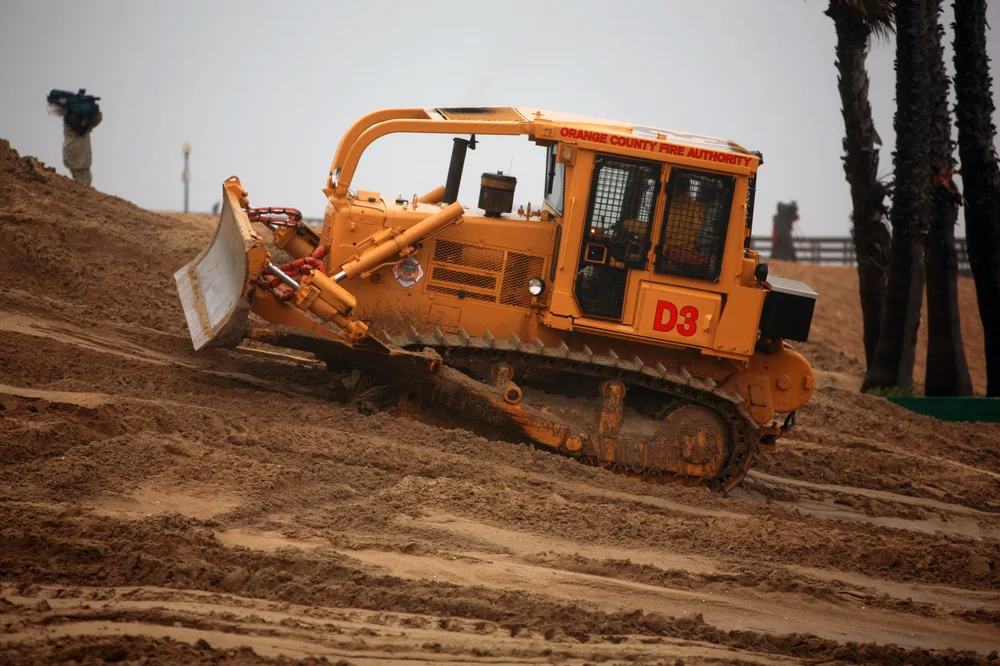
The dozer’s own losses are concentrated and unglamorous: undercarriage wear that is a maintenance cost rather than an insured one, overturn on a slope or a spoil edge, fire in the engine bay on a machine working in dry vegetation, and damage during transport, since a tracked machine of this size never drives itself anywhere. Around those sits the land-disturbance exposure, which behaves differently from every other machine we write — it is created by the work being done correctly, not by anything going wrong. Texas sharpens it at both ends of the water cycle: long dry spells leave exposed ground loose, and the intense rainfall that follows is what moves it off site.
Common Texas dozer claims we see
- Sediment leaving the site after heavy rain. The defining exposure on this machine, and a third-party question rather than a floater one.
- Overturn on a slope or spoil edge. Usually on ground the operator had already crossed safely earlier in the day.
- Engine-bay fire in dry conditions. Chaff and debris against hot surfaces, on a machine working where there is nothing to put it out with.
- Transport and loading damage. A tracked machine at this weight concentrates loss on the ramp, the deck and the tie-down.
- Undercarriage failure mistaken for a covered loss. Wear is not a peril, and separating the two early is what keeps a claim from souring.
Why Texas dozer owners choose Equipment Guard Insurance
Most equipment placements treat a dozer as a big skid steer and price the iron. We would rather be straight that on this machine the iron is the smaller half: the ground you moved, and where the water takes it, is where a bad year comes from. Writing the equipment monoline lets us schedule the machine properly without reopening a program built around Texas work, and it lets us have the land-disturbance conversation honestly instead of letting you assume the floater absorbed it. We place through markets — named on our homepage — that read earthmoving on its own terms.
Major Texas dozer markets
- Houston. Flat, wet, and built on ground that drains poorly — the market where runoff control is hardest and matters most.
- Dallas and Fort Worth. Continuous subdivision and industrial pad work, much of it inside larger common plans of development where the acre trigger reaches smaller sites.
- San Antonio. Shallow rock over recharge-sensitive ground, so both the undercarriage and the water question are live at once.
- Austin. Steep, thin-soiled hill country sites where slope work and erosion control run together.
- El Paso and the west. Abrasive, rocky ground that punishes an undercarriage, with long hauls between jobs.
- Corpus Christi and the coastal bend. Industrial site preparation with storm exposure on freshly disturbed ground.
Related
- Dozer insurance — the machine physics that hold in every state.
- Excavator insurance in Texas — the machine that answers for what is under the ground rather than what runs off it.
- All equipment insurance in Texas — the state hub.
- Equipment floater · Rented & leased equipment
Primary sources
- Stormwater General Permit for Construction Activities - Texas Commiss… — Texas Commission on Environmental Quality (stormwater and land disturbance)
Texas dozer insurance FAQs
What triggers a stormwater permit on a Texas dozer job?
Land disturbance of one acre or more — and, importantly, smaller sites that sit inside a larger common plan of development. That second half is what catches crews out: a half-acre pad is not automatically outside the requirement if it is one piece of a bigger scheme, and the machine most likely to cross that line is the one shaping ground.
Who administers the permit here, and does that matter to me?
Texas administers its own program through the state environmental commission rather than leaving it to the federal agency, so the permit, the paperwork and the inspector are all state. It matters practically: the people you deal with are in Austin rather than in a federal region office, and the program interacts with the rest of your Texas obligations rather than sitting alongside them.
Is a stormwater violation an insurance claim?
Usually not a covered one, and that is exactly why it is worth understanding. A fine for an inadequate control measure is a regulatory penalty, not property damage. What can become a claim is the consequence — sediment leaving your site and reaching a neighbor, a roadway or a watercourse. That is third-party damage arising from your work, and it is a pollution and liability question rather than a floater one.
Does the equipment floater cover the dozer itself in all this?
It covers the machine — fire, theft, overturn, transport damage, the things that happen to the iron. It does not answer for what the ground does after you have moved it. On a dozer that split matters more than on any other machine we write, because the machine is comparatively cheap and the earth it relocates is not.
What does Texas ground do to a dozer specifically?
Shrink-swell clay across much of the state moves seasonally, so a pad that was true in spring is not in August, and undercarriage wear runs high on the abrasive and rocky sites in the west. The other half is water: this is a state that alternates drought and intense rainfall, which is precisely the combination that turns exposed, freshly graded ground into sediment leaving the site.
Can you write the dozer without touching the rest of my program?
Yes. Equipment Guard Insurance places equipment monoline in Texas, so the machine goes on its own schedule. The land-disturbance exposure is a separate conversation we will have honestly rather than let you assume the floater has absorbed it.