

Texas gives an excavation contractor one dig law and then hands the rest of the rulebook to whichever city he happens to be working in that week. A firm running across a single metro can be registered in several jurisdictions at once, each with its own permitting habits and its own list of what your certificates must say.
This page covers the statewide clock and how its exclusions bite, what the ticket leaves in the contractor’s hands, how expansive clay quietly invalidates the depths on old drawings, and why a strike on the coast is a different category of loss altogether. The machine characteristics that do not change by state — reach and swing, undercarriage, breakers and thumbs — are on the excavator insurance pillar.
What excavator insurance costs in Texas
There is no honest statewide number, and Texas makes that more obvious than most places. What sets a placement here is the work: depth, how much of the year runs inside a live utility envelope, whether product-line corridors and plant work are part of your book or something you avoid, how far your crews travel and across how many jurisdictions. Then the ordinary inputs — unit size and age, attachments on the schedule, where the machine sits overnight, and your loss record. A contractor cutting pad and detention on a suburban greenfield and a contractor working inside a plant fence are not comparable submissions, and any figure printed before that distinction is made is worth exactly what it cost to read.
Texas excavator regulations: dig notice and the one-call duty
at least 48 hours before excavation, excluding Saturdays, Sundays, and legal holidays
The document we can show you is the state highway department’s right-of-way manual section on one-call requirements — a manual section, not the underlying Utilities Code chapter, and we say so rather than dress it up. The rule it describes is the one that governs your crews: at least 48 hours before excavation, Saturdays, Sundays and legal holidays out of the count. Short, uniform, and unforgiving of a Friday afternoon call. What the resulting ticket buys is a duty on registered facility owners to mark what they own, and nothing beyond that boundary. Depth is not certified. Abandoned and private plant is not reached. And a careful excavation beside a correct mark is what decides a claim, not the existence of the ticket. In a state where the shallow buried world drifts with the moisture in the clay and where a large share of what is down there carries product rather than service, the residue left with the contractor is the part actually worth insuring on purpose.
Common excavator risks in Texas
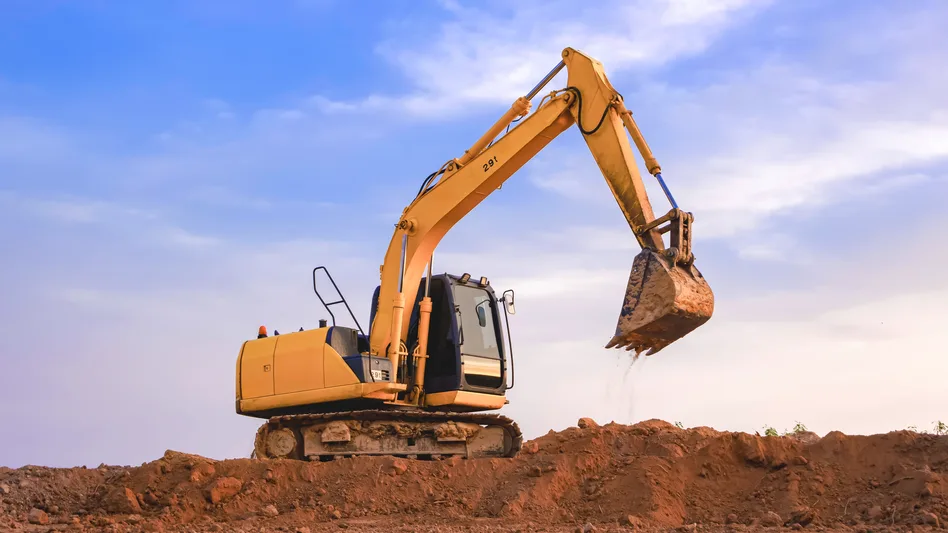
Three exposures stack here rather than one. The first is the classic strike, where the excavator is barely scratched and the interruption file runs for a year. The second is the coastal escalation of it — a breached product line is a release and an evacuation, with a regulatory tail no equipment limit was ever meant to answer. The third is the ground itself: expansive clay that cracks open in drought and turns plastic after rain, so trench walls behave one way in August and another in May, and shallow services sit at depths their drawings stopped describing years ago. Around all three, the machine keeps its own habits — the slide at a trench edge, the swing into what the operator cannot see, and the damage that accumulates loading and unloading across very long distances.
Common Texas excavator claims we see
- Product-line breach in an industrial corridor. Release, evacuation and regulatory response, with the physical repair as the smallest entry in the file.
- Fiber or gas strike on a service at the wrong depth. The record said one thing, the clay had spent a decade saying another.
- Trench wall failure after rain. Ground that stood perfectly through the dry months and stopped standing in a week.
- Swing or counterweight contact on a tight urban lot. Structures, vehicles and meter banks inside a swing circle nobody measured.
- Transport and loading loss over long hauls. The distances here mean more moves, more ramps and more chances to lose an attachment off the deck.
Why Texas excavator owners choose Equipment Guard Insurance
When the credential is issued by a city rather than the state, the paperwork has to satisfy several readers who do not coordinate with one another — and a certificate assembled to satisfy one of them tends to fail the next. We write the equipment monoline, build the schedule so it holds up across jurisdictions, and take the below-grade exposure seriously instead of leaving it to whoever wrote the liability. The markets behind that work are named on our homepage. None of it obliges you to move a policy you are already satisfied with.
Major Texas excavator markets
- Houston. The heaviest concentration of buried product line in the country sits under and around this market, which changes what a strike means here.
- Dallas and Fort Worth. Continuous metroplex growth over expansive clay, with registration and permitting rules that change from suburb to suburb.
- San Antonio. Rapid expansion over karst and limestone, where rock work and aquifer-sensitive ground arrive on the same jobs.
- Austin. Dense infill and technology-campus construction on constrained sites, with live services running under active buildings.
- Corpus Christi. Port, refinery and plant work behind fences, where the marking picture is owner-controlled rather than public.
- El Paso. Desert ground, long approaches and border-corridor logistics build-out, isolated from the rest of the state’s support network.
Related
- Excavator insurance — the machine physics that hold in every state.
- Dozer insurance in Texas — the machine whose statewide obligation is a stormwater authorization rather than a call before the blade drops.
- All equipment insurance in Texas — the state hub.
- Equipment floater · Rented & leased equipment
Primary sources
- One Call Requirements — Texas811 (dig notice and one-call)
Texas excavator insurance FAQs
How much notice does Texas require before excavation?
At least 48 hours before you begin, with Saturdays, Sundays and legal holidays left out of the count. That is a short fuse compared with much of the country and it flatters a crew that plans well, but the exclusions matter more than the raw figure: a call late on a Friday of a holiday weekend does not produce a Monday start. The state rule is uniform; what is not uniform is everything else layered on top of it once you cross into a municipality.
Do I need a state license to run excavation work in Texas?
There is no statewide general-contractor license. Specific trades are licensed at state level — electrical, heating and cooling, and irrigation through the state licensing department, plumbing through its own board — while general building and site work is handled by municipal registration and permitting. In practice that means the credential is local: you register where you work, the requirements differ between cities, and a firm operating across a large metro can hold half a dozen registrations with half a dozen sets of insurance conditions attached.
Does the notice put the strike risk on the utility?
It does not, and no version of the paperwork does. What the notice compels is marking by the operators who own registered facilities in the area you described. There is no depth warranty in it, no coverage of abandoned or private lines, and no forgiveness for excavation carried out carelessly beside marks that were perfectly correct. The claim turns on how the digging was done. That is a liability question with a different answer from the equipment question, which is why we place the two deliberately rather than assuming one absorbs the other.
What does shrink-swell clay do to buried infrastructure?
It moves it, seasonally and permanently. Across the black clay belt the soil expands when wet and contracts hard in drought, and the shallow band — service lines, irrigation, communications drops, older water services — rides that movement year after year. Depths recorded at installation stop being reliable, brittle pipe fractures on its own without anybody touching it, and a trench wall that stands beautifully in cracked dry clay behaves very differently after a week of rain. It is a strong argument for exposing by hand rather than trusting a number on a drawing.
Is a strike on the Gulf Coast a different kind of loss?
Materially. Between the ship channel and the refining and chemical corridors, a great deal of what is buried carries product rather than utility service, and breaching one produces a release, an evacuation, a regulatory investigation and a shutdown of everything downstream. The physical repair is the least significant number in the file. A policy sized against the value of the excavator has no relationship to that exposure, and building the placement as though it does is the error we most often find on submissions from this market.
Can the excavator be insured on its own?
Yes. Equipment Guard Insurance writes equipment monoline across Texas, so the machine and its attachments carry their own schedule while the below-grade exposure is handled beside them — no package required, and nothing you already hold has to move.