
Utah is a state where the consequences of moving earth arrive late. Ground opened in June sits there looking harmless for weeks, and then a single storm cell parked over a canyon delivers the whole exposure at once, down a channel that had been dry every day you walked past it.
That lag is what this page is about — who holds the permit that attaches to a disturbed acre, what the state expects while the ground is open, and where the exposure actually sits when it stops being theoretical. The machine itself, its blade loads and undercarriage and how it gets to a job, is constant wherever you work and belongs to the dozer insurance pillar.
What dozer insurance costs in Utah
There is no price on this page because a number produced without your details would be a guess wearing a decimal point. The Utah inputs that genuinely move a schedule are elevation and access — a canyon or bench job is not a valley-floor pad — how abrasive the material you routinely push is, how much ground you hold open through the summer storm season, whether the machine overnights on site or comes back to a yard, its hours and undercarriage condition, the valuation basis you pick, and your record. Abrasive ground alone can separate two otherwise identical fleets.
Utah dozer regulations: stormwater and land disturbance
Utah administers the national discharge permit program itself rather than leaving it federal, and the construction instrument is UPDES Construction General Permit (CGP) UTRC00000, held by Utah Division of Water Quality (DWQ). Coverage under it attaches to a land disturbance of one acre or more (or part of a common plan disturbing one acre or more).
The part worth dwelling on is not the filing; it is what the permit is protecting and how badly that is misread in a dry state. Most of Utah drains into channels that spend the year empty, and an empty channel invites the assumption that nothing downstream is at stake. It is the wrong assumption twice over: those channels lead to irrigation systems, canals and reservoirs that people rely on, and they move sediment in violent, concentrated pulses rather than steadily. So the state cares about the acre you opened long before anything visible has happened on it. Where insurance sits in this is fixed and worth being blunt about — an enforcement penalty is not property damage and no equipment policy answers for it, while material that physically leaves your site and reaches a canal, a road, a ditch or somebody else’s parcel is third-party damage arising out of the work. That belongs to liability and pollution wordings. The floater repairs the dozer; it has never had anything to say about where the ground went.
Common dozer risks in Utah
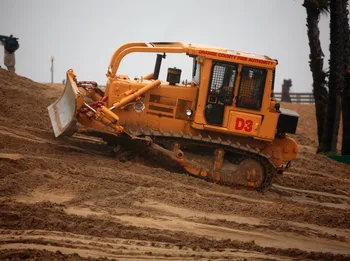
Wear dominates the machine’s own loss picture here, and most of it is not insurable. Lake-bench gravel and desert rock grind through undercarriage components and cutting edges faster than soil does, and owners regularly present that as a claim when it is a maintenance schedule. The genuine perils are overturn on the steep faces this state offers in abundance, fire in dry vegetation and dry duff, and transport damage on canyon approaches and grades where getting the machine to the job is the riskiest hour of the week. Wrapped around all of it is the land-disturbance exposure, which behaves differently from every other risk on the schedule: it is created by the work succeeding, and in Utah it is stored up quietly until weather chooses to collect it.
Common Utah dozer claims we see
- Sediment carried down a dry wash by a summer cloudburst. The signature Utah event, and a third-party matter rather than a floater one.
- Cut-face collapse in bench sand and gravel. Unconsolidated lake deposits hold the angle you gave them and no more.
- Overturn on a canyon grade or a bench edge. Terrain-driven, on a line that was crossed safely earlier in the shift.
- Undercarriage loss presented as damage. Abrasive ground makes wear look sudden, and separating it early keeps a claim from souring.
- Transport damage on a mountain approach. Grade, switchbacks and narrow shoulders concentrate loss on the move rather than on the work.
Why Utah dozer owners choose Equipment Guard Insurance
A dozer placed as though it were simply a large loader gets priced on the wrong half of its risk. We would rather start from the honest position: the iron is replaceable and comparatively cheap, and the expensive year comes from what the water did with the ground after you shaped it. Equipment monoline means the machine gets a proper value and a proper schedule without anything else in your Utah arrangements being disturbed to achieve it, and the markets behind us — named on the homepage — are ones that underwrite earthmoving rather than treating it as an oversized attachment problem.
Major Utah dozer markets
- Salt Lake City. Dense infill and redevelopment where sites are small, adjacent owners are close, and street drainage carries material away fast.
- West Valley City. Industrial and distribution pads on the valley floor, the flattest and highest-volume earthmoving in the state.
- Lehi. Continuous bench-terrace development on old lake deposits — cut and fill on material that erodes as easily as it digs.
- Provo and Orem. Campus, commercial and residential work below the mountain front, with steep drainage arriving from above the site.
- Ogden. Older industrial ground and canyon-mouth development, where access grades are as demanding as the work itself.
- St. George. Fast desert build-out on rock and caliche, hard on iron, with washes that flash hard when the season turns.
Related
- Dozer insurance — the machine physics that hold in every state.
- Backhoe insurance in Utah — the Utah vehicle code names bulldozers and backhoes by type, and the backhoe page works that classification through.
- All equipment insurance in Utah — the state hub.
- Equipment floater · Rented & leased equipment
Primary sources
- General Construction (Storm Water): UPDES Permits | Utah Department of Environmental Quality, Division of Water Quality — Utah Division of Water Quality (DWQ) (stormwater and land disturbance)
- Utah Code Chapter 55, Utah Construction Trades Licensing Act (58-55-301 License required) — Utah Department of Commerce, Division of Professional Licensing (DOPL) (contractor licensing)
Utah dozer insurance FAQs
What brings a Utah dozer job under the state construction permit?
Disturbance of one acre or more (or part of a common plan disturbing one acre or more). The second clause is the one that catches crews out on the Wasatch Front, because a small pad in a subdivision or a business park is rarely a standalone piece of ground — it is one lot of a scheme that was planned, and permitted, as a whole. Working out which it is before the tracks turn is far cheaper than establishing it afterwards.
Who issues it, and does that office decide anything else about my site?
Utah Division of Water Quality (DWQ) holds the construction permit, and it sits inside the state environmental department alongside the division that answers for air. That pairing is not academic on a dry site: the same stripped surface that becomes a sediment question when it rains is a dust question every day it does not, and along the Wasatch Front dust is watched closely. One department, two files, the same open acre.
The channel below my site has no water in it. Does the permit still care?
Yes, and this is the arid-state trap in one sentence. An ephemeral wash is dry for most of a Utah year and then carries a great deal of water very quickly during a summer cloudburst or a fast melt. Nothing about the empty channel tells you what it does when it runs. Sediment that has been accumulating at the toe of a stripped slope for a month leaves in a single afternoon, and it leaves in the direction the channel was always going to take it.
What does Utah ground do to a dozer?
The benches are the story. The terraces stepping down the Wasatch Front are old lake deposits — sand, gravel and cobble laid down loose — which is why they cut so cleanly and why a cut face in them will not hold a shape it was not given. That material is abrasive, so wear on the undercarriage and on the blade edges runs high, and the cobble in it is hard on a moldboard. South and west of that you trade lake gravel for desert caliche and rock, where the machine is breaking as much as pushing.
If the state issues a penalty, does the policy respond?
Not to the penalty, no. Enforcement is a matter between your company and the state, and it is not property damage in any sense an equipment policy recognizes. The insurable question is what physically happened: material that left your site and reached a road, an irrigation ditch, a canal, a neighboring parcel or a channel that leads to one. That is third-party damage arising out of your work, answered by liability and pollution wordings, and it has nothing to do with the schedule that repairs the machine.
What do you need to quote a Utah dozer?
The machine list with serial numbers, model years and hours, an honest valuation basis, where the iron sleeps, and roughly what your sites look like — bench work, desert pads, canyon access, or subdivision phases. Equipment Guard Insurance places equipment monoline, so nothing else in your file has to be reopened to get a schedule written properly. If the land-disturbance side needs its own conversation, we will say so rather than let it be assumed away.