
Vermont earthmoving happens in public. The state is small, the valleys are narrow, the brook at the bottom of the job has a name that people know, and a site that goes wrong is visible from the road within a day. That is not sentiment; it changes how a job is planned, how quickly a complaint reaches the agency, and how much a contractor’s reputation is worth as an asset.
Below is the Vermont side of running a blade: which permission covers what, why the second one is the one that delays projects, and how the season decides what the ground will tolerate. For the machine itself — blade and ripper work, undercarriage cost, and floating a tracked machine to a job — see the dozer insurance pillar, which is the same wherever you work.
What dozer insurance costs in Vermont
No page can quote this class honestly, and on a dozer the machine is rarely what decides the number anyway. In Vermont an account turns on how steep and how wet the ground you take on is, how close the work sits to surface water, how much you open in a season that closes early, the length and difficulty of the access you have to build to get there, the age, hours and undercarriage condition of the iron, where it sits through the winter, and your own record. A contractor benching a hillside driveway and a contractor stripping a flat commercial lot are not comparable risks on identical machines.
Vermont dozer regulations: stormwater and land disturbance
Vermont administers the national discharge program itself, through General Permit 3-9020 for Stormwater Runoff from Construction Sites, issued by Vermont Agency of Natural Resources, Department of Environmental Conservation (DEC). It applies to a land disturbance of one acre or more.
The part that surprises people is that the stormwater permit may not be the permission that governs the schedule. Vermont pairs it with Act 250 land-use review, which can add a permitting layer for larger earth-disturbing projects, and that review asks a fundamentally different question — not how the site will shed water, but whether the project belongs on this ground in this form. A contractor can therefore be fully compliant on erosion control and still be waiting, and the wait is not something good site practice can shorten. Underneath both sits the commercial line that actually matters. A penalty, a condition breached, a permit amended against you: those are regulatory outcomes, and no equipment policy responds to any of them. What can become a claim is the physical event — material off an opened slope into a brook, silt onto a neighboring property, mud on a town highway that puts a car in a ditch. Those are third-party damage arising out of your work and they answer under liability and pollution coverage rather than the floater. In a landscape where the receiving water is close, named and watched, that consequence is nearer than it looks, and it can cost a multiple of the machine that produced it.
Common dozer risks in Vermont
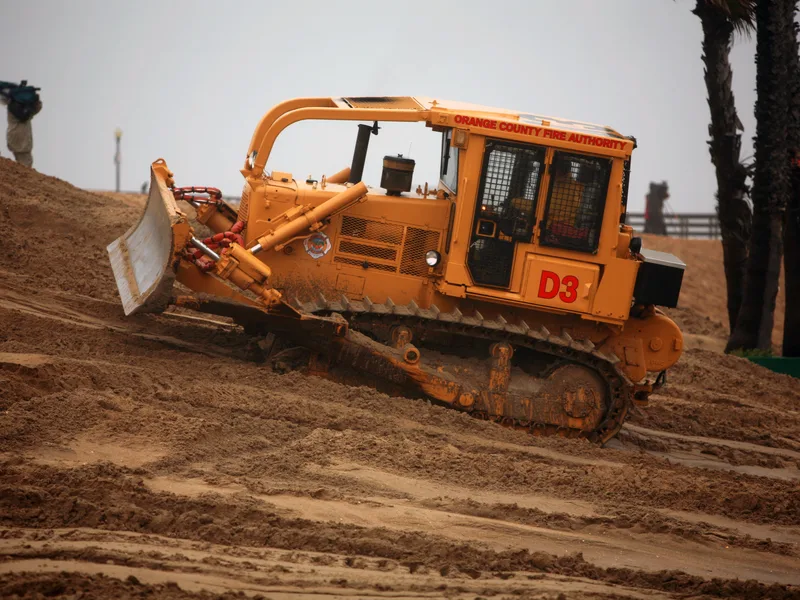
The season shapes everything. Work is compressed into the months when the ground will carry a machine, which means high utilization, long days and deferred maintenance in the middle of the year, then a long idle period at the end of it. Terrain does the rest: real grades load the undercarriage, the blade and the push-arms, and overturn risk here comes from the shape of the land rather than from carelessness. Access is its own hazard, because getting a tracked machine up a narrow, steep, unimproved approach is frequently harder than the earthwork waiting at the top. Around all of that runs the land-disturbance exposure, which does not need anything to go wrong at all — an open slope, a rain event and a brook downhill is an ordinary Vermont site.
Common Vermont dozer claims we see
- Material off an opened slope into a brook or wetland. The defining Vermont exposure, and a third-party question rather than a floater one.
- Access road failure in saturated spring conditions. Machines are lost, stuck and damaged getting to work rather than doing it.
- Overturn on a bench cut or steep grade. Terrain-driven, often on ground that held earlier in the day.
- Mud carried onto a town highway. A traffic exposure with a third-party outcome that has nothing to do with the machine.
- Loss on iron standing through a long off-season. Months of exposure at a finished site with nobody attending it.
Why Vermont dozer owners choose Equipment Guard Insurance
Small fleets get the worst of the equipment market: they are told to move everything before anybody will look at the machine, and the ground exposure never gets discussed at all. Writing equipment monoline means a Vermont owner-operator can have the dozer valued and scheduled properly on its own, and it leaves room to be honest that the blade is the cheap half of this risk while the hillside it reshaped is the expensive one. We would rather map which obligation belongs to the stormwater permit, which to a land-use review, and which to a policy, before a site is opened. We place through markets — named on our homepage — that read earthmoving on its own terms.
Major Vermont dozer markets
- Burlington. The state’s densest development, on ground that drains straight toward the lake.
- South Burlington. Commercial and institutional pad work where sites are large enough to trigger the fullest review.
- Rutland. Quarry country and valley industrial work, with rock close and haul roads long.
- Barre. Granite-belt earthmoving, where the material under the blade is the region’s whole economy.
- Montpelier. Public and institutional work in a tight river valley with flood history and close scrutiny.
- Essex Junction. Steady residential and light industrial grading, the routine end of the market and the volume behind most schedules.
Related
- Dozer insurance — the machine physics that hold in every state.
- Backhoe insurance in Vermont — the one machine in a small Vermont fleet that has to earn its keep on the road as well as off it.
- All equipment insurance in Vermont — the state hub.
- Equipment floater · Rented & leased equipment
Primary sources
- GENERAL PERMIT 3-9020 FOR STORMWATER RUNOFF FROM CONSTRUCTION SITES — Vermont Agency of Natural Resources, Department of Environmental Conservation (stormwater and land disturbance)
- Residential Contractors — Vermont Secretary of State, Office of Professional Regulation (contractor licensing)
Vermont dozer insurance FAQs
Which permit covers construction earthwork in Vermont?
Vermont Agency of Natural Resources, Department of Environmental Conservation (DEC) administers the state program and issues General Permit 3-9020 for Stormwater Runoff from Construction Sites, reaching a land disturbance of one acre or more. Vermont is a delegated state, so the permit, the conditions and the inspection are all in state hands rather than federal ones — which on a project that also touches New Hampshire is a genuine difference in who you correspond with.
What is the land-use layer people keep mentioning?
Vermont pairs the stormwater permit with Act 250 land-use review, which can add a permitting layer for larger earth-disturbing projects. It asks a different question from the discharge permit: not what leaves the site, but whether the project should reshape this piece of ground in this way at all. For a contractor the practical consequence is timing — the job may be waiting on a review that has nothing to do with erosion control and cannot be accelerated by good site practice.
Why is mud season a risk question and not just an inconvenience?
Because it puts the year’s first earthwork on the year’s worst soil. Frost comes out of the ground from the top down, so for several weeks the surface is saturated while the layer below is still sealed, and water cannot go anywhere but sideways. That is precisely when access roads fail, when a machine sinks to the belly pan, and when freshly opened ground gives up material to the nearest ditch.
Does insurance respond to a permit problem?
Not to the permit problem itself. A penalty, a condition breached, a review that goes against you — those are regulatory and administrative outcomes, and no equipment policy was written to answer them. Insurance engages when the physical consequence reaches somebody else: sediment into a brook, a neighboring property silted, material on a town road. Those are third-party matters arising out of your work and they belong to liability and pollution coverage.
What does Vermont work do to the machine itself?
It compresses a year of hard use into a short season and then leaves the iron standing. Grades are real here, so undercarriage and blade loads run high and overturn risk is terrain-driven rather than careless. Access is often long, narrow and steep, which makes getting the machine to the job a distinct exposure from the job itself. Then the season closes and the machine overwinters wherever it finished, sometimes for months, sometimes with nobody looking at it.
Will you write a single dozer for a small outfit?
Yes — and in Vermont that is most of the market. Equipment Guard Insurance writes equipment monoline, so a two-machine owner-operator can schedule a dozer properly without being told to move a whole program first. It also means the land-disturbance conversation happens out loud rather than being folded silently into a package.