
A dozer does not create risk by breaking down. It creates risk by working — by taking a slope apart, stacking it somewhere else and leaving the surface bare while the job catches up. In a climate where the rain arrives as a season rather than as a storm, that interval is the whole exposure.
This page covers the Washington side of the machine: which agency holds the permit, what pulls a site under it, how sharply the state changes character at the mountains, and where the money actually sits once the blade has done its work. Track wear, blade capacity and slope technique are the same everywhere and live on the dozer insurance pillar.
What dozer insurance costs in Washington
We publish no premium for this class, because the honest inputs are not things a page can know. In Washington the ones that move a number most are which side of the crest you work, how much ground you keep open through the wet months and what lies downhill of it, the machine’s hours and undercarriage state, how far it travels and over what kind of approach, and your own record. A crew that stages its clearing so only part of a site is bare at a time is not the same risk as one that strips everything in September and hopes, even on identical iron.
Washington dozer regulations: stormwater and land disturbance
Washington is a delegated state and runs the program itself: the Construction Stormwater General Permit (CSWGP) is issued by the Washington State Department of Ecology, and it reaches a land disturbance of one acre or more (or less than one acre if part of a common plan disturbing one acre or more).
The delegation matters more here than it does in a dry state, because the agency holding the permit also holds the water-quality brief for receiving waters that a great deal of this state cares intensely about — the streams and the Sound that most of the western sites eventually drain into. So the office is not a distant permitting desk; it is a regulator with a standing interest in the exact thing your open ground can send downhill. Where that lands commercially is the part owners most often get wrong. An enforcement penalty, a stop-work order or a corrective directive is a regulatory cost, and no equipment policy has ever been written to reimburse one. The claim arises at the next step: sediment that leaves the site and reaches a neighboring lot, a public road or a watercourse is physical damage to somebody other than you, arising out of your operations. That belongs in liability and pollution coverage, not in the floater that repairs the dozer — and in this state, where the ground stays wet for months and the drainage path is usually short, it is the exposure most capable of outrunning the value of the machine. Nothing about holding the permit changes that division; it simply tells you the state is watching the part of the job you cannot put back.
Common dozer risks in Washington
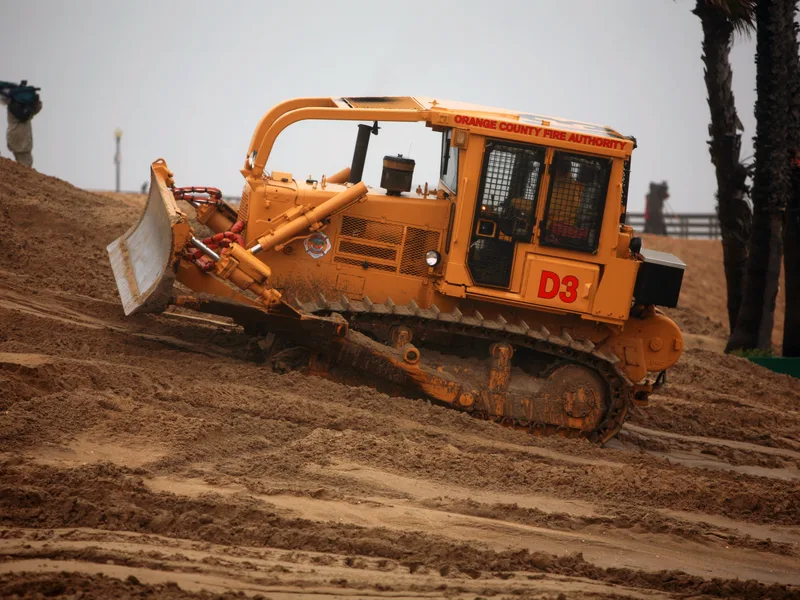
On the west side the machine fights water and weight. Saturated till and old valley fill will not carry load reliably, so tracks sink, edges give way and an operator who read the ground correctly in the morning can be wrong by mid-afternoon. Steep, wooded slopes add overturn risk that is terrain-driven rather than careless, and constant moisture is hard on pins, bushings and electrical connections. East of the crest the register changes: abrasive volcanic soils and rock in the cut, dust in every seal, long hauls between jobs, and frozen ground in spring that sheds meltwater as if it were paved. Transport damage is a statewide constant, because the last mile to a Washington site is rarely the easy part.
Common Washington dozer claims we see
- Sediment leaving an open slope during a long wet spell. The characteristic Washington loss on this class, and it is answered outside the equipment policy.
- Tracks or an edge giving way in saturated fill. Ground that carried the machine yesterday and does not today.
- Overturn on a steep wooded grade. Common enough on west-side clearing work to be treated as a design condition rather than bad luck.
- Transport and low-bed damage on a narrow forest approach. The riskiest part of many jobs happens before any dirt moves.
- Moisture-driven component failure argued as a sudden loss. Best separated from a covered peril in the wording, long before an adjuster is involved.
Why Washington dozer owners choose Equipment Guard Insurance
Registration and a bond tell an underwriter that a Washington contractor exists; they say nothing about how it works. That puts the weight on your own evidence — accurate serial numbers, honest hours, a valuation basis that survives a wet decade — which is exactly what a monoline equipment placement is for. We schedule the machine on its own without disturbing the liability and work comp already arranged around your operations, and we are direct about which exposure the floater does not reach. We place through markets — named on our homepage — that will read a clearing and grading account on its own terms.
Major Washington dozer markets
- Seattle. Constrained infill on glacial till and old fill, with short, steep drainage paths that reach salt water quickly.
- Bellevue and the Eastside. Hillside residential and commercial cut into till, where benching and erosion control are one job.
- Tacoma and Kent. Valley-floor port and distribution work on soft alluvial ground with a high water table.
- Everett. Industrial and riverine delta sites where the water is not downhill so much as underneath.
- Vancouver. Corridor distribution build-out, with a lot of material moved on a tight seasonal window.
- Spokane. The dry side — thin soil over basalt, abrasive cut, and runoff that arrives as melt on frozen ground.
Related
- Dozer insurance — the machine physics that hold in every state.
- Skid Steer insurance in Washington — the machine whose Washington problem is a filing office and a theft market, not a watershed.
- All equipment insurance in Washington — the state hub.
- Equipment floater · Rented & leased equipment
Primary sources
- Construction Stormwater General Permit | Washington State Department of Ecology — Washington State Department of Ecology (stormwater and land disturbance)
- Register as a Contractor — Washington State Department of Labor and Industries (contractor licensing)
Washington dozer insurance FAQs
Who runs construction stormwater in Washington?
The state, through its Department of Ecology, under a construction stormwater general permit of its own rather than the federal form. Washington took delegation of the national program, so the notice you file, the plan you keep and the person who turns up to look at your controls are all state. There is no federal region office in the loop for the ordinary construction case.
At what point does a site need it?
When disturbance reaches the statutory acreage — and also when a smaller area is one piece of a larger common plan that reaches it. That second limb catches more crews than the first, because a single lot inside a phased development is measured against the whole scheme rather than against its own boundary. The dozer, whose entire function is opening ground, is usually the machine that carries a job over the line.
What does the wet season actually change for a grading crew?
The arithmetic of how much you dare have open. West of the Cascades the rain is not a thunderstorm that passes; it is weeks of steady, low-intensity fall on ground that is already saturated, and exposed soil in that condition moves continuously rather than dramatically. Crews here plan around area exposed and duration exposed rather than around a forecast, and the machines are working shorter productive windows for the same volume of dirt.
Is the east side really a different job?
Completely. Cross the crest and the annual rainfall collapses, the soil goes from till and valley fill to loess and thin cover over basalt, and the runoff problem changes shape rather than disappearing. Dry ground does not absorb a sudden spring melt or a summer cell any better than wet ground does; it simply gives you less warning. Frozen ground east of the mountains sheds water like pavement, which is when material leaves a site fastest.
Does Washington license the contractor running the machine?
Not in the way most states do. Washington requires contractors to register with the state labor and industries department and to carry a bond, but that is a registration-and-security posture rather than a competency examination. For an underwriter it means the state record proves you exist and are bonded, not that anybody has assessed how you work — which puts more weight on your own equipment schedule, your maintenance records and your loss history.
Is a violation notice from the state something to claim on?
No. A regulatory penalty is not physical damage and no equipment policy answers for it. What can become a claim is what the disturbed ground does — sediment reaching a neighboring property, a public road or a stream that runs to the Sound. Equipment Guard Insurance writes equipment monoline in Washington, so the machine gets scheduled properly on its own; the third-party half is a liability and pollution question, and we would rather name that split up front than have you find it in a wet February.