
Building anything in West Virginia usually starts by creating flat ground that did not previously exist. A dozer cuts a bench, carries the spoil to a fill, and hands the job a level pad — and in the same afternoon it hands the hillside a new face, a new edge and a new route for every drop of water that lands above it.
This page is about that second half: who administers the permit that attaches once ground is opened, what the gradient below a cut does to the consequences, and which policy actually answers when material moves. The machine physics — blade and ripper loads, undercarriage economics, moving a tracked machine that cannot travel itself — sit on the dozer insurance pillar and hold in every state.
What dozer insurance costs in West Virginia
There is no honest published number for this class, and on a dozer the machine is not even the leading variable. What actually moves a West Virginia figure is the severity of the ground you take — sidehill and benching work is not priced like flat pad work — along with the size, age and hours of the machine, how much area you open at one time and what sits below it, how far and how often the iron travels between jobs on mountain roads, whether the work is one-off grading or continuous slope stabilization, and your own loss record. Two crews on identical iron can be genuinely different risks here purely on the strength of the hillsides they accept.
West Virginia dozer regulations: stormwater and land disturbance
West Virginia holds delegation for the national discharge program, so construction stormwater is administered by the West Virginia Department of Environmental Protection under a state general permit rather than by a federal office, and the obligation attaches at a land disturbance of one acre or more.
The consequence is what matters, and in this state topography supplies most of it. An opened acre is not a flat quantity; it is a face with a fall line, and the distance from a fresh cut to a stream, a hollow bottom or a public road below can be measured in a few dozen strides. That geometry compresses the interval between a control measure failing and somebody outside your fence being affected by it — which is exactly where the boundary between regulation and insurance sits. A penalty assessed against your control plan is a regulatory matter and is not the thing an equipment policy was ever written to answer. Material leaving the site and arriving on a neighbor’s ground, in a roadway or in water is third-party damage arising out of your work, and it belongs to liability and pollution wording rather than to the floater that repairs the machine. On steep ground that second exposure routinely outruns the value of the dozer that created it, and the permit is best read as the state marking where it begins rather than as the risk itself.
Common dozer risks in West Virginia
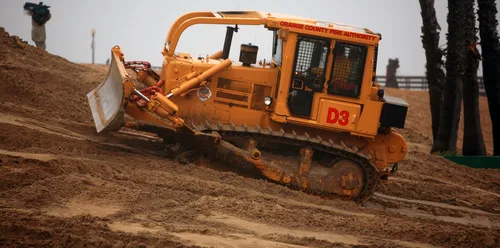
The iron’s own losses here are dominated by terrain and by rock. Working shale and sandstone benches loads the undercarriage, the blade and the push-arms hard, and produces the wear owners most often mistake for an insured event. Overturn exposure is elevated not by carelessness but by the simple fact that a great deal of West Virginia work happens on a cross-slope, on a fill edge, or on a bench whose outboard side did not exist that morning. Transport is its own chapter, because getting a tracked machine of this weight up a narrow valley road with switchbacks and posted bridges is frequently the most delicate part of the week. Around all of it sits the land-disturbance exposure, created by the work being done properly rather than by anything going wrong.
Common West Virginia dozer claims we see
- Runoff carrying material off a cut face after a heavy storm. The signature exposure on this machine in this state, and a third-party question long before it is a floater one.
- Overturn on a fill edge or fresh bench. The outboard side of a new cut has no history, which is precisely what makes it hard to read.
- Undercarriage and blade damage from rock work. Usually wear rather than a peril, and far easier to separate before a loss than during the argument about one.
- Transport damage on a narrow valley approach. Loading, hauling and unloading concentrate loss on switchback roads and posted bridges.
- Engine-bay fire on a machine working in dry brush. Debris against hot surfaces, in country where getting anything to the fire takes time.
Why West Virginia dozer owners choose Equipment Guard Insurance
A dozer account rewards an agency that treats the machine and the ground it moved as two separate problems, because in a bad year they are answered by two separate policies. We write the equipment monoline, so the iron can be scheduled properly without pulling apart arrangements already built around West Virginia work, and we are direct about which half of the exposure the floater carries and which half it does not. We place through markets — named on our homepage — that read a slope-work earthmoving account on its own terms rather than filing it beside compact equipment.
Major West Virginia dozer markets
- Charleston and the Kanawha valley. Chemical, institutional and highway work on constrained valley floors where every site has a hillside above it and a river below.
- Huntington. River-port and industrial ground where flat sites exist but drainage runs quickly to open water.
- Morgantown. University-driven expansion pushing development onto steep north-central ridges and hollows.
- Parkersburg. Ohio-valley industrial and utility earthmoving, with long approaches and heavier plant work.
- Wheeling. Northern-panhandle sites layered over older industrial ground, where a cut can find material nobody recorded.
- Martinsburg and the eastern panhandle. The state’s fastest commercial and distribution build-out, and the closest thing here to routine open-pad grading.
Related
- Dozer insurance — the machine physics that hold in every state.
- Excavator insurance in West Virginia — the machine that has to know what is buried in the bench before the blade widens it.
- All equipment insurance in West Virginia — the state hub.
- Equipment floater · Rented & leased equipment
Primary sources
- WV/NPDES Water Pollution Control General Permit No. WV0115924 — Stormwater Associated with Construction Activities (issued March 6, 2024; effective April 6, 2024; expires April 5, 2029) — West Virginia Department of Environmental Protection (stormwater and land disturbance)
- West Virginia Code §21-11 — West Virginia Legislature (contractor licensing)
West Virginia dozer insurance FAQs
Which agency runs construction stormwater in West Virginia?
The West Virginia Department of Environmental Protection holds the delegation, so the program that reaches a disturbed acre is a state program and not a federal one. The practical effect is that the office reviewing your control plan is the same office you already know from the rest of your environmental paperwork, which shortens the distance between a question and an answer but also means nothing about this obligation sits outside the state relationship.
Does steep ground change what the acre trigger means to me?
The threshold is the same number anywhere. What is not the same is what an opened acre does once it exists. On a bench cut into a hillside the disturbed face is at the top of a fall line that ends in a hollow, a stream or a county road, and there is very little flat ground between the two to slow anything down. The same disturbed area that would sit still on a plain is already in motion here the first time it rains hard.
We hold the statewide contractor license. Does that touch the insurance?
It touches how the file reads rather than what the policy says. West Virginia is one of the few states with a genuine statewide contractor license across general and specialty classifications, so a market underwriting an earthmoving account here can see a credential that carries real classification information. That does not price the machine, but it does mean an out-of-state underwriter has one fewer unknown in front of them.
Will the floater pay when the undercarriage gives out on rock?
Not for the wearing out itself, and this is worth settling before a claim rather than during one. Rails, rollers, idlers and pads consume themselves against shale and sandstone, and that consumption is a running cost the policy has never promised to reimburse. A sudden accidental event — a final drive holed by an obstruction, a track thrown in an incident — is a different question and a different answer.
Sediment washed onto the road below our site. Is that our problem?
Very likely yours, and it is the exposure most worth understanding on this machine. A regulatory penalty for a control measure that failed is not property damage and is not what an equipment policy answers. Material that leaves your site and reaches somebody else’s land, a public road or a watercourse is third-party damage arising out of the work, which lives in liability and pollution wording. On a benched site the road below is often the nearest thing downhill.
Can the dozer be scheduled on its own?
Yes. Equipment Guard Insurance writes equipment monoline in West Virginia, so the machine goes on its own schedule without the rest of the account being reopened. We would rather map the land-disturbance side out loud with you than let it sit unexamined behind a floater that was never built to carry it.