
A Wisconsin earthmoving year is shorter than the calendar suggests and lopsided in a way that catches people out. The productive months are counted carefully. The dangerous ones are not — and they arrive when almost nobody is on site.
This page is about the state around the machine: who issues the permit and under what name, what pulls a job under it, and why a frost climate rearranges the exposure rather than merely shortening it. Track life, blade capacity and slope technique do not change with latitude and live on the dozer insurance pillar.
What dozer insurance costs in Wisconsin
We do not publish a rate here, and on a dozer the machine is only part of the question anyway. The Wisconsin inputs that move a number are how much ground you keep open going into freeze-up, what sits downhill of it, whether you work the erodible ground of the west or the heavier till of the east, the machine’s hours and undercarriage condition, where and how it overwinters, and your record. A crew that stabilizes and walks away in November is presenting a different file from one that leaves a stripped forty acres to find out what March is like, whatever the iron on the schedule looks like.
Wisconsin dozer regulations: stormwater and land disturbance
Wisconsin holds delegation and runs the program under its own name. The instrument is WPDES Construction Site Storm Water Runoff General Permit No. WI-S067831-6, issued by Wisconsin Department of Natural Resources (Wisconsin DNR), and it applies to a land disturbance of one acre or more.
Delegation puts a state office in front of you rather than a federal one, which in this state means an agency whose remit runs across water, wildlife and land in one department — the same body that cares about the lakes and rivers your site eventually drains toward. Wisconsin sits on a divide between two enormous drainage basins, so a job on one side of a county line sends its runoff to the Great Lakes and a job on the other side sends it to the Mississippi, and both directions have constituencies. Where that becomes an insurance conversation is narrower than owners expect. A penalty for controls that failed or were never installed is regulatory, and an equipment policy is not the answer to it. The claim begins one step later: sediment that leaves your acreage and reaches a neighboring farm, a public road, a ditch or a stream is physical damage to somebody else arising out of your work. That sits in liability and pollution coverage, not in the floater — and on a machine whose job is to leave large areas bare in a state where all the water leaves at once in spring, it is the exposure with the greatest capacity to exceed the value of the iron that created it.
Common dozer risks in Wisconsin
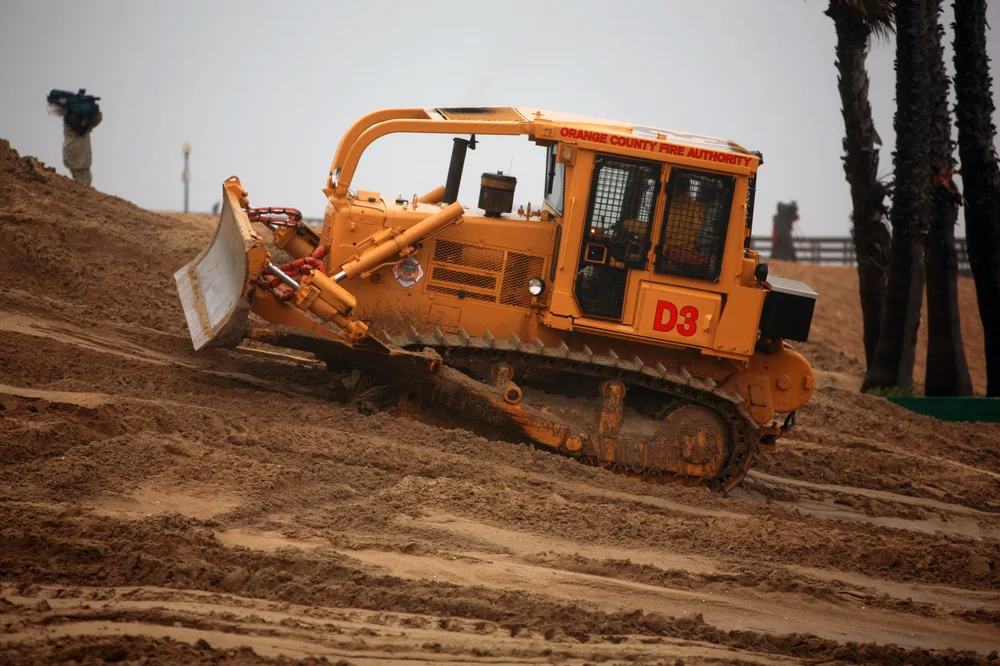
The machine’s own losses run with the seasons. Cold starts, brittle hoses and hydraulic systems worked hard before they are warm account for a lot of early-shift damage, and frozen ground is unforgiving of a cutting edge that finds a buried obstruction. Spring reverses it entirely: thawed, saturated ground will not carry the machine, and an operator who worked a surface confidently in February can lose an edge on the same ground in April. Long idle months are their own exposure — a machine parked where it finished is a machine nobody is looking at. Around all of it sits the land-disturbance risk, which peaks precisely when the site is quietest.
Common Wisconsin dozer claims we see
- Melt-driven sediment loss from a site left open over winter. The signature Wisconsin claim on this machine, and it is answered outside the equipment policy.
- Track or edge failure in thaw-softened ground. The same surface behaves differently in two consecutive months, and the machine finds out first.
- Cold-start and hydraulic damage on a hard winter morning. Frequently argued as sudden loss where the wear was building for seasons.
- Theft or damage to a machine overwintering on a remote site. Months of no attendance is a genuine exposure, not a technicality.
- Bluff or coulee slope failure under load in the west. Unglaciated ground is steeper and more erodible than the rest of the state and behaves accordingly.
Why Wisconsin dozer owners choose Equipment Guard Insurance
With no statewide competency credential for commercial earthmoving here, an underwriter reads what you put in front of it — which makes the equipment schedule the most persuasive document a Wisconsin contractor owns. Writing equipment on its own lets us get that document right, with real hours, a valuation basis that accounts for hard winters, and serial detail that will stand up after a theft from a closed site. Nothing else in your arrangements has to be reopened for it. We place through markets — named on our homepage — that read grading and clearing as work with its own shape.
Major Wisconsin dozer markets
- Milwaukee. Redevelopment over old industrial fill, with short drainage runs that reach the lake before anyone can intervene.
- Madison. Institutional and campus growth on a narrow isthmus, where a great many sites have water on two sides rather than one.
- Green Bay. Bay-head clay ground and river-mouth industry, heavy going for an undercarriage and slow to drain.
- Kenosha and Racine. The distribution corridor, where large flat pads mean large flat areas of exposed ground at one time.
- Appleton and the Fox Valley. River-corridor industrial work with limited room between the job and the water.
- Eau Claire. Sandy western ground at the edge of the unglaciated country, steep-sided and quick to move once it is opened.
Related
- Dozer insurance — the machine physics that hold in every state.
- Backhoe insurance in Wisconsin — the machine whose Wisconsin problem is road salt and a vehicle code rather than a watershed.
- All equipment insurance in Wisconsin — the state hub.
- Equipment floater · Rented & leased equipment
Primary sources
- Construction site storm water permits — Wisconsin Department of Natural Resources (stormwater and land disturbance)
- Dwelling Contractor Qualifier — Wisconsin Department of Safety and Professional Services (contractor licensing)
Wisconsin dozer insurance FAQs
Why is the Wisconsin permit called WPDES rather than NPDES?
Because the state runs its own pollutant discharge elimination system under delegation and names it after itself. It is the same federal frame every state works within, but the general permit for construction site runoff is a Wisconsin instrument with a Wisconsin number, issued by the state natural resources department. For a contractor the point is not the acronym — it is that authorization, inspection and enforcement all stay in state hands.
What brings a site under it?
Land disturbance reaching the statutory acreage, with smaller parcels counted in where they belong to a larger common plan. The dozer is usually the machine that carries a job across that line, because opening ground is the whole of what it does. A crew that thinks in lots rather than in schemes is the crew most likely to be surprised by which side of the threshold it is standing on.
What does frost actually do to the risk, as opposed to the schedule?
It concentrates it. Through winter the water sitting on and in a site is locked up and going nowhere, so an open surface looks stable when it is only frozen. Then the melt arrives over a short period onto ground that is saturated, bare and has no root structure holding it, and a season’s worth of runoff leaves at once. Freeze-thaw has also spent the winter working on the controls themselves — heaving stakes, tearing fabric, cracking the ditch checks you installed in good faith in October.
So the November decision matters more than the March one?
Usually, yes. How much surface you leave open at freeze-up, whether it is seeded or matted or simply left, and where the stockpiles sit relative to a swale all get locked in before the ground closes. By the time the thaw exposes the answer there is very little a machine can do about it, because you cannot work saturated ground without making it worse. The contractors who avoid the March problem are the ones who treated shutdown as a construction task rather than as the end of the season.
Does Wisconsin license the contractor doing this work?
Mostly not. The state certifies contractors working on one- and two-family dwellings, and leaves commercial earthmoving without a comparable statewide competency credential. That means a serious grading outfit here may hold no state license at all, which is perfectly lawful and also means an underwriter has nothing to look up. Your equipment schedule, your maintenance record and your loss history end up doing the work a license number does elsewhere.
Can you write just the dozer?
Yes — that is the way Equipment Guard Insurance prefers to do it. The machine sits on its own schedule at an honest value and nothing else in your arrangements has to move. The one thing we insist on saying out loud is the boundary: a citation from the state is a regulatory cost you carry, while sediment that leaves your site and reaches a neighboring parcel, a road or a stream is third-party damage and is answered by liability and pollution coverage instead.