
A lot of Alabama excavating outfits do not only excavate. They take the old structure down, break what will not move, and then dig the footings — three activities the state regulates on two separate clocks, with two separate boards standing behind the license that let you bid it.
That is the shape of the risk here, and it is administrative before it is mechanical: the losses arrive through what somebody did not renew, did not renotify, or could not show a general contractor on a Monday morning. What follows is how the notice regime is put together, what the ticket genuinely transfers, and where the machine and the third-party exposure part company. The machine-level material — reach, tail swing, undercarriage, the attachment ecosystem — lives on the excavator insurance pillar and holds everywhere.
What excavator insurance costs in Alabama
There is no rate to quote on a page, because the number is assembled out of things a page cannot see. The heaviest input is the character of the work — depth, how routinely you operate beside live gas, power and fiber, whether demolition and rock breaking are part of your normal mix — and then the size and value of the units, the hammers and shears on the schedule, where the fleet overnights during storm season, and the record behind you. Two operations with identical iron price nowhere near each other when one is pulling footings on a clean pad and the other is dropping structures over live service.
Alabama excavator regulations: dig notice and the one-call duty
Ordinary excavation runs on notice of at least 2 and not more than 10 working days before excavation (not including the day of notification), and a second window sits behind it — Demolition/blasting: at least 2 working days but not more than 30 calendar days.
Our data records the governing section as the notification-of-excavation-or-demolition provision of the Alabama Code, and we name it here without linking it. This page links only documents we have opened and read for ourselves, and that one has not cleared that bar, so it stays unlinked rather than dressed up as a citation. The regime is legible enough without one. Routine digging turns on a short working-day floor with a working-day ceiling; demolition and blasting keep the floor and push the ceiling out into calendar days, which is a far longer stretch of time for site conditions to change underneath a ticket that is still technically alive. Neither window transfers anything. The notification obliges the facility owners to respond; it leaves with you the duty of care in the ground around their paint, and it says nothing at all about the line nobody recorded. Every part of that gap is a liability question, and liability is where this machine generates the number that hurts.
Common excavator risks in Alabama
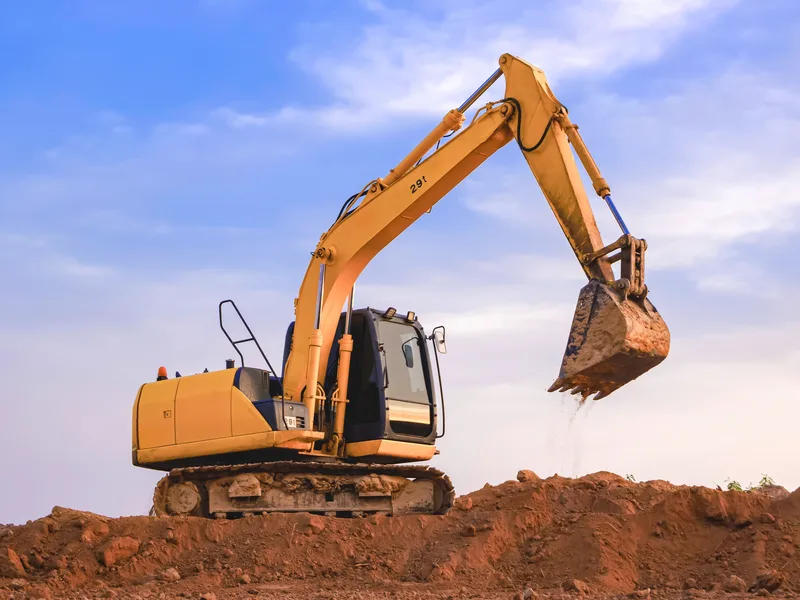
Rank the exposures by what they can cost rather than by how often they happen and the underground strike stands alone. A severed gas main or fiber trunk produces a restoration bill, an outage affecting people who never heard of your company, a crew standing down while the site is made safe, and a consequential tail that has nothing to do with the value of the excavator that caused it. Demolition work stacks a second class of third-party loss on top: debris, vibration and the structure that does not fall the way the plan said it would.
The machine’s own losses are steadier and smaller. Saturated red clay after heavy rain undercuts trench walls and turns a workable slope into a slide, which is how tracked units end up on their side here. The tail swing accounts for most of the property damage on constrained lots. And named-storm season is a concentration question rather than an operating one — it asks where the whole fleet sleeps, not how any single unit is worked.
Common Alabama excavator claims we see
- Utility strike with a consequential tail. Restoration and interruption together, on a machine that will be back at work tomorrow.
- Demolition damage to an adjoining property. Vibration, debris or a wall that came the wrong way — the exposure the digging half of the business does not have.
- Slide into a saturated trench. Clay that held all week and let go the morning after a heavy rain.
- Tail-swing contact on a tight lot. Counterweight into a structure, a fence or a parked vehicle behind the operator.
- Named-storm loss at the yard. Wind and water taking several units at once because they were all in the same place.
- Attachment theft between phases. Hammers, shears and thumbs walking off a site that is between contractors.
Why Alabama excavator owners choose Equipment Guard Insurance
With oversight split across two boards and no single document that proves competence to everybody, the certificates you hand over end up doing more work in Alabama than they do in states with one licensing authority. That is an argument for placing the equipment deliberately rather than accepting whatever arrived attached to a package. We write the iron monoline, so scheduling machines does not force you to re-bid the rest of the program, and we treat the strike and demolition exposures as things to be underwritten rather than glossed — through markets named on our homepage that will look at a dirt-and-demolition operation on its own record.
Major Alabama excavator markets
- Birmingham. The state’s deepest concentration of older buried service and industrial redevelopment, so the strike claim and the demolition claim show up on the same jobs.
- Huntsville. Sustained federal, aerospace and campus build-out, where a cut line stops a facility and the interruption side dwarfs the trench.
- Mobile. Port and coastal industrial work with a high water table, soft ground and a named-storm exposure sitting over every yard in the county.
- Montgomery. Municipal, institutional and utility replacement — the work where the records are oldest and least complete.
- Tuscaloosa. University and infrastructure work threaded through an established grid, with tight lots and constant tail-swing exposure.
- Hoover and the Birmingham suburbs. Residential and light-commercial site work under the other licensing board, on ground that has already been developed once.
Related
- Excavator insurance — the machine physics that hold in every state.
- Backhoe insurance in Alabama — the machine Alabama judges on the road between jobs rather than in the trench at the end of them.
- All equipment insurance in Alabama — the state hub.
- Equipment floater · Rented & leased equipment
Primary sources
- About – Alabama Licensing Board for General Contractors — Alabama Licensing Board for General Contractors (nonresidential) and Alabama Home Builders Licensure Board (residential) (contractor licensing)
We do not link an Alabama dig-notice section here. The notice duty described above follows Alabama’s own one-call statute as our data layer records it; where the state publishes a document that states it directly, this page links it.
Alabama excavator insurance FAQs
Why does Alabama have two different notice windows?
Because it treats two different jobs as two different hazards. Routine excavation runs on a short working-day window with an outer limit measured the same way. Demolition and blasting keep the same floor but stretch the ceiling out across calendar days instead, which is a much longer leash. The trap is not the arithmetic — it is that an operator who does both kinds of work on the same site has two tickets aging at two different speeds, and only one crew watching them.
Which board licenses an excavating contractor here?
It depends on what you are digging for, which is the part that surprises people who moved here from a single-board state. Nonresidential and commercial general contracting sits with one licensing board; residential building sits with a separate home builders board. A dirt operation working across both worlds ends up holding a relationship with two regulators, and the general contractor vetting you will be looking at whichever one is relevant to their project rather than at the pair.
We were marked and we still hit a line. Does the ticket protect us?
Not in the way crews hope. The notification puts a duty on the facility owners to come out; it does not certify that everything down there is on the plan, that the paint is over the pipe, or that a line abandoned by a predecessor was ever recorded at all. What decides the file afterwards is how the excavation was carried out in the vicinity of those marks — which is a liability question, and the reason the underground exposure is arranged deliberately rather than folded into the equipment schedule and forgotten.
Does Alabama ask for anything unusual on the site-plan side?
It does. Construction plans that go to the state environmental agency have to be prepared by a credentialed professional recognized for that purpose, which is a stricter posture than most states take on who may author the paperwork. It rarely changes what the excavator does in the dirt, but it changes the schedule: a plan that has to be authored by a qualified person is not a document the crew can fix on a Friday afternoon, and idle-machine time is a real cost on a dirt job.
How does the Gulf climate show up in an equipment placement?
Two ways, and only one of them is the storm. Named-storm season concentrates a wind and flood question onto wherever the fleet is staged, and a yard chosen for convenience in February is a decision being made about August. The quieter one is water in the ground: heavy rainfall on red clay produces saturated trench walls and slick working slopes long after the sky clears, and the machine losses that come from that are unglamorous and constant.
Do I have to move my other policies to get the machines written?
No. Equipment Guard Insurance places equipment as its own line in Alabama, so your units and attachments can be scheduled on their own terms while the liability side of the underground work is addressed alongside. Whatever you already have arranged for general liability and comp can stay where it is.