
Kansas is a state where the law about what is under a job is uniform everywhere and the law about whether you are allowed on the job is different in every town. An excavating contractor who works across it is keeping two entirely separate files: one that never changes, and one that has to be rebuilt at each new counter.
What follows deals with both, and with the reason the first one matters so much here — this is pipeline, gathering-line and collector-cable country, and open ground is no evidence of empty ground. For the machine itself, and the things about it that are the same in every state, start at the excavator insurance pillar.
What excavator insurance costs in Kansas
We do not quote an excavator from a web page, and the reason is that the machine explains less of the premium than the work does. What an underwriter looks at first is what you dig into: energy corridors, municipal street replacement, rural water, wind collection, or open site development where nothing is live. Then the specification and hours, the attachments on the same schedule, the distances the fleet covers between jobs, whether the machines are yarded under cover or parked in the open where hail and wind find them, and your loss record. Two firms with identical equipment lists can sit a long way apart and both be rated correctly.
Kansas excavator regulations: dig notice and the one-call duty
at least two full working days but not more than 20 calendar days before the scheduled excavation start date
The duty is set out in Kan. Stat. Ann. § 66-1804, within the state’s underground utility damage prevention act, and it runs through the statewide notification center under the commission’s damage-prevention authority. Two working days at the near end, twenty calendar days at the far end, and the mismatch in units is the trap — a schedule built on calendar arithmetic can be illegally early or holding an expired ticket without anybody noticing. What the notice produces is a locate: the member operators are told to come identify what they own. It is not a certificate that the corridor has been fully described, and it is emphatically not a transfer of liability. The care taken around the marks remains the contractor’s, and so does the consequence of everything that was never in the system. That last category is unusually large in Kansas, where energy gathering infrastructure, private service runs and irrigation have been going into farmland for generations. Behind all of it, the state itself takes no position on whether you are qualified to be doing the work — that judgment sits with a city or a county, and with whoever reads your certificates.
Common excavator risks in Kansas
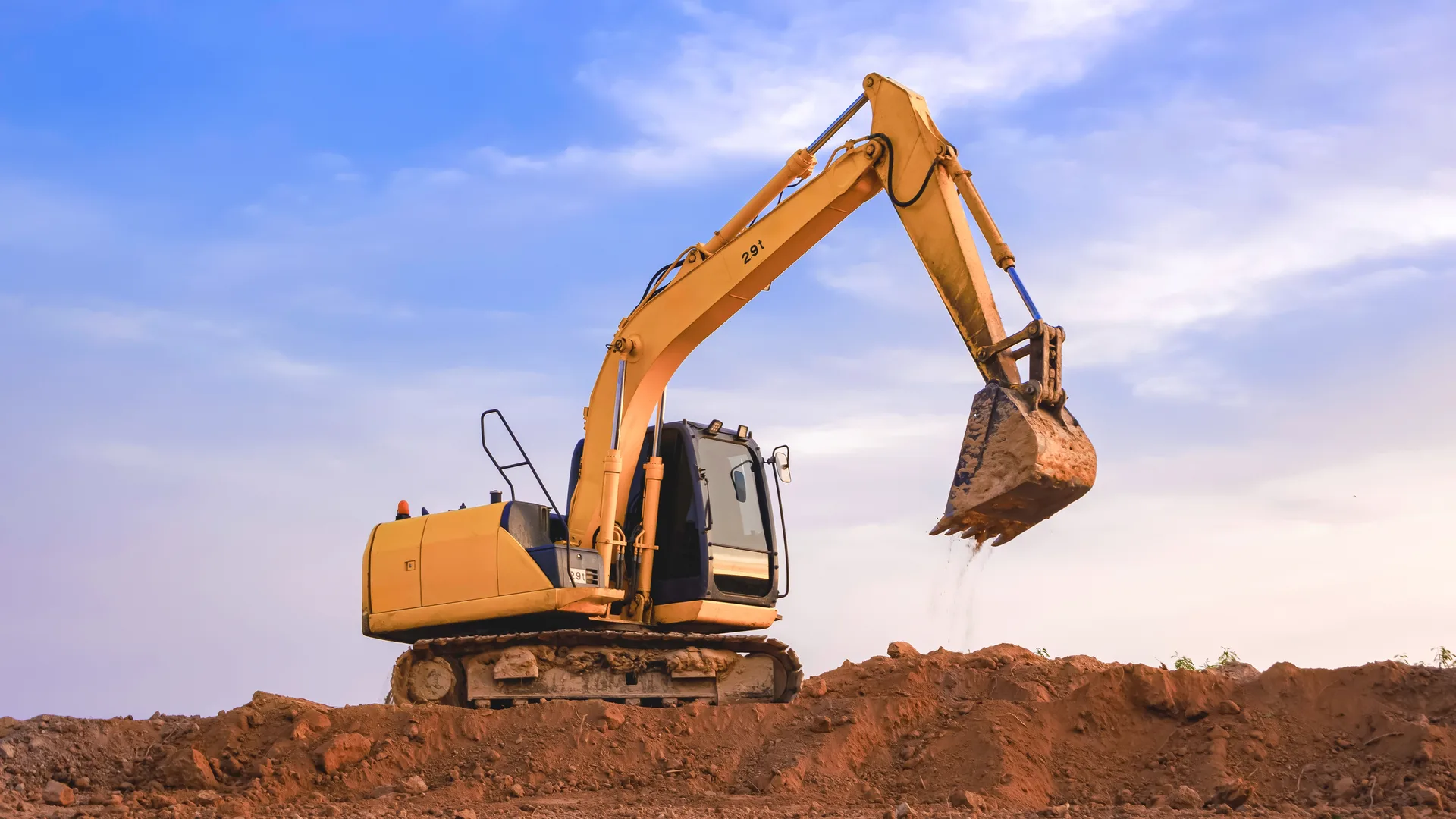
The severity risk is a struck line, and the profile in Kansas skews toward energy: a pipeline or gathering-system contact brings an operator, a regulator and an emergency response onto the site simultaneously, and the exposure is measured in evacuation, environmental response and interrupted throughput rather than in the price of pipe. Collector cable on wind projects and rural water mains produce the same shape at a smaller scale. Weather then supplies a second, distinct set: sustained wind that dries an open trench and complicates precise boom work, hail and straight-line storms landing on machines parked in the open, grass fire around hot undercarriages in a dry season, and expansive clay that moves under everything. The everyday failures persist too — the tip at a trench edge, the swing into what sits behind the operator, and the loss that happens on the ramp during a long haul.
Common Kansas excavator claims we see
- Pipeline or gathering-line contact. The claim that brings regulators and emergency response with it, and where the machine is the smallest number involved.
- Unmarked private or irrigation line cut on open ground. No member operator, no marks, and a repair obligation nobody anticipated.
- Hail and wind damage to units parked in the open. Glass, panels and lighting on a fleet with nowhere indoors to go.
- Trench failure in expansive clay. Ground that changes character between a dry week and a wet one.
- Fire started around a hot machine in dry vegetation. A small ignition with a very large third-party tail.
Why Kansas excavator owners choose Equipment Guard Insurance
When qualification is decided locally and the state has no view, the documents you present do the persuading — which makes it worth placing the equipment on purpose rather than accepting what came bundled. We schedule machines on their own, treat the underground exposure as a question to be underwritten rather than assumed, and place through markets — named on our homepage — that will look at energy-adjacent excavation work seriously. Your liability and comp can stay exactly where they are.
Major Kansas excavator markets
- Wichita. Aviation and industrial plant work plus continuous municipal replacement, over the densest subsurface in the state.
- Overland Park. Corporate and commercial build-out on constrained suburban sites with live services in every street.
- Kansas City and Wyandotte County. River-bottom industrial and rail ground, old fill, and heavy incoming utility runs.
- Olathe. Sustained residential and light-industrial expansion where new corridors cut across former farm ground.
- Topeka. State and institutional work alongside utility replacement in an older street grid.
- Lawrence. University and municipal work on river terrace ground, on sites that stay occupied throughout.
Related
- Excavator insurance — the machine physics that hold in every state.
- Skid Steer insurance in Kansas — the machine whose Kansas paperwork sits in the same office that holds your business record.
- All equipment insurance in Kansas — the state hub.
- Equipment floater · Rented & leased equipment
Primary sources
- 66-1804 — Statewide notification center (dig notice and one-call)
- Construction | Kansas Business Center One Stop — None statewide; general-contractor licensing is handled by cities and counties (state role limited to Secretary of State business registration) (contractor licensing)
Kansas excavator insurance FAQs
What is the timing on a Kansas locate request?
At least two full working days before the scheduled start, and not more than twenty calendar days before it. That outer boundary is generous by regional standards and it invites a specific mistake: pulling tickets far in advance for a run of jobs, then discovering that the early ones lapsed while the crew was still finishing the first. Note also that the floor is counted in working days and the ceiling in calendar days, so the two ends of the window are not measured in the same units.
Who gives me permission to run this work in Kansas?
A city or a county does, if anyone does. There is no statewide general-contractor license here; the larger jurisdictions run their own licensing and the smaller ones may run none. The only state-level step for most contractors is registering the business entity with the Secretary of State — which is also the office where a lender files against your machines. So the state holds your records and your liens in one place and has no opinion about your competence, while the counter that actually decides whether you can work moves every time you cross a boundary.
Does a locate ticket shift the risk of a strike?
It does not. The notice buys a locate, not an indemnity. The facility operators owe a response; the obligation to advance the bucket carefully around whatever comes back stays with you, and so does everything unmarked. In a state this heavily crossed by energy infrastructure, an unmarked or mislocated line is not an abstract worry, and the liability that follows one is a separate underwriting problem from damage to the machine.
What makes Kansas ground different to dig?
The infrastructure more than the soil. Transmission pipelines cross the state in every direction, gathering systems thread the southern and central counties, wind projects have laid collector cable across open farmland, and irrigation and rural water serve ground that looks empty from the road. Then the soil does contribute: expansive clays that shrink and swell, loess in the north-west, and a shallow table in the river bottoms. An open field here is one of the least reliable places in the country to assume nothing is buried.
Does the weather actually change the risk on a machine like this?
Yes, and in ways that do not show up on a forecast. Sustained wind is a working condition rather than an event here — it moves suspended loads, it dries and destabilizes an open trench, and it makes a long boom harder to place precisely. Storm season brings hail and straight-line wind onto machines parked in the open, and grass fire is a live exposure around hot undercarriages in dry months. A machine that sleeps outdoors in Kansas has a different loss profile from one that does not.
Can you place the excavator on its own?
Yes. Equipment Guard Insurance writes equipment monoline in Kansas, so the machine and the attachments that travel with it can be scheduled by themselves. The underground liability is taken up in the same conversation rather than assumed, and nothing about it requires you to move liability or comp you already carry.