

Most machines fail in ways an owner can see coming. An excavator fails in the one place nobody can look, and in Louisiana the place nobody can look is also the wettest, softest and least stable ground any operator in the country puts a bucket into.
This page covers three things: how the state times its warning before a trench opens, what the resulting ticket does not hand off, and how alluvial soil and a shallow water table turn ordinary excavation losses into compound ones. The machine itself — reach and swing, undercarriage, breakers and thumbs — is handled on the excavator insurance pillar, which reads the same in every state.
What excavator insurance costs in Louisiana
No page can quote this machine honestly, and the reason is worth stating plainly: the iron is the smaller half of the question. What drives a Louisiana excavator placement is the work — trench depth, how often you open ground inside a live utility envelope, whether you take on product-line corridors or stay on drainage and pond work, how much dewatering the job needs — and then the unit size, the attachments riding on the schedule, where the machine sleeps, and your own record. A firm cutting drainage across cane ground and a firm opening street inside a refinery fence are priced on different questions entirely.
Louisiana excavator regulations: dig notice and the one-call duty
Excavator must wait at least 48 hours beginning 7:00 a.m. the next working day following notice before commencing.
The duty runs through the state damage-prevention statute, and the shape worth memorizing is a floor with a ceiling: not less than 48 hours, not more than 120 hours, weekends and holidays out of the count, with the wait measured from 7:00 a.m. on the working day after the call rather than from the call. Both edges bite. Call too late and you cannot start; call too far ahead and the ticket has aged out before the crew mobilizes. What the ticket then produces is an obligation on facility owners to mark, and nothing more than that. It does not certify depth, it does not promise that everything down there is a member of the system, and it does not move responsibility for careful excavation off the contractor who is digging. In ground that settles and shifts as readily as this state’s, the distance between a correct mark and an intact line is real, and it is why the underground exposure is placed on purpose instead of assumed into the floater.
Common excavator risks in Louisiana
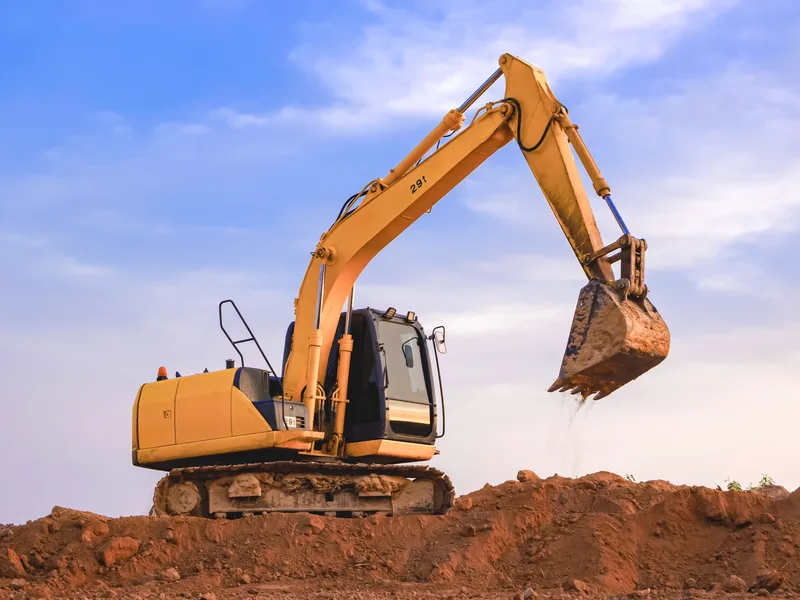
The strike is the loss that defines this class, and Louisiana adds a second one that arrives on its own: the trench that will not stand. Saturated banks slough, spoil piled on soft ground loads the wall it is standing on, and a machine working the lip can settle far enough to go over without anything dramatic happening first. Dewatering brings its own tail, because drawing the table down under a site pulls settlement into whatever is built beside it. Above ground, the familiar habits still apply — the swing catching what the operator cannot see, the load shifting on a float. And when a strike does happen in the industrial corridor, the consequential side of the claim is not an outage but a shutdown, an evacuation and an investigation, none of which are measured by the value of the machine that caused them.
Common Louisiana excavator claims we see
- Product-line or gas strike with corridor consequences. Evacuation, regulatory response and lost throughput, on a scale the excavator’s own value never approaches.
- Bank failure into an open trench. Saturated wall, spoil too close, shoring lost, and often the machine that was working the edge.
- Settlement damage from dewatering. The adjacent structure moves while the site is pumped down, and the claim belongs to the neighbor.
- Fiber cut on a shallow service. Modest repair, serious downstream loss, and a record that put the line somewhere it no longer was.
- Float and ramp damage on soft approaches. Loading off unimproved ground where the trailer sinks before the machine is secured.
Why Louisiana excavator owners choose Equipment Guard Insurance
Placing the equipment on its own is what lets the real conversation happen. Most submissions on this machine are priced as iron and a serial number, with the underground question waved toward whoever wrote the liability. We would rather start with the work — how deep, how close to live product, how much of your year is spent inside a corridor — and put the machine and that exposure in front of markets that read excavation on its merits. Those markets are named on our homepage. Nothing about the arrangement requires you to move a policy you are satisfied with.
Major Louisiana excavator markets
- New Orleans. The oldest and most congested subsurface in the state, worked in ground that holds water within a short reach of the surface.
- Baton Rouge. Capital-area build-out running alongside the heaviest concentration of industrial pipe in Louisiana.
- Lafayette. Energy-services and municipal work across Acadiana, where field infrastructure and town infrastructure meet on the same jobs.
- Lake Charles. Plant expansion and rebuild work behind fences, on sites where the marking picture is owner-controlled rather than public.
- Shreveport and Bossier City. Firmer northern ground, longer approaches, and a market that runs on regional site development rather than corridor work.
Related
- Excavator insurance — the machine physics that hold in every state.
- Dozer insurance in Louisiana — the machine judged by what leaves the site in the runoff rather than by what it meets underground.
- All equipment insurance in Louisiana — the state hub.
- Equipment floater · Rented & leased equipment
Primary sources
- La. R.S. 40:1749.13 — Louisiana 811 (dig notice and one-call)
- Types of Licenses — Louisiana State Licensing Board for Contractors (contractor licensing)
Louisiana excavator insurance FAQs
When does the Louisiana dig clock actually start running?
Not at the moment you phone it in. Notice must reach the notification center at least 48 hours and no more than 120 hours ahead, weekends and holidays excluded, and the waiting period is measured from 7:00 a.m. on the next working day after the call. A Friday afternoon call therefore buys nothing until Monday morning, and crews that schedule from the call rather than from the following working day lose the start they planned.
The marks were correct and the line had moved. Who carries that?
You do, in the first instance, and Louisiana produces this argument more than most states. Alluvial soil settles, subsides and floats things; a shallow service that was surveyed at one depth years ago may sit higher or lower than the record says, and a flexible line in saturated ground can drift laterally. Marks describe a horizontal position on the surface, never a depth guarantee, so the careful practice — soft excavation on approach, hand exposure before the bucket commits — is what stands between an accurate ticket and an expensive one.
Why does wet ground make an excavation loss worse here?
Because two claims arrive together. Saturated banks slough without warning and take the trench, the shoring and sometimes the machine sitting alongside it; the same water then makes the recovery slow, since a flooded excavation has to be dewatered before anyone can assess what happened. Add the settlement risk to adjacent structures when you draw water down, and a routine trench collapse in the coastal parishes turns into a property claim on the neighbor as well as an equipment claim on you.
Is a strike in the industrial corridor a different kind of claim?
Materially different. Between the river parishes and the Lake Charles industrial belt, buried lines carry product rather than natural gas alone, and the response to a breach is an evacuation, a regulatory investigation and a shutdown of everything the line feeds. The physical repair is the smallest number in the file. That is the exposure we write for deliberately, because a policy sized to the machine is not sized to the corridor the machine works in.
Does my contractor license change how you place the equipment?
It changes who is reading your paperwork. The state licensing board grades commercial and residential licenses by the size of contract a firm may take, which means the certificates you hand a general contractor here are being checked against a license class rather than taken on trust. Limits and endorsements that would pass unnoticed elsewhere get read closely, and it is worth having them right before the bid rather than during it.
Can the excavator go on its own policy?
Yes. Equipment Guard Insurance places equipment monoline throughout Louisiana, so the machine, its attachments and the underground question can be handled without disturbing the liability or comp you already carry.