

Missouri gives an excavating contractor one consistent thing and then takes consistency away everywhere else. The dig law is statewide. The licensing is not, the metro boundaries are not, and in the two markets that matter most the ordinary working radius crosses out of the state entirely.
This page deals with what that patchwork does to a crew running an excavator: where the ticket stops being valid, what changes when the machine moves between jurisdictions, and what soluble limestone does underneath all of it. The parts of the machine that behave the same in every state — swing and reach, undercarriage life, the attachments — are covered on the excavator insurance pillar.
What excavator insurance costs in Missouri
A premium figure printed on a page would be a guess dressed up as information, and the inputs that actually matter are not ones a page can see. What you take on leads: how much of the year runs through congested urban corridors, how deep the typical cut is, whether gas and fiber work is a normal part of your book, how much of the schedule sits over karst, and whether your machines cross a state line weekly. Then the unit itself — size, age, attachments, where it rests between jobs — and your record. A trenching crew in an older city block and a crew building pad on an Ozark hillside price differently because the work is different, not because the iron is.
Missouri excavator regulations: dig notice and the one-call duty
at least two working days, but not more than ten working days, before the expected date of commencing the excavation activity
The requirement is codified at Mo. Rev. Stat. § 319.026, inside the Underground Facility Safety and Damage Prevention Act at § 319.010 and following. The mechanics are conventional — a working-day floor, a working-day ceiling, a statewide notification center, an obligation on member operators to mark. What is not conventional is how quickly the rest of the regulatory picture stops being uniform. Missouri sets no statewide license for general contracting, so competence is vetted municipally and the requirements move when the machine does. The notification duty is bounded by the state line, so a metropolitan crew whose normal radius reaches into another state is starting a fresh obligation every time it crosses. And the marks themselves carry the same limits they carry anywhere: approximate locations of facilities the participating operators own, no survey, no warranty, and no transfer of what happens when a bucket finds something the record never held. On urban Missouri work, where a great deal of infrastructure predates careful mapping, that last limit is doing a lot of quiet work.
Common excavator risks in Missouri
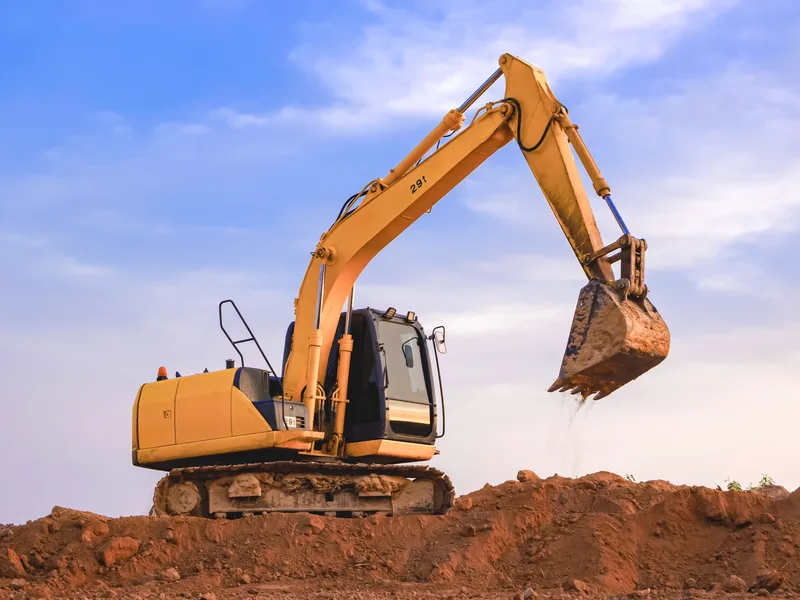
The utility strike leads, and the shape of it is familiar even where the setting is not: the excavator survives, and the invoice does not. Restoration, lost service to everyone fed by the line, an idle crew and a site closed until it is safe are the components, and on gas or fiber the third-party side runs far past the value of the machine. Missouri layers two of its own problems on top. The first is ground behavior — voids and seams in soluble rock that take support out from under a track or open a throat in the floor of a cut, with no warning and no locate to blame. The second is weather that arrives fast: a convective season that puts hail and straight-line wind over parked iron, and river-country flooding that can strand a machine on a site nobody can reach. Around those sit the constants, the trench-edge slide and the swing into something behind the operator, which the tight lots in both big markets keep supplying.
Common Missouri excavator claims we see
- Strike on an unrecorded line in an older city block. Both metropolitan cores are full of infrastructure laid before mapping was disciplined.
- Ground loss over karst. A void or seam that takes a track, drops a bench, or drains a trench in a direction nobody planned for.
- Work stopped on an out-of-date or wrong-jurisdiction ticket. The state-line and schedule-drift claim, which usually costs days before it costs anything else.
- Storm damage to parked equipment. Hail and wind reaching a machine sitting in a yard between jobs, which is a loss the schedule has to anticipate.
- Swing or trench-edge loss on a confined lot. The counterweight into a structure, or spoil stacked close enough to the lip to bring the wall down.
Why Missouri excavator owners choose Equipment Guard Insurance
Because nothing about this state is uniform, a placement built on assumptions goes wrong quietly. We write the equipment on its own so the questions get asked directly: which jurisdictions you work in, how often the machine crosses a border, how much of your year is inside live corridors, and what the ground under your typical job is actually made of. Then the machine and the underground exposure go to markets, named on our homepage, that will underwrite excavation deliberately rather than folding it into a generic contractor package. Nothing in that requires you to move liability or comp you already carry.
Major Missouri excavator markets
- St. Louis. The oldest and most layered subsurface in the state, where replacement work runs through generations of municipal infrastructure.
- Kansas City. A wide metropolitan footprint whose ordinary working radius crosses a state line, so jurisdiction is a daily question rather than an occasional one.
- Springfield. The hub of Ozark plateau work — shallow rock, sinkhole-prone ground and a lot of excavation that ends up being rock removal.
- Columbia. University and institutional build-out on constrained campus sites with live services running under everything.
- Jefferson City. Government and river-adjacent work, where the water table and older public infrastructure shape how deep anyone goes.
- St. Joseph. Industrial and agricultural-processing sites on the western river corridor, with long approaches and heavier site work.
Related
- Excavator insurance — the machine physics that hold in every state.
- Skid Steer insurance in Missouri — the machine whose state-line problem is a filing office rather than a locate.
- All equipment insurance in Missouri — the state hub.
- Equipment floater · Rented & leased equipment
Primary sources
- Missouri Revisor of Statutes - Revised Statutes of Missouri, RSMo Section 3… — Statewide notification center (dig notice and one-call)
Missouri excavator insurance FAQs
How much warning does a Missouri excavation need?
The notice belongs in a band rather than on a date — no fewer than two working days before the expected start, and no more than ten. The lower edge is the one crews respect and the upper edge is the one that bites, because a job pushed by weather or by an owner decision drifts out of the band quietly. Nothing tells you the ticket has aged; you simply find out afterwards that the excavation was not the one that was called in.
My crew works both sides of the state line. Does the ticket travel?
It does not. A notice is made to the system that serves the jurisdiction where the ground is, and the obligations it creates stop at the border. Kansas City and St. Louis both put a large amount of ordinary work on the far side of a line, so a foreman who called the Missouri notification center on Monday and moves the machine ten minutes west or east on Thursday is starting from nothing. It is a scheduling problem far more often than it is an ignorance problem, and it is the most common way a competent crew ends up digging on an invalid ticket.
Who licenses a heavy-equipment contractor in Missouri?
Nobody, at state level, for general contracting — the state registers particular trades and leaves the rest to local government. Kansas City, the City of St. Louis, St. Louis County, Springfield and Columbia each run their own requirements, so a contractor working a metro region can hold several credentials for what is functionally one market. For an owner or general contractor, that patchwork makes your certificates the steadiest thing in the file, which is a reason to make sure they say what you think they say.
What does karst ground do to an excavation?
It removes the assumption that solid means solid. Much of the state sits on soluble limestone and dolomite, which over time develops voids, seams and sinkholes that no locate ticket describes and no drawing predicts. A bucket can find a soft throat where the material simply goes, a bench can lose support under one track, and a trench can drain in a direction nobody expected. It is a ground-behavior exposure rather than a strike exposure, and it belongs in the conversation about how the machine is insured.
Does a valid ticket transfer the risk of hitting something?
No. What it produces is a duty on facility operators to mark approximate locations of what they own and record. It is not a survey, it is not a promise that every operator responded, and it says nothing about private service lines or about the older infrastructure both of the state’s large cities are full of. How the crew excavated around the marks is what determines the outcome, which is why the underground exposure is arranged deliberately rather than assumed to follow the machine.
Can you write the excavator by itself?
Yes. Equipment Guard Insurance places equipment monoline in Missouri, so the machine and its attachments sit on their own schedule and the underground question gets its own attention — with no need to disturb the liability or comp already in place.