

Almost every dig statute in the country gives a contractor a number to plan against. Montana gives one to the facility owner instead, and gives the excavator a condition: wait for the response. It is a small drafting difference that changes how a machine gets booked.
The second thing to understand is simpler and costs more. Out here the size of a loss is governed less by what broke than by how far the help has to come, so downtime is the exposure to plan for rather than an afterthought. Everything about this machine that is true regardless of geography lives on the excavator insurance pillar.
What excavator insurance costs in Montana
We do not publish a premium for this machine, and here the honest reason includes a factor most states do not have to weigh. Alongside the usual inputs — depth, proximity to live service, machine size and age, the attachments scheduled with it, where it sits unattended, your loss record — a Montana account gets priced partly on geography: how far your jobs sit from a service base, how much of the year they are reachable, and how long a machine would realistically be out of production after a failure. A contractor working inside one valley and a contractor whose jobs are scattered across open country are genuinely different risks with identical iron.
Montana excavator regulations: dig notice and the one-call duty
no fixed excavator advance-notice day count in statute; the excavator may not begin until receiving a positive response, and operators must locate and mark within two business days
Montana is a positive-response regime — 69-4-503 requires operators to ‘locate and mark the location within 2 business days’ (five business days for engineering locates) before excavation may proceed.
The section is published as the notification, locating and marking provision of the state code, and the practical effect of a positive-response regime is worth stating plainly: there is no window to run out, so there is also no moment at which silence gives you permission. If nothing comes back, you have not been released. What does come back describes the facilities the members hold records for — and in country where private water, irrigation and field infrastructure were laid by owners who never told anybody, that leaves a great deal unaccounted for. Neither the response nor the marks transfer the risk of what the bucket finds, and neither excuses a careless excavation around good paint. That gap is exactly what the underground side of an equipment account is written to sit against.
Common excavator risks in Montana
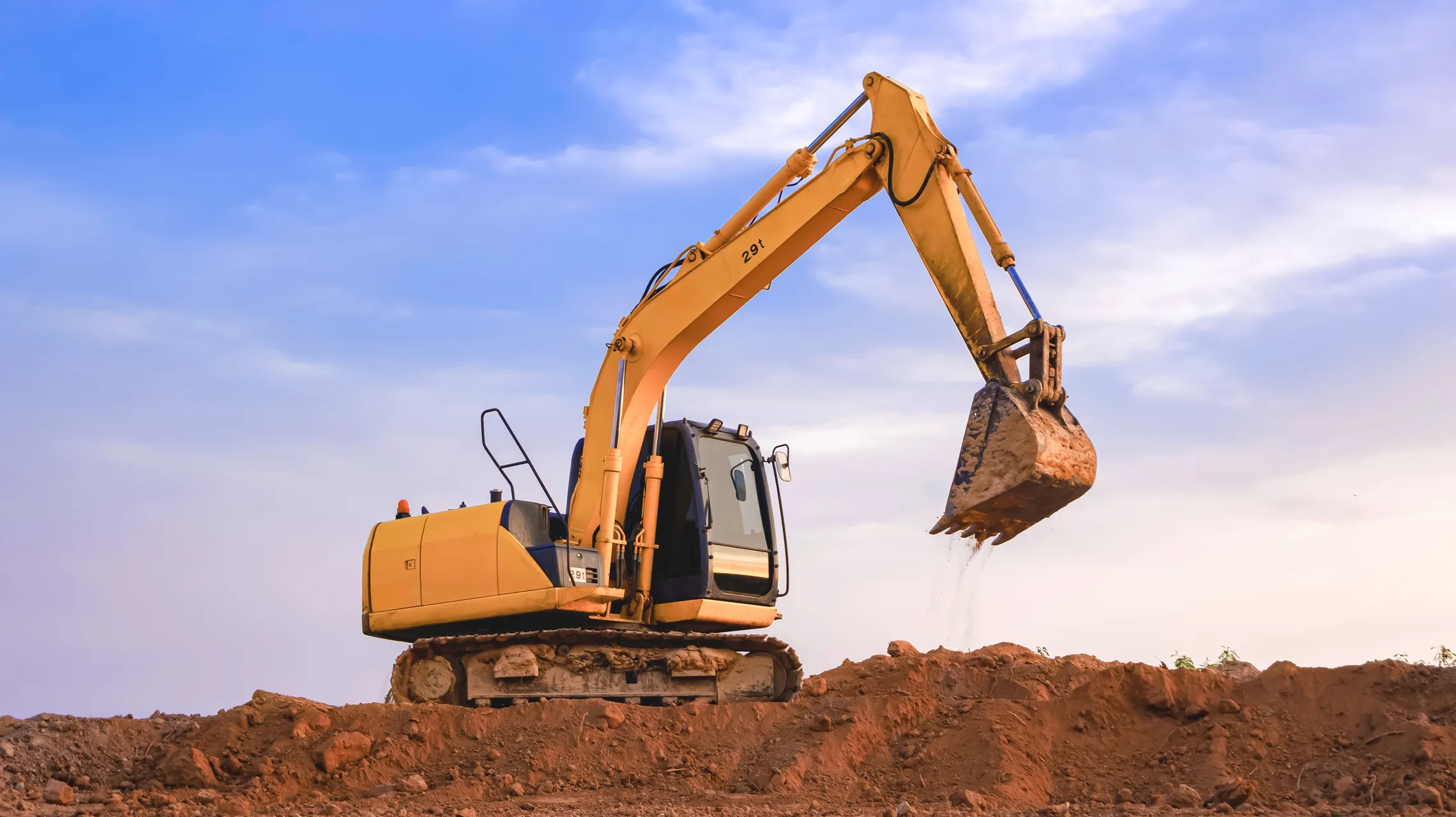
Two exposures share the top of the list here, which is unusual for this machine. The first is the strike, with its familiar upside-down economics — the excavator undamaged, the third-party bill enormous — made worse on rural ground by how much is buried without a record. The second is time. A machine down in open country stops earning immediately and keeps not earning while a technician, a part or a lowboy makes its way out, and the crew, the rentals and the client all keep costing money through the wait. Behind both sit the ordinary hazards, weighted for this terrain: a tip or slide on ground that has been softened by snowmelt, an approach road that will not carry a loaded trailer, a hard winter that closes the working season, and equipment standing unattended on sites where nobody drives past for days at a time.
Common Montana excavator claims we see
- Cut on an unregistered rural line. Irrigation, private service or field infrastructure that no notification system had ever heard of.
- Extended downtime after a failure in the field. The loss where the invoice for the repair is the smaller of the two numbers.
- Theft or vandalism on an unattended site. Machines and attachments left in open country between crew visits, sometimes for a week at a time.
- Roll or slide on an access route. Two-track and gravel approaches that hold in summer and give out after snowmelt or rain.
- Transit loss on a long haul. The trailer covers real distance on every mobilization, and the machine is exposed for all of it.
Why Montana excavator owners choose Equipment Guard Insurance
Most equipment policies are written as if a broken machine is a repair invoice. In this state it is a stalled job, and the terms that decide how badly it hurts — downtime, rental reimbursement, transit, where the unit is allowed to sit unattended — are exactly the ones a bundled placement tends to leave at default. We write the equipment on its own so those terms get set against the distances you actually work, and we treat the underground exposure as its own underwriting question rather than an assumption. The markets behind that are named on our homepage, and using them leaves your liability and comp untouched.
Major Montana excavator markets
- Billings. The largest construction base in the state and the supply point for energy and industrial work reaching far beyond it, where a job can be a full day’s round trip from the yard.
- Bozeman. The fastest build-out here, putting new service into ground that was agricultural within living memory and is not always documented as anything else.
- Missoula. Constrained valley and river-corridor work, where sites are tight, the water table is close and the older parts of town hide the usual surprises.
- Great Falls. Municipal, industrial and agricultural excavation on open ground, with irrigation infrastructure that predates most of the records covering it.
- Butte and Helena. Historic mining and capital-city ground, where abandoned works and long-superseded utility are a routine finding rather than a surprise.
- Kalispell. Mountain resort and second-home construction on steep access, with the shortest working season and the slowest recovery when a machine goes down.
Related
- Excavator insurance — the machine physics that hold in every state.
- Backhoe insurance in Montana — the machine that has to justify itself to the vehicle code every time it leaves the yard.
- All equipment insurance in Montana — the state hub.
- Equipment floater · Rented & leased equipment
Primary sources
- 69-4-503. Notification -- locating and marking, MCA — notification center (dig notice and one-call)
Montana excavator insurance FAQs
How many days ahead am I supposed to call?
There is no fixed excavator day count in the statute, which surprises people who have worked in states that publish one. What the law establishes instead is a response: you may not begin until you have received a positive response, and operators are required to locate and mark within two business days, or five where an engineering locate is involved. The practical consequence is that you cannot schedule a start date with confidence from the calendar alone — the start is defined by an answer arriving, not by a clock expiring.
What is a positive response and how does it change the way I plan?
It is confirmation back to you that a facility owner has dealt with your notice — marked, cleared, or otherwise resolved. Under a countdown regime a crew can book the machine for the morning after the window closes and be roughly right. Under a response regime the machine is committed to a job that has not been released yet, which is why the good operators here manage a queue of open tickets rather than one at a time, and why a mobilization that turns out to be premature is a real and recurring cost.
Why does distance matter more here than the repair bill?
Because a broken machine on a job a long way from anywhere is not a repair problem, it is a schedule problem. A technician has to travel, parts have to travel, and if the unit cannot be fixed in place a lowboy has to make the trip in both directions. Meanwhile a crew, a rented pump and a client are all waiting. That is the reason we push hard on the downtime and rental-reimbursement side of an equipment floater here rather than treating it as an optional extra — in this state it is frequently the larger half of the loss.
What is buried out in open country that a locate will not find?
More than the marks suggest. Gathering lines and old field infrastructure, irrigation mains, private water and power runs to outbuildings, and service laid by owners who never registered it with any notification system are all common on rural ground and all outside the marking obligation, because nobody holds a record to mark from. The response you receive describes what the members know about. It is not a survey of the ground, and on open country the difference between those two things is at its widest.
Does the registration I hold say anything about my competence?
Not really. Contractor status here is tied to registration built around workers’ compensation rather than to a competency examination, so nothing in the credential attests that you can run a machine safely near a live line. That puts the weight back on what an owner can verify independently — your certificates, your schedules and your record — which is a good argument for having those documents be accurate and current rather than approximate. We are not linking a source for the registration position, because we have not cleared a current document that states it in full.
Will you insure just the excavator?
Yes, and it is the way we prefer to work. Equipment Guard Insurance places equipment as its own line, so the machine, the buckets, the thumb and anything else riding with it sit on a single schedule, with the downtime and transit terms set to match the distances you actually cover. Nothing else in your program needs to move for that to happen.