

Most of the excavating disputes that turn ugly in this state come down to one of two moments: a crew that decided its problem counted as an emergency, or a bucket that met ground harder than the estimate assumed. Neither is really about the machine, and both end up on an insurance schedule.
What follows is the local version of the excavation question — the notice regime and the single lawful way past it, what the contractors board means for how you are seen, and what caliche and summer heat do to the equipment. Everything true of the machine anywhere, from swing and reach to undercarriage economics, sits on the excavator insurance pillar.
What excavator insurance costs in Nevada
The premium on this machine is a description of your work far more than of your iron, so a page-level number would be fiction. What actually drives it: whether you are trenching in a resort corridor beside services that cannot go down, cutting pads on desert ground, or supporting mine work hours from the yard; how deep you go; the size and age of the unit; the attachments scheduled with it; where it sits overnight; how far it travels; and the claims behind you. We would rather build that picture and take it to a market than publish a range and let you discover it does not describe you.
Nevada excavator regulations: dig notice and the one-call duty
Emergency excavation is excepted where delay risks loss of life, health, or property.
The rule lives in the excavation chapter of the state statutes, and its bones are simple enough to state once: at least two working days ahead, and no more than twenty-eight calendar days before the work is scheduled to start, with notice going through the regional notification association that serves this state. The part that repays attention is the exception. Emergency excavation is excepted where delay would risk loss of life, health or property — a narrow provision written for gas leaks, water main failures and situations where waiting is itself the danger. It is not a mechanism for a job running behind, and a crew that treats it as one has created its own evidence problem. Note also what the exception does not touch: it lifts the waiting period, not the duty of care. Nor does an ordinary ticket move much risk. Marking is an obligation on the facility owners, not a warranty to you, and the way the crew dug around what was painted is what decides the outcome when something is hit.
Common excavator risks in Nevada
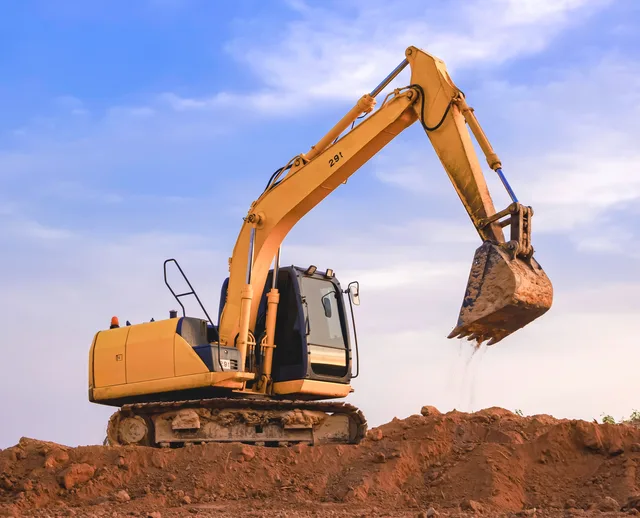
The strike remains the loss that changes an account, and the resort and gaming corridor gives it an unusual accent: the property above the trench often runs continuously, so an interruption is not a quiet afternoon of inconvenience but a business losing revenue by the hour while the repair proceeds. Cemented ground supplies the second exposure. Caliche loads a machine hard, encourages forcing the boom, and produces trench walls that look self-supporting until they fail in slabs rather than sliding gently. Heat is the third — hydraulic temperature, operator fatigue, and long summer days where the productive window is early and the pressure to keep going is not. Behind those sit distance and exposure: units working out of remote sites in mining country, parked where nobody is watching, and hauled long distances between jobs.
Common Nevada excavator claims we see
- Service strike beneath a property that never closes. Interruption measured by the hour, against a machine that may not be scratched.
- Emergency dig gone wrong. A crew that skipped the wait on a judgment call that did not survive review afterwards.
- Structural and attachment damage in caliche. Cemented ground met at production pace, showing up in sticks, cylinders and bucket edges.
- Slab failure of a trench wall. Hardpan that stood up beautifully until it came away in one piece.
- Loss on a remote site or a long haul. Theft, vandalism and transit damage on jobs hours from the nearest yard.
Why Nevada excavator owners choose Equipment Guard Insurance
In a state that screens contractors properly, the license you hold and the certificates behind it are read together, and a placement assembled carelessly undercuts a credential you worked to get. We write equipment as its own line — the schedule reflects the machines and attachments actually in service — and we spend the underwriting conversation on the excavation rather than on replacement cost alone, including the questions about emergency work and corridor exposure that markets rarely get asked properly. Those markets are named on our homepage, and none of this asks you to move liability or workers compensation that already fits.
Major Nevada excavator markets
- Las Vegas. Corridor work under properties that operate around the clock, where any outage is a revenue event for somebody.
- Henderson. Master-planned expansion straight into caliche shelf, with production estimates that live or die on it.
- North Las Vegas. Distribution and industrial pads with long linear utility runs across open desert ground.
- Reno. Industrial and technology build-out east of town, on grade and rock with heavy service infrastructure.
- Sparks. Rail-served warehouse district, where older industrial services underlie newer development.
- Elko. Mine-support and civil work far from anywhere, with machines living on site between visits.
Related
- Excavator insurance — the machine physics that hold in every state.
- Skid Steer insurance in Nevada — the compact machine whose worst night is somebody driving it off the site, not somebody hitting a line with it.
- All equipment insurance in Nevada — the state hub.
- Equipment floater · Rented & leased equipment
Primary sources
- NRS: CHAPTER 455 - EXCAVATIONS AND HIGH-VOLTAGE LINES — the appropriate association for operators (dig notice and one-call)
- License Classifications — Nevada State Contractors Board (NSCB) — Nevada State Contractors Board (contractor licensing)
Nevada excavator insurance FAQs
What are the outer edges of the notice window?
At least two working days ahead, and not more than twenty-eight calendar days before the excavation or demolition is due to begin. The outer limit is unusually generous and it is measured in a different unit from the inner one, which is where the mistakes come from. A ticket taken far in advance for a job that then slips can quietly age past the back edge, and the request has to be made again rather than stretched.
When can I dig before the waiting period is over?
Only in a genuine emergency — the statute excepts emergency excavation where delay would risk loss of life, health or property. That is a narrow door and it is not a schedule remedy. A crew behind on a milestone, a supplier who arrived early, an owner leaning on the superintendent: none of those is an emergency, and treating them as one is exactly the decision that gets examined later. When the exception really does apply, notify as fast as the situation allows and document the condition that made waiting unsafe.
Does the exception also excuse how carefully I have to dig?
No, and the distinction matters more than anything else on this page. What the exception relieves is the waiting, not the standard of care. You still owe careful excavation around whatever is down there, and a strike made under emergency conditions is judged on method exactly as any other would be — arguably more closely, since the crew was working without the marks a normal ticket would have produced.
How seriously does the state take contractor licensing?
Very. Licensing runs through the State Contractors Board in three categories — general engineering, general building and a long list of specialty classifications — and the license carries limits tied to the financial capacity you have demonstrated. That makes your classification and your limit a public statement about the size and kind of work you can take. It is one of the few states where a general contractor checking you out learns something real before ever asking for a certificate.
What does the ground do to the machine here?
Caliche is the local answer: a naturally cemented hardpan layer that behaves closer to weak concrete than to soil. It slows a trench badly, wears teeth and bucket edges, loads the boom and the stick when an operator leans on it, and produces a spoil that does not backfill kindly. Then heat compounds it — sustained summer temperatures push hydraulic and cooling systems hard, shorten what a crew can safely do in an open excavation, and move real production into the early hours.
Can you place just the excavator?
Yes. Equipment monoline is what Equipment Guard Insurance does, so the machine and its attachments sit on their own schedule and the underground exposure is addressed alongside, with nothing required of the liability or workers compensation you already carry.