

Ask a site contractor here what goes wrong and the first answer is rarely a utility. It is ledge — rock found at a depth the estimate did not allow for, boulders stacked through the till, and a machine that spends the season hammering instead of digging.
That does not make the underground exposure smaller; it makes it sharper, because a bucket already fighting stone gives an operator very little warning about anything else it meets. What follows is the notice regime, the ground, and where those two things intersect for an excavating business in this state. For the material that holds wherever the machine works — reach and tail swing, undercarriage, the attachment ecosystem — see the excavator insurance pillar.
What excavator insurance costs in New Hampshire
You will not find a number on this page, because the inputs that move it are not visible from here. The biggest one is the material you work in: an operation that breaks rock most weeks puts a different kind of wear and a different kind of attachment schedule in front of an underwriter than one shaping loam. After that come proximity to live services, unit values and the breakers and thumbs riding with them, how the fleet travels between scattered small jobs, where it sits over the winter, and your record. Rock moves the machine side of the price; congestion moves the liability side.
New Hampshire excavator regulations: dig notice and the one-call duty
Dig Safe takes the call, and the statute sets the span: at least 72 hours (excluding Saturdays, Sundays and legal holidays) but not more than 30 days before excavation.
The obligation itself is set out in the excavator notification section of the Revised Statutes, and two features of it deserve more attention than the day count. First, the center taking your call is a regional body covering several New England states, so a single familiar phone number sits in front of several different legal regimes — the number travels, the rules do not. Second, the outer limit is long by national standards, which is administratively kind and physically irrelevant: marks degrade on their own schedule, and a faded stripe in a gravel shoulder after several weeks of weather is not a located facility. What the notification buys is a duty on the facility owners to come out and mark. It does not warrant the marks, it does not reach lines nobody recorded, and it does not touch your own obligation to dig carefully around what was painted. In ground where the rock forced installers shallower than the drawing assumed, that last obligation is doing more work than crews realize.
Common excavator risks in New Hampshire
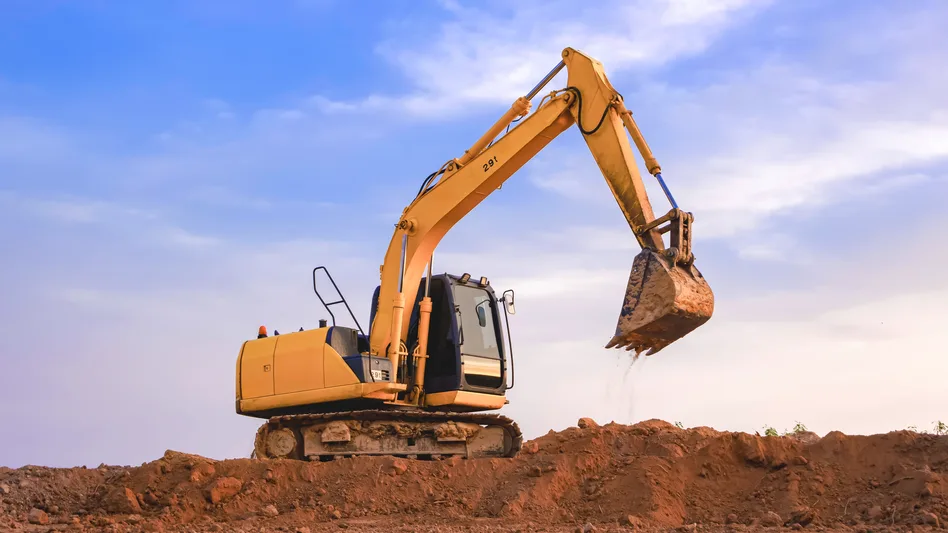
Two exposures dominate and they pull in opposite directions. The strike is the severe one: a cut gas service, water main or fiber run brings restoration, an outage that reaches people who never hired you, and a site standing idle — a loss whose size has nothing to do with the machine. The rock is the frequent one. Sustained hammer and breakout work fatigues booms, sticks and pins, batters the undercarriage on abrasive till, and produces the steady stream of mechanical and impact losses that actually shape an equipment loss ratio in this state.
Around those, the ordinary hazards take on a local accent. Steep, narrow approaches to hillside and lakeside lots make transport and unloading genuinely risky. Freeze and thaw moves shallow facilities and collapses trench walls that stood fine in October. And the working year is compressed enough that machines sit idle through months of winter at whichever site they finished on, which is a storage question long before it is a theft claim.
Common New Hampshire excavator claims we see
- Shallow service struck in rocky ground. A line installed as deep as the ledge allowed, found by a bucket already loaded against stone.
- Boom, stick or pin damage from sustained breaking. The characteristic mechanical claim where hammer work is a weekly routine rather than an exception.
- Undercarriage wear and impact on abrasive till. Distinct from the wear a floater will not pay for — the sudden version, from a boulder nobody saw.
- Transport loss on a steep or narrow approach. Loading and unloading on hillside and lakeside driveways with no room to work.
- Frost-heave trench failure in spring. A wall that held through the fall giving way once the ground let go.
- Winter layup theft of attachments. Breakers and buckets taken from a unit parked at a closed site until spring.
Why New Hampshire excavator owners choose Equipment Guard Insurance
Rock work makes brokers nervous, and nervousness usually shows up as a worse placement rather than an honest conversation. We would rather ask what the ground is actually like, how much of the year is spent breaking, what attachments live on the machine and where the units sleep between jobs — and then place the iron on its own, monoline, so nothing else in your program has to be renegotiated to fix a schedule. The excavation liability gets its own attention rather than a paragraph, through markets named on our homepage that will read a New England site contractor on the record it has rather than on the material it digs.
Major New Hampshire excavator markets
- Manchester. The state’s largest concentration of urban excavation, with older mill-era service beneath a working street grid.
- Nashua and the southern tier. Cross-border commuting work where crews move between two states and two rule sets in the same week.
- Concord. State, institutional and municipal replacement work — steady, close to live services, and often on lots with no room around the machine.
- Portsmouth and the Seacoast. Coastal redevelopment on a high water table, where trench dewatering and adjacency to occupied buildings drive the losses.
- Dover and the Strafford corridor. Residential and commercial site development pushing into ledge that was left undeveloped for a reason.
- Derry and the I-93 corridor. Fast subdivision and commercial growth on till and boulder ground, with heavy breaker use on ordinary utility work.
Related
- Excavator insurance — the machine physics that hold in every state.
- Skid Steer insurance in New Hampshire — the compact machine whose exposure is a filing office and a night-time yard rather than the ledge underneath it.
- All equipment insurance in New Hampshire — the state hub.
- Equipment floater · Rented & leased equipment
Primary sources
- Section 374:51 Notification by Excavator. — Dig Safe System, Inc. (dig notice and one-call)
New Hampshire excavator insurance FAQs
Who takes the notification call, and is it a New Hampshire body?
It is a regional notification center serving several New England states rather than a state-run system. That is convenient for anyone working across the border and quietly hazardous for the same person, because one phone number does not mean one rule set — the notice period, the exclusions and the marking obligations are each state’s own. A crew that carries a Massachusetts habit north, or a New Hampshire habit south, is relying on a memory of the wrong statute.
The outer limit here is unusually generous. Is that useful?
Less than it looks. A long ceiling means a ticket pulled well ahead of mobilization is still technically alive when you arrive, which helps a scheduler. It does nothing about the marks themselves: paint fades, stakes get knocked out, weather and traffic erase them, and a mark nobody can see is worth precisely nothing when the bucket goes in. Treat the outer limit as an administrative convenience and the condition of the marks as the real question.
How much does the rock actually change things?
It changes the whole shape of the job. Shallow bedrock and boulder-laden glacial till mean a trench that would be routine elsewhere turns into hammer work, and the machine spends its life absorbing shock rather than moving soil. That loads the boom, the stick pins, the undercarriage and the hydraulics, it turns a breaker into a permanent fixture on the schedule rather than an occasional rental, and it means the difference between the ground you bid and the ground you found is a live commercial risk on every job.
Does hitting rock change the strike exposure too?
Yes, and not in the direction people expect. A machine committed hard into resistant material gives the operator far less warning: the same hesitation that says "something is there" gets lost in a bucket already fighting ledge. Utilities in rocky ground are also often shallower than a plan implies, because whoever installed them went as deep as the rock allowed rather than as deep as the standard suggested. Shallow and hard is a worse combination than deep and soft.
There is no state contractor license. What do owners look at instead?
Your documents and your reputation. Only specific trades are licensed at the state level, general contracting requirements are left to towns, and there is no statewide competency credential for excavation work. That places unusual weight on what your certificates say, how your equipment schedule reads, and whether the limits line up with the job — because for a general contractor vetting you, that paperwork is most of the objective evidence available.
Can you write the iron on its own?
Yes. Equipment Guard Insurance handles equipment as a standalone placement in New Hampshire, which means the excavator, the breaker and the buckets are scheduled properly and the excavation liability is dealt with next to them. Nothing has to move on the liability or comp you already carry.