

The awkward thing about excavating in New York is not the rule. It is that the rule, the license and the enforcement each come from a different place — two notification centers across the map, a utility commission holding the penalty end, and a city hall deciding whether you were entitled to bid the job.
For a contractor that fragmentation is where the surprises live, and it is a different problem from the one the machine itself presents. Below is how the layers fit together, what a notification genuinely does for you, and where the losses on this class actually come from in a state that has been digging up its own streets for two hundred years. The equipment-level material — reach, tail swing, undercarriage, the attachments — is on the excavator insurance pillar.
What excavator insurance costs in New York
A premium here is mostly a statement about geography and work type rather than about iron. A unit that spends the year in a Manhattan street among live service, protected structures and night restrictions is not the same risk as the same unit on a Southern Tier site job, and no rate table pretends otherwise. What underwriters weigh is depth, adjacency to live facilities and neighboring buildings, the mix of street versus open ground, the size and value of the units and their attachments, where they are stored between jobs in a market with limited yard space, and the record behind the operation.
New York excavator regulations: dig notice and the one-call duty
The rule itself is short: notice at least 2 but not more than 10 working days before commencement.
Our data records the governing reference as the Public Service Commission’s underground damage prevention rule. We name it and we do not link it, and the reason is worth stating plainly: the source we hold refuses automated requests, so we have not opened and read it ourselves, and this page cites only documents we have. We will not describe a document we could not open, and we will not dress an unverified link up as a citation. What we can say is what the ledger records, above. Around it sit three facts that shape the work more than the count of days does. Notification goes to one of two centers depending on territory, so the first question on a new job is which system covers this ground. The enforcement end is held by a utility regulator, which is why damage events feed a regulatory record rather than evaporating into a private argument. And the notification transfers nothing — it obliges the facility owners to respond, and it leaves the duty of care in the ground, and the whole unrecorded category, exactly where it was: with you.
Common excavator risks in New York
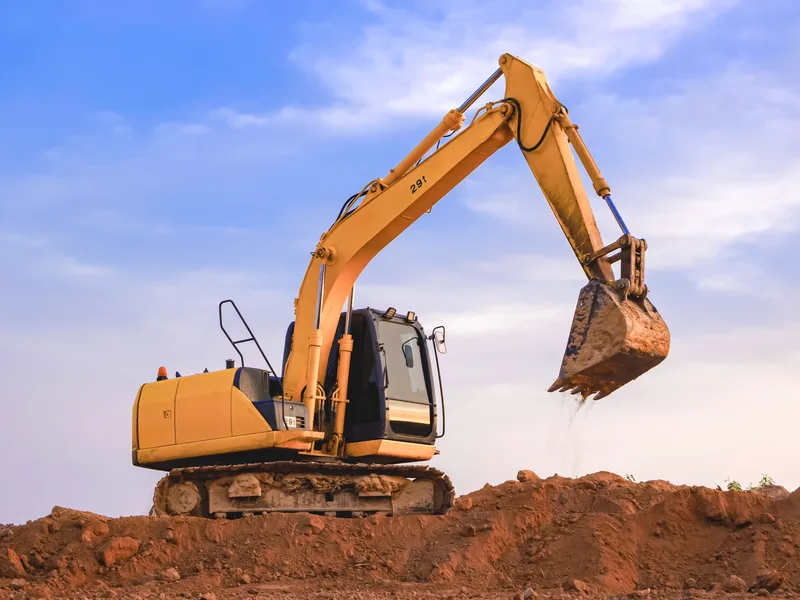
The strike remains the loss that dwarfs everything else, and New York gives it two extra dimensions. One is age: layer upon layer of service laid, abandoned, re-routed and occasionally forgotten, so the marks can be correct and the ground still holds something nobody drew. The other is consequence — a cut feeder or fiber trunk in a dense district takes out businesses by the block, and the interruption side of that claim has no relationship at all to the value of the machine holding the bucket.
Adjacency is the second exposure, and in the downstate markets it is nearly as expensive. Excavation beside an occupied building brings undermining, settlement and vibration claims that arrive weeks after the crew has gone. Then the ordinary machine losses: the slide at an unsupported edge, the tail swing into shoring or a vehicle, and — a genuine New York category — damage during delivery and setup, because getting a tracked unit onto a constrained urban site is a hazardous operation in its own right.
Common New York excavator claims we see
- Feeder or fiber strike in a dense district. Restoration plus interruption across a whole block, on an undamaged machine.
- Undermining or settlement next door. The adjacency claim: cracking and movement in an occupied neighboring structure, reported late.
- Strike on an abandoned or unrecorded line. The marks were right; the ground was older than the record.
- Damage during delivery and setup. Loading, walking and positioning a unit on a constrained urban lot.
- Tail-swing contact with shoring or a vehicle. The counterweight finding the one thing behind the operator on a narrow street.
- Winter idle-period loss upstate. Theft or damage on a unit sitting through a long layup at a remote site.
Why New York excavator owners choose Equipment Guard Insurance
Where no single credential settles the question of whether you should be on a job, your documents do the arguing — and a schedule assembled carelessly is a bad argument. We write equipment as its own line, so getting the machine placement right does not mean disturbing liability or comp arranged around work you already hold. And we treat the excavation liability as a subject rather than an afterthought: what you dig, how close, beside what, and under whose enforcement. The markets we use are named on our homepage, and they will look at a New York excavation account on its own record instead of its zip code alone.
Major New York excavator markets
- New York City. The densest and oldest subsurface in the country, with adjacency claims, night work and permit constraints stacked on top of the strike exposure.
- Buffalo. Legacy industrial ground and sustained utility replacement, with a lake-driven season that compresses the outdoor working year.
- Rochester. Institutional, campus and municipal work over an established grid where the record and the reality were laid down in different centuries.
- Syracuse. A crossroads market with heavy highway and interchange work, so the machines are larger and the alignments run beside live transmission.
- Albany and the Capital District. State and institutional build-out on constrained downtown sites, with steady replacement work rather than greenfield volume.
- Yonkers and lower Westchester. Redevelopment on ground already built once, where the tail-swing and adjacency exposures dominate the trench itself.
Related
- Excavator insurance — the machine physics that hold in every state.
- Backhoe insurance in New York — the machine that meets New York at the curb and on the highway rather than below the street.
- All equipment insurance in New York — the state hub.
- Equipment floater · Rented & leased equipment
Primary sources
- CONSUMER ALERT: NYS Department of State's Division of Consumer Protection Provides New Yorkers with Tips for Avoiding Home Improvement Scams — No statewide licensing agency — the New York Department of State does not license contractors; licensing is by local jurisdiction (e.g., NYC Department of Consumer and Worker Protection and various counties). (contractor licensing)
We do not link a New York dig-notice section here. The notice duty described above follows New York’s own one-call statute as our data layer records it; where the state publishes a document that states it directly, this page links it.
New York excavator insurance FAQs
Why are there two one-call centers, and which one do I notify?
New York is served by two separate notification centers rather than one statewide system, split by territory. For a contractor who works one region that is a non-event; for one chasing work across the state it is a live operational question, because "we called it in" is only true if the call went to the center that covers the ground you are standing on. Confirm coverage before mobilizing rather than at the trench, and keep the ticket reference where a claims adjuster can find it a year later.
Who actually enforces the dig rule here?
The Public Service Commission does — a utility regulator, not a construction or contractor authority. That is more than a trivia point. It means the framework was built around protecting the facility network, that facility owners are regulated participants in it rather than bystanders, and that damage reporting flows into a regulatory record rather than staying a private dispute between two contractors. Your conduct at a dig site becomes part of somebody’s compliance file.
Does the notification put the risk of a strike onto somebody else?
It does not, and no state makes it do that. Notifying obliges the facility owners to respond and mark; it certifies nothing about completeness, nothing about accuracy under the paint, and nothing about the lines laid before anyone was recording them. In a state that has been building continuously for two centuries, the unrecorded category is not an edge case. What decides the file is how the excavation proceeded around the marks, and that is a liability question sitting beside the machine rather than inside its schedule.
There is no statewide contractor license. Does that make things easier?
It makes them less predictable. Licensing sits with cities and counties rather than the state, and New York City runs its own regime, so an outfit working from one jurisdiction into the next may find the vetting requirements change with the town line. The practical consequence for insurance is that your certificates and your schedule end up carrying more evidentiary weight than they would in a state with one license class, because there is no single credential that answers the question for everybody.
What makes New York City excavation different from the rest of the state?
Density and adjacency. The subsurface is layered with generations of service in a corridor barely wide enough for the machine, the neighboring structures are close enough that vibration and undermining are live claims of their own, and the work is often nocturnal and permit-constrained. Add street-level protections, traffic control and the sheer difficulty of getting a unit in and out, and the transit and setup portions of the job carry real loss frequency before anything is dug.
Can the equipment be written without moving everything else?
Yes — that is how we prefer to do it. Equipment Guard Insurance writes equipment monoline in New York, so units and attachments sit on their own schedule and the underground liability question is worked through alongside them rather than used as a reason to re-bid your whole program.