
The rule most crews here quote is the two-day locate period. The rule that decides claims is the one about distance: a mark is the middle of a band, not the edge of one, and the machine is expected to stop well before the paint.
That discipline is easy to describe and hard to hold on a bid where every hour matters, in a state where a lot of the work happens where nobody is watching. This page is about the regime and about what it is like to run this machine in a place with real distance and a real winter in it. The parts of the story that belong to the excavator wherever it goes — reach and tail swing, undercarriage, the attachment ecosystem — are on the excavator insurance pillar.
What excavator insurance costs in North Dakota
We will not print a rate, and on this state the honest reason is that two North Dakota operations with identical machines can sit in different worlds. Municipal trenching in a valley city and pad-and-pipeline work in the oil counties differ in what a contact event releases, in how far a unit sits from a yard, and in how long a loss goes unnoticed. Underwriters weigh the work mix first, then unit values and attachments, storage and overwintering, distance from the base of operations, and your record — and only then do the model numbers on your schedule matter much at all.
North Dakota excavator regulations: dig notice and the one-call duty
Operator positive-response duty and a two-foot tolerance zone on each side of the facility.
The chapter behind that sits in Chapter 49-23 — One-Call Excavation Notice System, and it is worth separating what it gives you from what it asks of you. What it gives is a response: operators owe an answer, so an unmarked site is not left ambiguous. What it asks is restraint. Because the mark is the center of a two-foot band on each side rather than a line over the pipe, the machine is supposed to stop short and the last distance is opened by careful means — and that is where production pressure and the rule meet head on. None of it moves the risk off you. The notification discharges an obligation on the facility owners; the duty to excavate carefully inside and around that band stays with the contractor, and so does everything the record never held. On the gathering infrastructure common in the west, the cost of getting that wrong is not measured in a repair.
Common excavator risks in North Dakota
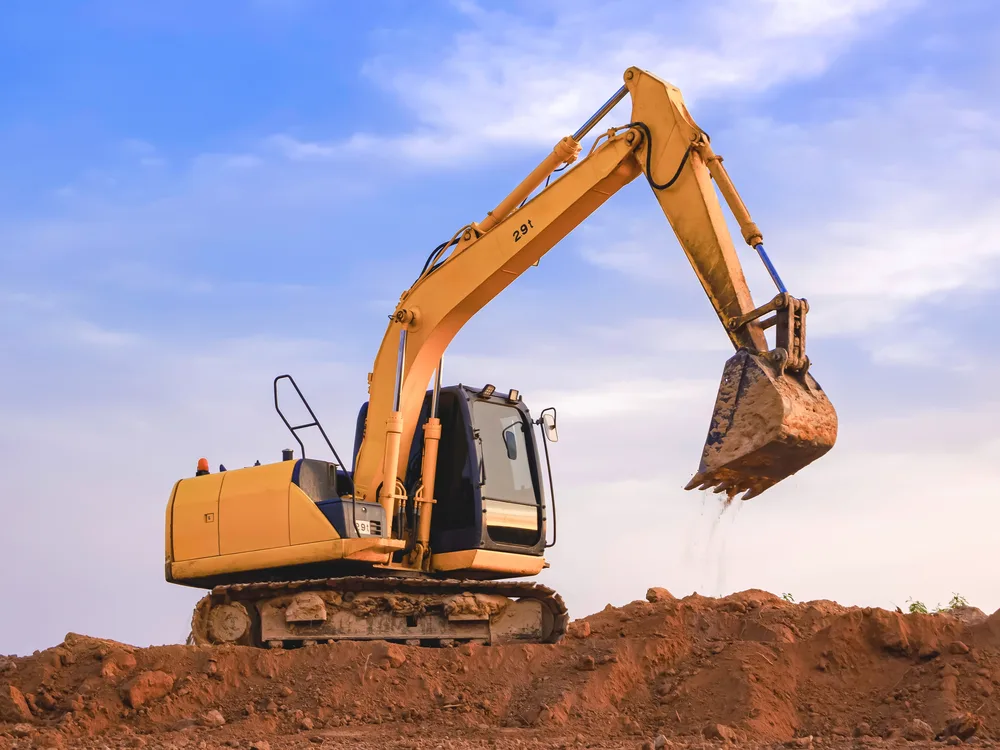
Contact with a pressurized facility is the exposure that reorganizes an account, and North Dakota raises its severity rather than its frequency. In open country the machine may be nearly undamaged while the event becomes a release, an emergency response and an investigation, with third-party consequences that have no relationship to the price of the excavator. Municipal work carries the more familiar version — the cut service line, the restoration bill, the block without power or fiber, the site shut down until it is safe.
Then there is distance and weather, which shape the equipment side. Units work far from the yard, so a theft or a vandalism loss can be days old before anyone knows, and recovery of a stranded machine is its own expense. Extreme cold is a peril in its own right: hard starts, brittle components, hydraulic failures and the operator errors that come with short daylight. Frost concentrates a year of work into a compressed season, which pushes crews to dig frozen ground where a bucket reads badly, and then leaves the fleet parked for months wherever it finished.
Common North Dakota excavator claims we see
- Contact with a pressurized gathering line. The severity claim of this state — release, response and investigation on a machine that will start again tomorrow.
- Service strike inside the tolerance band. The paint was found and the machine did not stop soon enough.
- Cold-weather mechanical loss. Hydraulic and component failures on units worked through deep cold, and the damage that follows a hard start.
- Overwinter theft or vandalism at a remote site. Discovered in spring, on a unit nobody had visited since the ground froze.
- Trench-wall failure in saturated valley soil. Spring conditions in the Red River valley working against an undercut edge.
- Transport and recovery damage over long distances. Loading, hauling and extracting units across a state where jobs are far apart.
Why North Dakota excavator owners choose Equipment Guard Insurance
Energy-adjacent earthwork is exactly the kind of account a generalist placement handles badly — either by pricing it as ordinary dirt work or by declining it on the word "oilfield" without asking what the crews actually do. We would rather ask: how much of the year is spent in the west, how close to pressurized facilities, how far from the yard, and where does the iron sit when the ground is frozen. Then we write the machines on their own, monoline, and take the underground liability seriously as a separate subject — through the markets named on our homepage, none of which requires you to hand over the rest of your program to get there.
Major North Dakota excavator markets
- Fargo. The largest concentration of municipal and commercial trenching in the state, with saturated valley soils working against every open excavation.
- Bismarck and Mandan. Capital-region institutional and utility replacement, where older buried service and steady public work meet.
- Grand Forks. Campus, flood-protection and municipal infrastructure work on flat, wet ground with a short outdoor season.
- Minot. A staging point between the valley and the oil counties, so fleets here mix city work with long moves west.
- Williston. The heart of the oilfield exposure — pad construction, facility work and earthmoving alongside pressurized gathering infrastructure.
- Dickinson. Energy-driven site development at distance from any large yard, where an unattended unit is genuinely unattended.
Related
- Excavator insurance — the machine physics that hold in every state.
- Backhoe insurance in North Dakota — the machine that spends its exposure on the long hauls between scattered sites rather than in the trench.
- All equipment insurance in North Dakota — the state hub.
- Equipment floater · Rented & leased equipment
Primary sources
- Chapter 49-23 — One-Call Excavation Notice System — North Dakota One-Call, Incorporated (dig notice and one-call)
- Contractors — North Dakota Secretary of State (contractor licensing)
North Dakota excavator insurance FAQs
What is the tolerance zone, and what does it change on site?
North Dakota does not treat a mark as a precise location. It puts a band of two feet on each side of the facility, and inside that band the machine is not the right tool — the ground gets opened carefully, by hand or by soft methods, until the line is seen. Crews who read the paint as the pipe rather than as the middle of a zone are the ones who make contact, and an operator who insists on that discipline in a competitive bid is protecting more than the pipe.
What does the positive-response duty give me?
Confirmation rather than silence. The operators owe a response, so instead of guessing whether a non-appearance means "no facilities" or "nobody read the ticket", you get an answer to work from. It does not make the answer a guarantee. It tells you an obligation was discharged; it does not certify that everything down there was located, that the record was complete, or that an abandoned line ever made it onto anyone’s map.
Is oilfield work really a different exposure from municipal digging?
Materially, yes. Bakken activity puts earthmoving crews alongside high-pressure gathering infrastructure in open country — lines running between wells and facilities, sometimes on private ground, sometimes newer than the last plan anyone looked at. The consequence of contact there is not a repaired water main and a wet street. It is an energy release, a release of product, and an incident investigation, which is why we ask directly whether oilfield work is in your mix rather than treating all excavation as one class.
How does the winter actually affect the policy conversation?
It moves it from operations to storage. Frost drives the working year into a compressed stretch, and outside it a significant part of the fleet sits — often at the last job rather than at a yard, because dragging units back across the state is expensive. So where machines overwinter, whether anyone visits them, and how they are secured are questions we ask before binding. Extreme cold also does its own damage: hydraulic and cold-start failures, cracked components and the losses that follow a unit worked hard at temperatures that make steel brittle.
Does the Secretary of State contractor license affect how I am underwritten?
It affects the paperwork more than the pricing. The state licenses contractors in classes tiered by the value of the work, so unlike states with no license at all, there is a public credential that says what scale of job you are entitled to hold. Owners and general contractors here check it. Keeping the class consistent with the schedule you actually run avoids the awkward conversation where your license says one thing and your equipment list says another.
Will you write just the machines?
Yes, and it is the normal shape of what we do. Equipment Guard Insurance places equipment as a standalone line in North Dakota, so your units and attachments get scheduled on their own while the underground and oilfield liability questions are handled beside them. No requirement to move any other policy.