

Pennsylvania digs through more history than almost anywhere else. Two centuries of industry, rail, mining and municipal utility left a subsurface where the record and the reality diverge more often than a crew would like, and the excavator is the machine that finds out.
This page is about what the state asks before the bucket goes in, why the answer changes with the complexity of the job, and what a locate ticket does not do for you afterwards. For the machine itself — reach and swing, undercutting, the undercarriage, the attachments — see the excavator insurance pillar, which holds in every state.
What excavator insurance costs in Pennsylvania
We will not print a number for this machine, because the number is mostly not about the machine. What moves a Pennsylvania excavator premium is the character of the work — depth, how close you operate to live services, whether you take on gas and fiber corridors or stay in open ground — then the size of the unit, the attachments scheduled with it, where it sits between jobs, and your record. A crew opening street in an older borough and a crew shaping a rural site are not comparable risks and should not be priced as if they were.
Pennsylvania excavator regulations: dig notice and the one-call duty
Complex projects require not less than ten business days’ notice.
The governing law is recorded in our data as the Underground Utility Line Protection Law, and we name it without linking it: this page cites only documents we have opened and read, and that one has not been verified to the standard the rest of our citations meet. What the regime does is clear enough without a citation. Ordinary work runs on a not-less-than-three, not-more-than-ten business-day window; complex work asks for the longer notice instead, because some corridors simply cannot be marked well in three days. Business days rather than calendar days is the operational trap — a holiday week moves a start date further than crews expect. And the ticket itself transfers less than people assume: it obliges the facility owners to mark, and it leaves with you both the duty to dig carefully around those marks and the risk of everything the record never captured. In a state with this much legacy infrastructure, that last category is not theoretical.
Common excavator risks in Pennsylvania
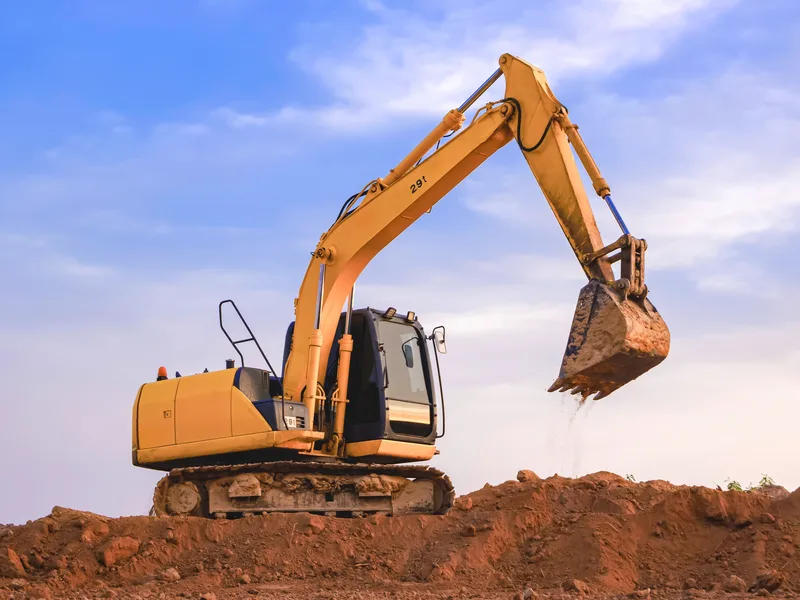
The strike is the exposure that defines this machine here, and Pennsylvania sharpens it in a specific way: the density of unrecorded and abandoned infrastructure. Legacy gas, mining works, older municipal lines and utilities laid before anyone was mapping them mean the marks can be accurate and the ground still hold a surprise. The consequences run past the trench — restoration, service interruption to everyone downstream, and a stopped site. Beneath that sit the machine’s own failure modes, which travel everywhere: the slide or tip at a trench edge or on a slope, and the swing catching what the operator cannot see. Terrain adds the rest, with grade and rock through the western and northern counties working both the undercarriage and the operator.
Common Pennsylvania excavator claims we see
- Strike on an unrecorded or abandoned line. The distinctly Pennsylvania version of this claim — the marks were right and the ground was not.
- Utility strike with consequential loss. Restoration plus interruption, routinely exceeding the value of the machine that caused it.
- Trench-edge or slope slide. Undercut ground, spoil too close to the lip, or a bank that held until it did not.
- Swing contact on a constrained site. Counterweight against a structure or a vehicle in the tight street work these markets are full of.
- Float and loading damage. Concentrated on the moves between jobs, especially on grade.
Why Pennsylvania excavator owners choose Equipment Guard Insurance
Because Pennsylvania sets no competency license for this work, the documents you hand a general contractor are doing the job a license class does elsewhere — and that is an argument for getting the equipment placement right rather than inheriting whatever came bundled. We write the machine on its own, take the underground question seriously instead of treating it as somebody else’s section, and place through markets — named on our homepage — that will read excavation work on its merits. Nothing about that requires you to move the liability or comp you already carry.
Major Pennsylvania excavator markets
- Philadelphia. The densest and oldest subsurface in the state, where street work runs through layers nobody fully documented.
- Pittsburgh. Grade, rock and legacy industrial ground, so the undercarriage and the unrecorded line are exposures at once.
- Allentown and the Lehigh Valley. Sustained warehouse and distribution build-out, with large site work on a compressed schedule.
- Harrisburg. Municipal, institutional and utility replacement — the work where old records matter most.
- Erie and the north-west. Lake-influenced ground, a shorter season, and long approaches to dispersed jobs.
- Scranton and Reading. Older industrial and mining-adjacent corridors where abandoned infrastructure is a routine finding rather than an anomaly.
Related
- Excavator insurance — the machine physics that hold in every state.
- Skid Steer insurance in Pennsylvania — the compact machine that answers to a filing office rather than to a locate ticket.
- All equipment insurance in Pennsylvania — the state hub.
- Equipment floater · Rented & leased equipment
Primary sources
- Home Improvement Contractor Registration - PA Office of Attorney General — No statewide contractor license; the Pennsylvania Office of Attorney General administers home-improvement contractor registration under the Home Improvement Consumer Protection Act (contractor licensing)
We do not link a Pennsylvania dig-notice section here. The notice duty described above follows Pennsylvania’s own one-call statute as our data layer records it; where the state publishes a document that states it directly, this page links it.
Pennsylvania excavator insurance FAQs
How much notice does Pennsylvania require before excavation?
Not less than three business days and not more than ten — and a complex project asks for not less than ten business days instead. Business days matter more here than the raw count: a holiday week can push a Monday start well past where a crew assumed it would land, and a ticket that ages past the outer limit has to be made again rather than stretched.
What makes a project "complex" enough to need the longer notice?
The longer clock exists because some work cannot be marked adequately in three days. Rather than paraphrase a threshold we cannot show you, the practical answer is that if the job involves substantial depth, multiple facility owners or a corridor nobody can mark quickly, plan on the longer window and confirm it with the notification system before you mobilize. Building the schedule around the short clock and discovering otherwise is where crews lose days.
Does calling it in put the risk of a strike onto somebody else?
It does not. The notice obliges facility owners to mark; it does not warrant that the marks are complete or that the ground holds nothing unrecorded. In a state with this much legacy industrial and mining infrastructure, unrecorded is a live category — and how carefully the crew dug around the marks is what decides the claim.
Why is the underground exposure treated separately from the machine?
Because the two losses are not the same size. When a bucket finds a gas main or a fiber trunk, the excavator itself may be undamaged while the restoration, the service interruption and the downstream claims run far beyond its value. Insuring the iron and assuming the rest follows is the structural mistake on this class.
Does Pennsylvania require a contractor license to run this work?
Not a statewide competency license — the state has none for general contracting. Home-improvement contractors register with the Attorney General, which is a registration rather than a test of ability, and commercial and heavy-civil work sits outside it. So a general contractor or an owner vetting you here is reading your certificates, not a license class, which puts unusual weight on what your insurance documents actually say.
Can the excavator be scheduled on its own?
Yes. Equipment Guard Insurance writes equipment monoline in Pennsylvania, so the machine and its attachments go on their own schedule and the underground question gets addressed alongside — without disturbing liability or comp arranged around work you already have.