
In most states an underground strike is a claim. In Tennessee it is a claim and a compliance event, and the two do not resolve on the same timetable or in front of the same audience. That is the single most useful thing for an excavating contractor here to understand before it happens.
The other is that the ground stops cooperating in a different way depending which end of the state you are in — limestone voids and solution features through the middle and east, deep river alluvium in the west. For everything that is true about this machine regardless of where it is parked, the excavator insurance pillar covers the mechanical and coverage fundamentals.
What excavator insurance costs in Tennessee
There is no rate to publish here, and the reason is that the machine is the smaller half of the question. What an underwriter weighs is the work: how deep you routinely go, how often you are inside a live utility corridor, whether transmission gas or fiber trunk lines are part of your normal week, the class and age of the unit, the attachments scheduled beside it, the security of wherever it sleeps, and your own record — including anything that ever reached the enforcement side. Two contractors with identical machines and very different answers to those questions will not be quoted alike, and should not be.
Tennessee excavator regulations: dig notice and the one-call duty
Emergency excavation may proceed immediately with notice to the one-call center and facility owner as soon as reasonably possible.
The duty comes from the state’s damage prevention act and is administered through the utility commission’s damage prevention program, which is the structural difference worth planning around. Notice runs at least three working days ahead and no more than ten, and a genuine emergency may proceed at once with notice given as soon as reasonably possible. So far, so familiar. What is not familiar is the enforcement board standing behind it: violations are reviewable as violations, independent of who pays for the pipe. That gives a strike a documented existence outside your loss run — one that outlives the settlement, follows you into prequalification, and is read by the next underwriter as evidence about how you dig rather than about how unlucky you were. Meanwhile the ticket itself does what tickets do everywhere: it obliges owners to mark what they know of, and leaves you the unmapped, the abandoned and the consequences of careless work around good paint.
Common excavator risks in Tennessee
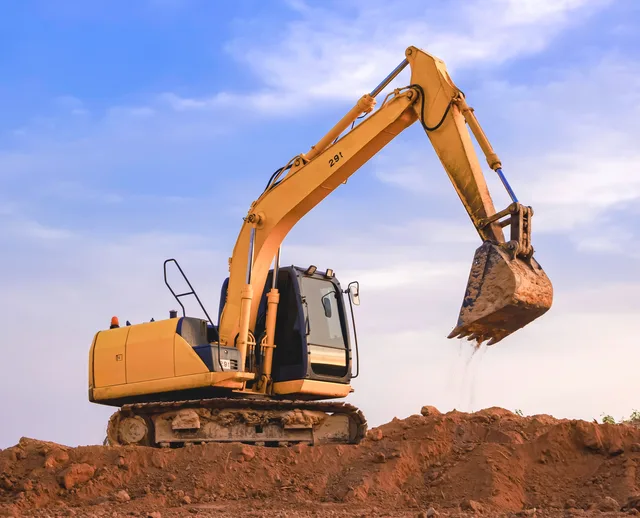
The strike is the loss that reorders an account, and its arithmetic is peculiar to this machine — the excavator itself is frequently untouched while restoration, lost service and a stopped jobsite run into numbers no equipment schedule was written for. Tennessee then layers on ground that misbehaves in two opposite ways. Karst country produces voids and soft seams: a bucket that suddenly meets nothing, a trench wall that collapses along a solution seam, occasionally a machine standing on something that will not hold it. River-bottom ground digs easily and stands badly, with water close to the surface. Between those, the machine’s constant companions — the slide at an undercut edge, the tail swing into what is behind the operator — go on happening, and they happen more often on the narrow valley and ridge sites the eastern half of the state is built on.
Common Tennessee excavator claims we see
- Strike that opens an enforcement file. The distinctly Tennessee version — one event, two proceedings, and a paper trail that outlasts both.
- Void or solution-feature collapse. Ground that gives way beneath the excavation or beneath the machine working it.
- Emergency-exemption dispute. A start made under the urgency door that a facility owner later argues was not an emergency at all.
- Slope or bench failure on valley ground. Cut work on grade in the eastern counties, where there is rarely room to lay a slope back properly.
- Transit loss on a long haul. Crews that cover several markets from one yard put serious mileage under the machine before it ever digs.
Why Tennessee excavator owners choose Equipment Guard Insurance
When a strike can generate a compliance record as well as a claim, the way your equipment and your underground exposure are placed stops being a paperwork detail. We write the machine as its own line, so the schedule is accurate and the attachments are actually listed, and we treat what happens at the end of the boom as a question to underwrite rather than a section to skip. The markets we use for that are named on our homepage, and using them costs you nothing on the liability and comp you already have in place.
Major Tennessee excavator markets
- Nashville. Continuous redevelopment over limestone, where new service is threaded through old corridors and almost every downtown dig is a congested one.
- Memphis. Deep alluvial ground, a high water table and heavy industrial and distribution work — easy digging with the worst trench-wall behavior in the state.
- Knoxville. Valley and ridge sites with rock close to the surface, where benching and slope work put the machine on ground it has to be walked onto carefully.
- Chattanooga. Riverfront and industrial reconstruction over legacy infrastructure, and the market where old records and current reality diverge most.
- Murfreesboro. Fast greenfield build-out in karst country, where the utility is new but the ground underneath it is full of features nobody mapped.
- Clarksville. Residential and public work spread across a wide footprint, with long approaches and jobs that sit open between crew visits.
Related
- Excavator insurance — the machine physics that hold in every state.
- Backhoe insurance in Tennessee — the machine that spends its regulated life in the right of way rather than under it.
- All equipment insurance in Tennessee — the state hub.
- Equipment floater · Rented & leased equipment
Primary sources
- Damage Prevention — Tennessee 811 (dig notice and one-call)
- Contractor (Tennessee Board for Licensing Contractors, Dept. of Commerce & Insurance) - raw <title> is 'Contractor' — Tennessee Board for Licensing Contractors, Department of Commerce and Insurance (contractor licensing)
Tennessee excavator insurance FAQs
What difference does the enforcement board make after a strike?
It means the incident does not simply become a bill between you and the facility owner. Damage prevention in this state is backed by a board with authority over violations, so an event can be reviewed as a compliance matter in its own right, with its own file, alongside whatever the civil claim is doing. Practically, that gives a strike a second and more permanent life: prequalification packets and renewal questionnaires eventually ask about it, and an administrative record is harder to characterize away than a closed claim.
How much warning does the state want before I break ground?
At least three working days, and not more than ten. The working-day count is the part crews misjudge — a short holiday week stretches the front of the window, and a job that drifts past the far end has to be called in again rather than resumed on the strength of paint that is still faintly visible. Neither end of that range is negotiable by being busy.
When can I dig without waiting, and what does that cost me?
Genuine emergency excavation may begin immediately, provided notice goes to the one-call center and the facility owner as soon as reasonably possible. That is a narrow door and it is worth treating it as one. A job that was merely urgent, or a schedule that ran out of room, is not an emergency, and starting under the exemption without the facts to support it converts an ordinary strike into a disputed one — with the enforcement side asking the same questions your insurer is.
Does the ground really change that much across the state?
Enough to change how you dig. Through the middle and the east, limestone means solution features — voids, soft seams and cavities that show up as a bucket suddenly finding nothing where it expected resistance, and occasionally as ground that will not support the machine that is standing on it. Out west toward the river the profile is deep alluvium: easy digging, poor trench-wall behavior and a high water table. A crew that works the whole state is operating in two different geologies with one set of habits, which is exactly where losses come from.
A locate was done and marked — does the risk move to the utility?
It does not move anywhere. Calling in the ticket triggers a duty on the facility owners to mark their own records, and that is all it does. Nothing about it certifies the marks as complete, covers a line that was never mapped, or answers for how the crew worked around the paint once it was down. On this machine the responsibility that matters stays with the excavator, which is the reason it is worth underwriting as its own exposure.
Can the excavator be insured on its own here?
It can. Equipment Guard Insurance places equipment as a monoline account in Tennessee, so the machine, the buckets and the hammer go on one schedule of their own without any requirement to move the rest of your insurance. We look at the underground side in the same conversation, because on this class it is the part that decides the year.