

In a state where a large share of the work happens on private land, up a dirt road, on ground somebody has been altering for two hundred years, the hardest thing about running an excavator is knowing what is already there. Vermont’s answer starts with a can of paint in your hand, not a phone in it.
What follows covers the premarking duty and the notice clock that follows it, why a clean ticket can still leave a farm or house lot full of unlocated pipe, and how ledge, frost and a short working year shape the machine’s physical exposure. For what stays constant about an excavator wherever it runs — boom and swing geometry, undercarriage life, the attachment ecosystem — see the excavator insurance pillar.
What excavator insurance costs in Vermont
We will not publish a premium figure for a Vermont excavator, because a page cannot know the inputs that actually decide it. The character of the work leads: how deep you go, whether your year is mostly private site development or mostly utility corridor, how often you are in a village street rather than a field, and how much of the schedule is spent breaking rock. Then the machine — size, age, the attachments that travel with it, where it overwinters — and finally your own history. A crew doing driveways and septic and a crew trenching main through a downtown are two different risks that happen to own the same model.
Vermont excavator regulations: dig notice and the one-call duty
Premarking of the proposed excavation area is required before notifying the System.
The duty is set out at 30 V.S.A. § 7004, and reading it in order matters. First you premark the proposed excavation area. Then the notice goes to the System, which cannot be given less than seventy-two hours ahead — weekends and legal holidays excluded from that count — nor more than thirty days ahead, so a ticket taken early in the season for a job that slips has simply expired. What comes back is a set of approximate locations for facilities belonging to the operators who participate. Two limits sit on the far side of it. The marks do not certify the ground, so careful excavation around them remains an obligation you carry rather than one you have discharged. And they reach only utility facilities: on rural Vermont sites the well line, the septic run, the propane feed and the buried service to an outbuilding are privately owned, frequently unrecorded, and no part of what the ticket answers. Those two limits, not the hour count, are where the expensive Vermont claims come from.
Common excavator risks in Vermont
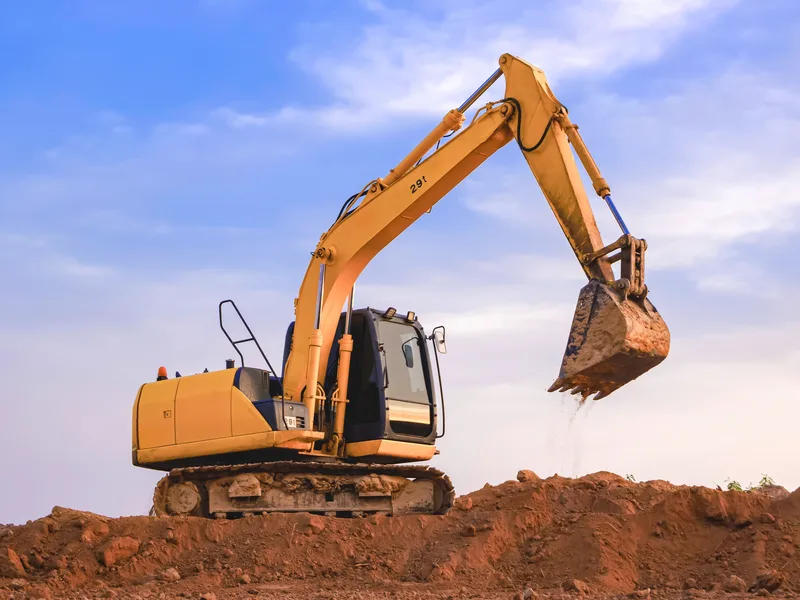
The strike sits at the top of the list and behaves the way it does everywhere — modest damage to the machine, a serious bill from the facility owner, service lost to whoever was downstream, and a site that stops until it is safe. Vermont then adds its own texture. Ledge is close to the surface across much of the state, so hammer work is routine and the shock load lands on pins, bushings and the undercarriage rather than on any single dramatic event. The working year is short and interrupted: frost drives crews into hard ground at the edges of the season, and the thaw turns access into its own hazard, with loaded floats and tracked machines moving over roads that are barely holding. Steep approaches and side-hill setups raise the ordinary tip-and-slide exposure, and the machines that are not working spend a long winter parked somewhere remote enough that nobody checks them weekly.
Common Vermont excavator claims we see
- Unlocated private service on a house or farm lot. The distinctly Vermont claim — the ticket was clean because the pipe belonged to the owner, not to a utility.
- Utility strike with interruption. Restoration plus lost service, on a bill that bears no relation to the damage visible on the machine.
- Side-hill slide or tip. A setup on grade that held until the boom came around loaded, which is most of what steep ground does to this machine.
- Ledge and hammer wear surfacing as failure. Cumulative shock through the arm and undercarriage from breaking rock that was never in the estimate.
- Thaw-season transport and recovery loss. Damage getting a machine on and off soft back roads during the weeks nothing holds weight.
Why Vermont excavator owners choose Equipment Guard Insurance
A machine that digs deserves a placement that acknowledges what digging is. Bundled quotes tend to treat an excavator as a value on a list and leave the strike question to a liability form nobody reads, which works right up until the day it does not. We write the equipment on its own, ask what your year actually looks like — village street or open field, utility corridor or private site, how much ledge — and take that to markets, named on our homepage, that will underwrite excavation rather than avoid it. Since Vermont sets no commercial competency license, the documents in your file are doing more work here than they would in a licensed state, and they ought to be right.
Major Vermont excavator markets
- Burlington. The state’s only genuinely congested subsurface, where street work runs through layered municipal infrastructure with very little room to stage.
- South Burlington. Commercial and airport-adjacent development on the flatter Champlain ground, where the schedules are tightest and the corridors are live.
- Essex Junction. Industrial and institutional sites with heavy service density and rail nearby, so setups are constrained and the swing has nowhere to go.
- Montpelier and Barre. Government, institutional and granite-country work — old service networks above, rock immediately below.
- Rutland. A regional base for southern and central hill-town jobs, which means long approaches, steep drives and machines working far from the yard.
Related
- Excavator insurance — the machine physics that hold in every state.
- Skid Steer insurance in Vermont — the small machine that spends its winters somewhere a thief can reach.
- All equipment insurance in Vermont — the state hub.
- Equipment floater · Rented & leased equipment
Primary sources
- 30 V.S.A. § 7004 — Notice of excavation activities — Dig Safe System, Inc., under the Department of Public Service (dig notice and one-call)
- Residential Contractors — Vermont Secretary of State, Office of Professional Regulation (contractor licensing)
Vermont excavator insurance FAQs
What does Vermont expect me to do before the notice even goes in?
Premark the area you intend to excavate. The duty runs the other way from what most crews assume: you delineate the proposed dig on the ground first, so that the people coming out to locate know which piece of the site they are being asked to clear. Skipping it is not a technicality — an unmarked or vaguely marked area produces locates that answer a question nobody asked, and the crew ends up digging beside the marks rather than inside them.
How long is the notice good for once it is in?
The clock has a floor and a ceiling. Nothing may start until at least seventy-two hours have passed, counted without Saturdays, Sundays or legal holidays, and the notice cannot be given more than thirty days ahead of the work. A Vermont season is short enough that crews front-load their calls in spring; a ticket pulled in April for a job that slips to June has aged out, and starting on it is starting on nothing.
Will the locate cover everything buried on a rural Vermont site?
No, and this is the exposure that catches people on back roads. The notification system reaches the operators of utility facilities. It does not reach the landowner’s own buried infrastructure — the line to the well, the septic run, the propane feed, the electric that somebody trenched out to a barn twenty years ago with no record kept. On a residential or farm site, a substantial part of what is under the bucket may be private, unmapped and entirely outside the ticket. Asking the owner what they know before you start is not politeness, it is loss control.
Does a clean ticket mean the strike is not my problem?
It does not. The marks are approximate locations produced by other people under a duty to respond; they are not a survey and they are not an indemnity. Responsibility for how the excavation is carried out around them stays with you, and so does everything nobody located. That separation is the reason the underground liability question gets arranged as its own piece of the program rather than left to fall out of the machine schedule.
Does Vermont license the contractor doing this work?
Not for commercial or heavy-civil work — the state has no statewide general-contractor license. What it has is a registration for residential contractors through the Office of Professional Regulation, which applies to residential construction above a statutory value and is a registration rather than a test of skill. Larger earth-disturbing projects can also pull in Act 250 land-use review, which is a permitting layer rather than a credential. The practical result is that whoever hires you is reading your certificates closely.
Can the excavator be insured on its own here?
Yes. Equipment Guard Insurance places equipment monoline in Vermont, so the machine and its attachments go on a schedule of their own and the underground question is dealt with beside them — no requirement to move the liability or comp you already have arranged.