
Every excavating contractor in Wisconsin is running a scheduling business as much as a digging one. The ground is workable for part of the year, the notice clock is counted in working days, and those two facts multiply rather than add. What is left over after they have taken their share is the season you actually bill.
Below: what the working-day count really costs, why nothing in the state vouches for your competence on commercial work, and how three separate geologies treat the same machine. For the physics that follow an excavator anywhere — reach, swing, undercarriage life, couplers and attachments — go to the excavator insurance pillar.
What excavator insurance costs in Wisconsin
A number for this machine is not something a web page can give you honestly, because the machine is the smaller variable. What an underwriter weighs first is the work itself — depth, how often you operate alongside live services, whether the schedule leans toward utility trenching or bulk site development, and how much of the year the fleet is idle. Then the specification, the hours, the attachments carried with it, whether the unit winters in a building or under a tarp behind the shop, and the losses on your record. Two contractors with matching iron and different work patterns should not be quoted alike, and anyone who does it anyway is guessing.
Wisconsin excavator regulations: dig notice and the one-call duty
not less than 3 working days before the start of nonemergency excavation
The duty is set out at Wis. Stat. § 182.0175(2) — published as Wisconsin Legislature: 182.0175(2) — and administered through the statewide one-call system known as Diggers Hotline. The parameter is a floor of three working days before non-emergency excavation. Read it against a Wisconsin calendar rather than an abstract one and it stops being trivial: working days skip weekends and holidays, so the same three-day requirement can consume a week of a season that is already short at both ends. What arrives when the clock runs out is a set of marks, and marks are an estimate carrying a tolerance, made by member operators from records of varying age. They do not certify completeness, they do not reach facilities whose owners are not in the system, and they do not shift the consequence of a careless dig onto anyone else. That consequence stays with the excavating contractor — the one who chose the method, the speed and the moment to stop. And because Wisconsin issues no statewide commercial competency license, there is no credential standing between your judgment and the person who hired you.
Common excavator risks in Wisconsin
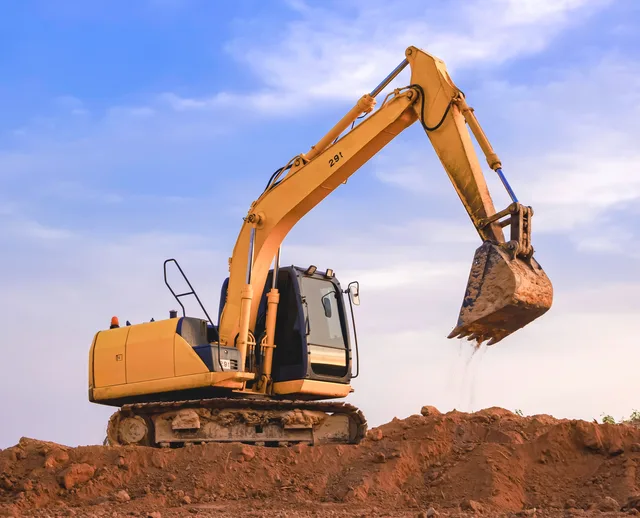
The utility strike is the loss with the worst tail, and its arithmetic is counter-intuitive: a machine that is barely marked can generate a claim that outruns its own value several times over once restoration, lost service and a halted site are counted. Wisconsin then layers on a compressed-season exposure that shows up in a different way from a pure weather claim — crews working long days against a closing window make faster decisions in worse light. Ground behaves three ways across the state, so a fleet that travels meets shallow dolomite in the east, unstable sand through the center, and side-hill rock in the driftless southwest, each with its own failure. Add the winter months when machines sit parked and unvisited, and frost heave rearranging shallow facilities away from where they were recorded, and the year has two distinct risk shapes rather than one.
Common Wisconsin excavator claims we see
- Strike with downstream service loss. Repair is the small figure; the interrupted customers behind it are the large one.
- Side-hill rollover in coulee country. A tracked machine working across a grade that gave way at the wrong moment.
- Sudden drive or boom damage on shallow dolomite. Rock arriving at a depth the plan set did not anticipate.
- Sand sidewall collapse. A trench in the central counties that never really stood, taking shoring and sometimes the machine.
- Winter-storage loss found in spring. Theft, vandalism or water damage on a unit nobody has looked at since freeze-up.
Why Wisconsin excavator owners choose Equipment Guard Insurance
When no license class speaks for you, the documents do — which makes placing the equipment properly worth real attention rather than something inherited with a package. We schedule the machines on their own, treat the subsurface exposure as a question to be underwritten instead of an assumption, and work through markets — shown on our homepage — that understand a business which has to earn its year in a shorter season than most. Your liability and comp arrangements can be left untouched.
Major Wisconsin excavator markets
- Milwaukee. The state’s oldest and most congested subsurface, with combined-sewer and water replacement running continuously through built-up streets.
- Madison. Institutional and state-campus work threaded between two lakes, on sites with a shallow water table and no room to stage.
- Green Bay. Port, paper and food-processing plant work over shallow bedrock, where depth is limited and rock is close.
- Kenosha. Large-format distribution and industrial build-out on the state line, with big earthwork on schedules that do not flex.
- Racine. Manufacturing redevelopment and lakefront utility replacement over ground that has been rebuilt repeatedly.
- Eau Claire. The gateway to the driftless and north-west counties — grade, rock and long approaches to dispersed jobs.
Related
- Excavator insurance — the machine physics that hold in every state.
- Skid Steer insurance in Wisconsin — the machine whose Wisconsin paperwork goes to a financial-institutions office instead of the usual one.
- All equipment insurance in Wisconsin — the state hub.
- Equipment floater · Rented & leased equipment
Primary sources
- Wisconsin Legislature: 182.0175(2) — Diggers Hotline (dig notice and one-call)
- Dwelling Contractor Qualifier — Wisconsin Department of Safety and Professional Services (contractor licensing)
Wisconsin excavator insurance FAQs
How far ahead does the notice have to go in for ordinary excavation?
Not less than three working days before non-emergency work starts. The word doing the damage there is working. Three working days is a full calendar week once a Friday call, a weekend and a holiday get involved, and Wisconsin holidays cluster in exactly the months when the ground is finally open. Contractors who plan a season around calendar dates lose whole weeks to that arithmetic without ever being told they did anything wrong.
Why does a notice window matter more here than in a warmer state?
Because the working season is the scarce resource. Frost closes real excavation for months, which compresses a year of digging into the part of it that thaws, and every ticket that has to be raised again is taken out of that compressed window rather than out of slack. The pressure that creates — start early, dig faster, keep the machine moving — is exactly the pressure that produces strikes and trench failures, and it is the reason the season shows up in an underwriting conversation about a Wisconsin excavator.
Once the marks are down, is a strike somebody else’s problem?
It is not. A mark is a prediction with a tolerance attached, not a warranty of position, and the statute imposes a marking obligation on the facility owners rather than an indemnity that runs back to you. What decides the claim is how the excavation proceeded — whether the crew slowed down where it should have, exposed by hand where powered digging was wrong, and stopped when the ground stopped agreeing with the paint. Underground liability behaves differently from equipment damage and we arrange it as its own subject.
Does Wisconsin license me to do this work?
Not for commercial or heavy-civil work. The state credentials contractors building one- and two-family dwellings, through a certification held by the business and a qualifier held by an individual, and it regulates commercial construction through permits and trade credentials instead. There is no statewide general-contractor competency license for the work an excavator does on a site development or a utility job, so the general contractor evaluating you is reading certificates and references, not a license class.
How much does the ground change across the state?
Enough that a single fleet meets three different problems. The eastern lakeshore counties are heavy clay over shallow dolomite, so a trench holds well until the bucket finds rock at a depth nobody planned for. The central sand counties drain fast and stand badly, and sidewalls there are unreliable in any weather. The unglaciated southwest is coulee country — steep grades, rock close to the surface and side-hill work that puts a tracked machine in a position it does not like. Frost then reworks all three every spring.
Will you write the machine without the rest of my program?
Yes. Equipment Guard Insurance writes equipment monoline in Wisconsin, so an excavator and the attachments that follow it can be scheduled by themselves. We take the subsurface exposure up in the same conversation, and your existing liability and workers compensation can stay exactly where they are.