
A compact loader is the machine that makes a small Wisconsin outfit viable in both halves of the year: digging, grading and loading through a working season squeezed between frosts, then blowing and stacking snow when the ground closes. It is also the easiest serious machine to steal, and the one whose ownership record is filed in the least obvious place in the country.
What follows is specific to Wisconsin: a central filing office that is not the Secretary of State, a credential regime that reaches dwellings but not commercial work, and a winter that generates its own category of claim. How the machine itself works, wherever it happens to be — couplers and attachment ranges, skid steering, the tipping line — is covered on the skid steer insurance pillar.
What skid steer insurance costs in Wisconsin
You will not find a rate on this page: a number worth relying on is built from the loader, the attachment list and the shed it does or does not have. In Wisconsin the two levers that move it furthest are shelter and cold: whether the loader spends the winter indoors, and whether it spends any night behind a gate at all. After that come the number and value of attachments on the schedule — two seasonal sets is normal here, and both need declaring — the valuation basis you choose, whether a tracking unit is fitted, how far the machine travels between jobs, and your own loss history. A loader wintered in a heated shop and a loader wintered on a job it finished in November do not price alike, and the gap is not small.
Wisconsin skid steer regulations: title, lien and ownership
A skid steer is untitled construction equipment; unlike most states, a lender perfects its security interest by filing a UCC-1 financing statement with the Wisconsin Department of Financial Institutions (DFI), not the Secretary of State.
The consequence runs through the whole account, and it is the part out-of-state lenders get wrong. A financed loader is perfected by a UCC-1 filed in the central filing office at the Wisconsin Department of Financial Institutions, not at the Secretary of State, and that lender then appears on the policy as a loss payee against the scheduled unit so any loss payment is issued jointly. Filed in the wrong office, a financing statement does not do the job it was meant to do, and the first anybody hears of it is usually during a loss or a sale. After a theft, settlement and recovery turn on the serial number and the bill of sale rather than on a certificate of title. Ownership that is easy to prove is ownership that pays quickly.
Common skid steer risks in Wisconsin
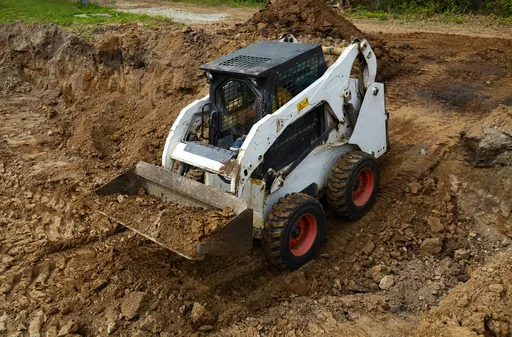
Theft heads the list, and in Wisconsin it is sharpened by a state line: the corridor running south out of Milwaukee reaches a much larger metropolitan area in another state within a short drive, which shortens the window between a loader leaving a yard and a loader leaving the jurisdiction. Cold is the second exposure and it is unusually productive of claims — cracked glass, failed seals, hydraulic damage from working oil that has not warmed, water intrusion through freeze and thaw on machines left out. Snow work adds contact damage against curbs, hydrants and parked cars on night shifts. The remainder is the machine itself: struck utilities on tight residential lots, damage during loading, and the forward tip.
Common Wisconsin skid steer claims we see
- Overnight theft with a short run to a state line. The defining Wisconsin claim, settled against the serial number and the filing record because no title exists.
- Cold-weather hydraulic and glass damage. Cracked glass, failed hoses and pump damage on a machine worked hard before it was warm — a maintenance-record argument, not a single event.
- Snow-shift contact damage. A struck hydrant, curb or parked vehicle during an overnight push, where the liability side often exceeds the machine damage.
- Out-of-season attachment taken from a yard rack. A cold planer, breaker or blower found to sit under a blanket per-item sublimit rather than scheduled by name.
- Forward tip while placing a load at height. Usually on ground less level than it looked, on a machine carrying its load out in front.
Why Wisconsin skid steer owners choose Equipment Guard Insurance
We write equipment monoline, which on this machine matters more than it sounds: a Wisconsin contractor usually has liability arranged the way its permits and its general contractors want it and no appetite for moving a whole program to get the loader scheduled properly. We do not ask for that. We schedule attachments by name in both seasonal sets, we check that a lender is named against the right unit and filed in the right office, and we place through markets named on our homepage that will read a Wisconsin equipment schedule on its own merits rather than as an add-on to a package.
Major Wisconsin skid steer markets
- Milwaukee. The largest and most industrial jobsite market here, with lakefront work, tight urban storage and the shortest run to an out-of-state metro.
- Madison. University, government and institutional site work on constrained lots, where finished-surface damage and confined loading drive the non-theft file.
- Green Bay. Industrial and mill-adjacent ground work with a long winter and a deep base of owned rather than rented machines.
- Kenosha. Distribution ground work at the southern end of the corridor, where a stolen trailer crosses a state line in minutes.
- Appleton and the Fox Valley. Dense mid-scale build-out with heavy attachment use and a large seasonal swing in what is on the machine.
- Eau Claire and the west. Dispersed rural and municipal work where machines travel long distances and sit alone between visits.
Related
- Skid steer insurance — the machine physics that hold in every state.
- Dozer insurance in Wisconsin — the machine the state construction stormwater permit actually reaches.
- All equipment insurance in Wisconsin — the state hub.
- Equipment floater · Rented & leased equipment
Primary sources
- Uniform Commercial Code Frequently Asked Questions — Wisconsin Department of Financial Institutions (title, lien and filing)
- Dwelling Contractor Qualifier — Wisconsin Department of Safety and Professional Services (contractor licensing)
Wisconsin skid steer insurance FAQs
Where does a lender file to secure a financed Wisconsin skid steer?
With the Department of Financial Institutions, not the Secretary of State. Wisconsin is one of a small number of states whose central UCC filing office sits inside a financial-regulation agency rather than in the Secretary of State’s office, and an out-of-state lender or broker who files by habit files in the wrong place. On the policy the lender is then added as a loss payee against the scheduled unit, and the filing record and the schedule need to describe the same machine — a lienholder still named against a loader you paid off is the signal a schedule has gone stale.
Is a skid steer titled or registered in Wisconsin?
No. It is untitled construction equipment, so there is no title to transfer at a sale and none to produce after a loss. What identifies the machine is the serial number, the bill of sale, and the financing record held by the state — which, as above, is not held where most people go looking for it.
Do I need a state credential to run a skid steer in Wisconsin?
Not for commercial work. Wisconsin issues no statewide commercial general-contractor license; commercial work is governed through building permits and trade credentials instead. Where the state does require a credential is one- and two-family dwelling construction, which needs a Dwelling Contractor certification for the business and a Dwelling Contractor Qualifier for an individual, both through the Department of Safety and Professional Services. That reaches who may pull a dwelling permit, not who may operate the loader — but it does mean a residential crew and a commercial crew in this state carry different paperwork for identical machines.
What does a Wisconsin winter actually do to a compact loader?
It produces claims that do not look like accidents. Sustained subfreezing weeks are hard on batteries, glow systems, hoses and seals, and cold hydraulic oil worked before it is warm is a slow way to damage a pump. Glass cracks in the cold, door seals fail, and a machine that thaws and refreezes on an open site collects water where it should not be. None of that is dramatic, and all of it turns on maintenance records when a loss is argued — which is why a loader wintered outdoors is a materially different risk before theft is even discussed.
Are attachments covered on a Wisconsin skid steer policy?
Only where they are scheduled by name. Blanket attachment limits carry a per-item sublimit, which buckets and pallet forks fit inside and which breakers, augers, cold planers and snow blowers routinely exceed. Wisconsin crews also swap attachment sets seasonally, and the out-of-season set is the one sitting unattended on a yard rack for months — the most stealable equipment a contractor owns, since a rack does not lock and an attachment leaves in a pickup bed.
Can I write just the loader, without moving my other policies?
Yes. Equipment Guard Insurance writes equipment monoline in Wisconsin, so a loader and its attachments can be placed on a schedule of their own. If your general liability suits you, it stays exactly as it is — we would rather write the iron correctly than rearrange a program that is already working.