
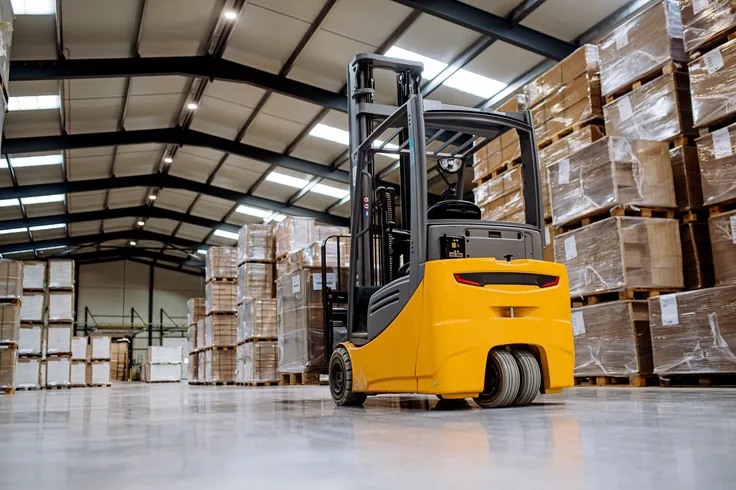
On most Arizona sites the rough-terrain forklift is the machine that never makes the safety meeting. It sets block, lands truss bundles, feeds a tilt-up crew and carries material across raw ground all day — which is exactly why nobody watches it until the day it puts a load where the chart said it could not.
This state is unusual in owning both sides of the paperwork. Arizona runs the occupational safety program that covers private employers, and Arizona also licenses the contractor by classification, so the enforcement identity and the credential identity are the same government. For the machine physics that hold true anywhere — reach against capacity, boom geometry, what the ground has to carry — the forklift insurance pillar is the reference.
What forklift insurance costs in Arizona
Any figure printed here would be invented, because this class is priced on the people and the records around the machine rather than on the machine. What moves it in Arizona is the operator headcount and whether every one of them has an evaluation documented on the specific unit, the balance between fixed-mast trucks and telehandlers working at reach, the classification of work being done and the sites it puts the machine on, how the unit is secured on open desert-edge parcels overnight, and the losses already recorded. Replacement value is a small term in that expression.
Arizona forklift regulations: who enforces operator safety
Arizona operates its own OSHA-approved State Plan covering private-sector employers, so powered-industrial-truck operator training, evaluation and enforcement run through the state program rather than federal OSHA directly.
The change that produces is administrative rather than substantive, and the distinction is worth holding onto because owners tend to hear a state program as a softer one. It is not: recognition depends on measuring up against the federal benchmark, so operator training, evaluation and refresher duties are not a place to find relief. What actually changes is identity. The inspector is an Arizona employee, the citation carries the state’s name, the contest runs through a state route, and the file lives in a state office. Set that beside the other state relationship a contractor here already has — a license issued by the Registrar of Contractors under a specific commercial, residential, dual, engineering or specialty classification — and Arizona ends up holding two independent records about the same business, one about competence to do the work and one about how safely it was done. They are not connected to each other, and nothing moves between them automatically. For an owner crossing into a federal-enforcement state on the next job, the practical consequence is two sets of correspondence, two appeal paths, and one evaluation file that has to satisfy both.
Common forklift risks in Arizona
Arizona pressures this machine through the operator and the ground in different seasons. Summer takes the edge off judgment in a hot cab, and judgment is the whole control on a marginal pick: whether to retract before slewing, whether the pad will hold, whether the load is worth the reach. Then the monsoon arrives and undoes months of reliable ground in an afternoon, softening surfaces, cutting channels at the edges of a pad and leaving pockets that look no different from the hardpan beside them. The state also contains two climates at once — a valley that works through the winter and a high country that does not — so one contractor can be running the same unit in genuinely opposite conditions inside a single season.
Common Arizona forklift claims we see
- Load dropped from height. Block, truss and glazing landing on raw ground do not survive, and neither does the schedule.
- Forward tip under extension. Capacity falls away as the boom goes out, and the chart is the document read least often.
- Ground worker struck. A workers compensation and liability event, and the outcome that dominates the cost of this class.
- Outrigger breaking through softened ground after a storm. Seasonal here, and it arrives fast rather than gradually.
- Damage while placing into finished construction. The boom reaches into work that has already been inspected and paid for.
Why Arizona forklift owners choose Equipment Guard Insurance
Most quotes on this machine treat it as a small crane with none of the attention, and stop at the floater. We would rather be honest that the floater is the affordable half: the events that make an Arizona telehandler year expensive are an injured person and a damaged structure, and those answer to liability and workers compensation. Writing the equipment line monoline lets the unit and its attachments be scheduled properly without touching a program already built around this state’s arrangements, and the markets we place through — named on our homepage — read jobsite lifting as jobsite work rather than as indoor equipment that went outside.
Major Arizona forklift markets
- Phoenix. The largest build-out in the state, with tilt-up and industrial shells rising on raw valley-floor parcels.
- Mesa and Gilbert. East-valley expansion at volume, where block and truss setting keeps units working long days on repetitive picks.
- Chandler. Large process and technology plants, where a machine does not pass the gate without a current operator evaluation record.
- Tucson. Southern institutional and mining-adjacent industrial work, with long hauls and units that stay on site for months.
- Scottsdale. High-finish commercial and resort projects where the boom regularly reaches over completed and expensive work.
- Flagstaff. High-country construction with a real snow season, and the market where the operating conditions invert the valley entirely.
Related
- Forklift insurance — the machine physics that hold in every state.
- Excavator insurance in Arizona — the machine that cannot break ground here until the locate marks are complete and still valid.
- All equipment insurance in Arizona — the state hub.
- Equipment floater · Rented & leased equipment
Primary sources
- State Plans — Occupational Safety and Health Administration (operator safety)
- Arizona Revised Statutes §32-1122 — Qualifications for license — Arizona Registrar of Contractors (ROC) (contractor licensing)
Arizona forklift insurance FAQs
Who inspects a forklift incident on an Arizona jobsite?
The state. Arizona operates an approved program of its own covering private-sector employers, so the compliance officer who arrives after a load comes down works for Arizona, the citation is a state citation, and the contest is heard through the state process. A contractor who also runs machines in a federal-enforcement state is dealing with two entirely separate authorities for identical work on identical equipment.
Does a state-run program mean an easier standard?
No, and expecting one is a costly assumption. Approval requires a program to measure up against the federal benchmark before it is recognized at all, so the substance of operator training, evaluation and refresher obligations is not somewhere to look for slack. What genuinely differs is who administers it: the office, the inspector, the appeal route and the correspondence are all Arizona rather than federal.
How does Arizona licensing interact with this?
It runs alongside it rather than through it. Contractors here are licensed by the Registrar of Contractors under commercial, residential and dual building classifications plus engineering and specialty classes, each with its own experience and examination requirements. That classification determines what work a machine can legitimately be on. It is a separate state file from the safety program, and neither one updates the other — but it does mean Arizona holds both records, which is not true in most states.
What does the Arizona climate actually do to this machine?
Two different things in two different seasons. Summer heat degrades the operator long before it degrades the equipment, and judgment about a marginal pick is exactly the thing that fades in a hot cab in the middle of the afternoon. Then the monsoon arrives, and ground that had been reliably hard for months takes a downpour, softens in patches and washes out at the edges. A pad that supported an outrigger in June is not automatically the same pad in August.
Is a telehandler treated the same as a lift truck on a finished floor?
The operator qualification duty covers both, and the resemblance ends there. A rough-terrain unit works on grade and on fill, changes its own capacity every time the boom extends, and delivers material into structures rather than onto level ground. Training assembled around an indoor machine leaves an operator unprepared for all of that, and the evaluation record specific to the actual unit is what a state inspector asks to see first.
Can you schedule the machine on its own?
Yes. Equipment Guard Insurance writes equipment monoline in Arizona, so the telehandler and every attachment go on their own schedule by serial number. Because the safety and licensing files both sit with the state here, we would rather be precise with you about what the equipment policy answers for and what it does not before anything puts it to the test.