
A telehandler is the quietest expensive machine on an Arkansas jobsite, and the crew’s attention is rarely on it. It sets block for a mason, walks bundles of framing material up to a deck, feeds an ironworker, and never once looks like the thing that will produce the worst claim of the year — which is precisely why it does.
The Arkansas-specific question is not what the rule says. It is who owns it, and here the answer runs away from the state entirely: safety belongs to a federal agency, while the state keeps its hand on something else. For the machine itself — the load chart, what reach costs you in capacity, the forward-tip geometry, attachments — start at the forklift insurance pillar, which holds in all forty-eight states.
What forklift insurance costs in Arkansas
Nobody can print a number for this class and be honest about it, because the machine is the smaller half of the exposure. In Arkansas the inputs that actually move a quote are the operator count and how their evaluations are recorded, whether the unit is a fixed-mast truck or a telescopic machine placing loads at reach, how far the crew travels between jobs and what the ground looks like at each, whether the machine sleeps behind a fence or on an open pad, and the loss record you bring with you. Two identical machines with different paperwork are different submissions, and any underwriter who has priced this class will tell you the same.
Arkansas forklift regulations: who enforces operator safety
Arkansas is under federal OSHA for private-sector employers, so the powered-industrial-truck operator training and evaluation requirements are the federal standard applied directly.
Read that as an absence and then look at what sits in the space it leaves. There is no Arkansas safety agency with jurisdiction over your crew — not a smaller one, not a cooperating one, none. But this is not a state that leaves contractors unregistered. The Contractors Licensing Board holds the statewide commercial license required above a set contract value, and it grants that license against a net-worth showing and a surety bond rather than paperwork alone, with separate licensing for residential builders and remodelers. So the state that will never write you a safety citation is nonetheless the state that decides whether you may bid the work. That matters after an incident because the consequences arrive indirectly: the federal inquiry runs its course, and meanwhile the loss sits in a record that a bond underwriter, a renewing carrier and a project owner all read. Contractors who assume a federal posture means a light touch are half right about the regulator and wrong about the cost.
Common forklift risks in Arkansas
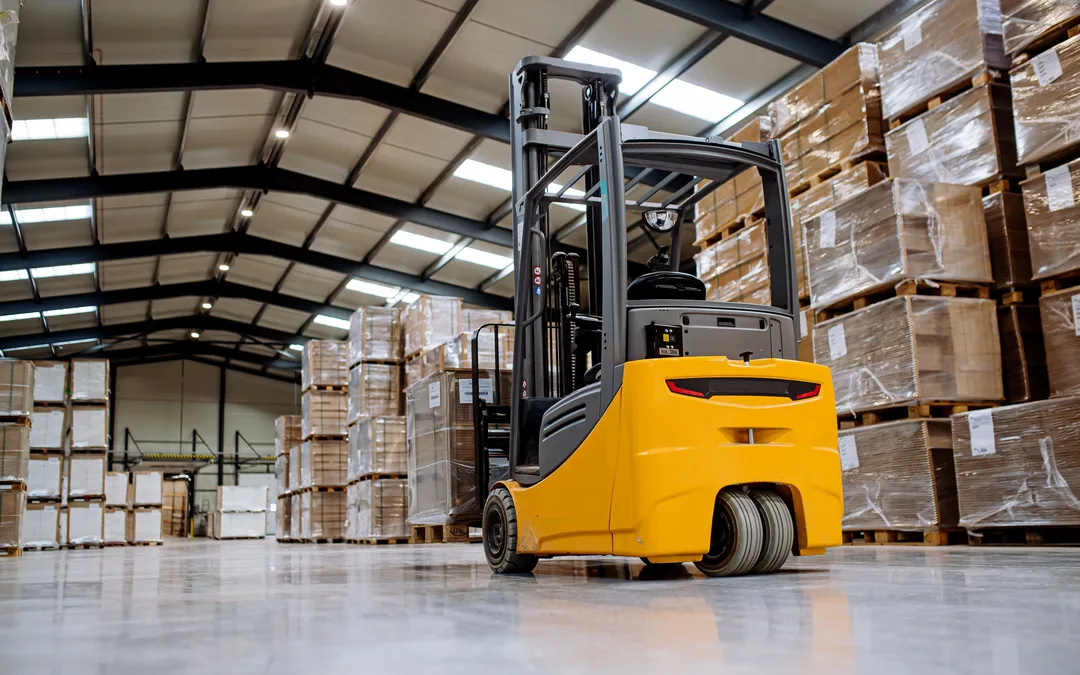
Almost nothing on this class hurts the machine. A telehandler that drops a bundle or settles a wheel mid-lift usually needs an inspection and a hydraulic once-over; the material on the ground, the wall it was reaching into and the person who was standing under it are what generate the file. Two mechanical habits drive most of it. Reach spends capacity — the further out the boom goes, the less the machine can legally hold, and the operator who checked the chart at the start of the lift did not recheck it at full extension. And the ground is a variable, not a constant: Delta soil holds moisture and moves under an outrigger, while a benched pad in the northwest puts one side of the machine on cut rock and the other on fill. Add an Arkansas summer, which fatigues an operator doing precise work in a hot cab, and a storm line that can close a lift down faster than a boom retracts.
Common Arkansas forklift claims we see
- Bundle dropped during placement. The material and the structure beneath it carry the claim; the telehandler rarely does.
- Forward tip at full extension. Capacity falls away with reach, and the chart in the cab is the document nobody rereads mid-lift.
- Worker struck on the ground. A liability and workers compensation event, and by a wide margin the most expensive outcome this machine produces.
- Outrigger settling into saturated Delta ground. A pad that carried the load yesterday after a dry week is not the same pad after a storm.
- Damage reaching into completed work. Placing into a finished wall or opening puts the boom where the money already is.
Why Arkansas forklift owners choose Equipment Guard Insurance
Most submissions we see on this machine have been priced as though the iron were the risk. We would rather start where the money goes: the operator, the person under the load, and the material that was never worth less than the telehandler carrying it. In a state with no safety authority of its own, the documentation nobody is legally forcing you to keep is the documentation a project owner will demand at the gate, so we treat it as an underwriting asset rather than an obligation. We write equipment monoline, which means the machine can be scheduled properly without touching a program you have already built around Arkansas work, and we place through markets — named on our homepage — that read a jobsite lifting account as its own thing.
Major Arkansas forklift markets
- Little Rock. Capital-city institutional and highway work, where public owners ask for the operator file before the machine is allowed through the gate.
- Bentonville. Sustained corporate-campus construction with high-value finishes going into buildings a boom has to reach across.
- Springdale. Food-processing and industrial plant expansion, with lifting done around live operations that cannot be shut down for it.
- Fayetteville. University and multi-family build-out on constrained, sloping sites where the setup pad is cut rather than found.
- Fort Smith. River-corridor industrial and maintenance lifting, with older structures that were never designed for the loads now being placed into them.
- Jonesboro. Delta agricultural and light-industrial work on deep soft ground, and long hauls between jobs that leave machines standing outdoors between them.
Related
- Forklift insurance — the machine physics that hold in every state.
- Backhoe insurance in Arkansas — the machine that has to answer a registration question this one never faces.
- All equipment insurance in Arkansas — the state hub.
- Equipment floater · Rented & leased equipment
Primary sources
- State Plans — Occupational Safety and Health Administration (operator safety)
- Apply for Contractors License/Registration » Arkansas Department of Labor and Licensing — Arkansas Contractors Licensing Board, Department of Labor and Licensing (contractor licensing)
Arkansas forklift insurance FAQs
Is there an Arkansas agency that inspects a forklift incident?
No. Private employers in this state answer to federal OSHA, so the person who arrives after a telehandler puts a load somewhere it should not have gone is a federal inspector, and the citation and the appeal are federal too. Owners who moved here from a state that runs its own program keep looking for a state office to call about it. There is not one.
Then what does Arkansas actually control?
Whether you may contract at all. The Contractors Licensing Board issues the statewide commercial license for work above a set contract value, and that license is backed by a net-worth showing and a surety bond rather than by a test alone. Residential builders and remodelers hold their own licenses through the same board. None of it is safety regulation — but it is a live state file with your name on it, and it is the state’s record a project owner checks.
How does that change what happens after a serious lifting injury?
Two clocks start, and only one of them is a regulator. The federal safety inquiry runs on its own schedule. Separately, the incident lands in your loss record, and the loss record is what the bond market and the licensing paperwork read the next time either is renewed or reviewed. In a state with no safety agency, that indirect route is how a bad day keeps costing you.
Does Arkansas heat belong in an underwriting conversation about a telehandler?
It belongs in the risk conversation, which comes first. A long Arkansas summer puts an operator in a hot cab doing precise work at reach, and fatigue shows up as small errors in load placement rather than as anything dramatic. The other half is the afternoon storm line, which arrives faster than a boom comes down and finds a machine parked with a load still up.
Is the ground the same across the state?
Not remotely, and this class is unusually sensitive to it. Delta ground in the east is deep alluvial soil that holds water and gives under an outrigger long after the surface looks dry. The northwest is the opposite problem — rock near the surface, benched sites, and a machine set up on a cut pad with slope on one side. A single crew working both is running two different stability stories with one load chart.
Can the telehandler be written on its own?
Yes. Equipment Guard Insurance places equipment monoline in Arkansas, so the machine and its attachments go on a schedule of their own. Because the state offers no safety layer, we spend the conversation on the documentation an owner will ask for instead — that is the audit that actually happens here.