
A rough-terrain forklift is the least dramatic machine on a Florida site and one of the most consequential. It lands block on a second floor, feeds a truss crew, walks material across bare sand, and does it in heat that keeps everyone else moving slowly — for years, without incident.
The regulatory answer here is short and the state answer is not. No Florida agency enforces operator safety on a private site; the enforcement is federal. What Florida does own is who is licensed to do the work and where that license is good, which is a real question for a machine that gets trailered between counties. For capacity against reach, boom geometry and what the ground has to carry, see the forklift insurance pillar.
What forklift insurance costs in Florida
There is no defensible number to publish for this class, because the rating conversation is about people and records rather than about iron. In Florida what moves it is how many operators run the machine and how current and unit-specific their evaluations are, whether the fleet is fixed-mast trucks or telehandlers working at reach, the counties the work covers and the license tier behind it, where the unit is stored and what happens to it when a storm is named, and the loss record already in hand. The replacement value of the machine is the smallest lever on the list.
Florida forklift regulations: who enforces operator safety
Florida is under federal OSHA for private-sector employers, so the powered-industrial-truck operator training and evaluation requirements are the federal standard applied directly.
Read that as a statement about who is absent, because that is the useful content. No Florida safety agency inspects, cites or hears an appeal about a private lifting crew — the whole chain is federal, and an owner who has worked in a state-plan jurisdiction will spend a while looking for a state counterpart that does not exist. What Florida does regulate closely is the contractor rather than the machine, and it does so in two tiers. Under Chapter 489 a contractor is either certified, holding a state certificate of competency that is good anywhere in Florida, or registered, holding a local competency card that is good only in the jurisdiction that issued it. That distinction has a sharp edge for an owner whose principal asset is mobile: a telehandler is trailered between counties without a second thought, and the authority to be doing the work at the other end is not automatically portable in the same way. On the safety side there is nobody at the state level to ask; on the licensing side the tier is the first thing anybody checks. Keeping the operator evaluation file current is the one control that answers to the federal half, and it is entirely self-imposed here.
Common forklift risks in Florida
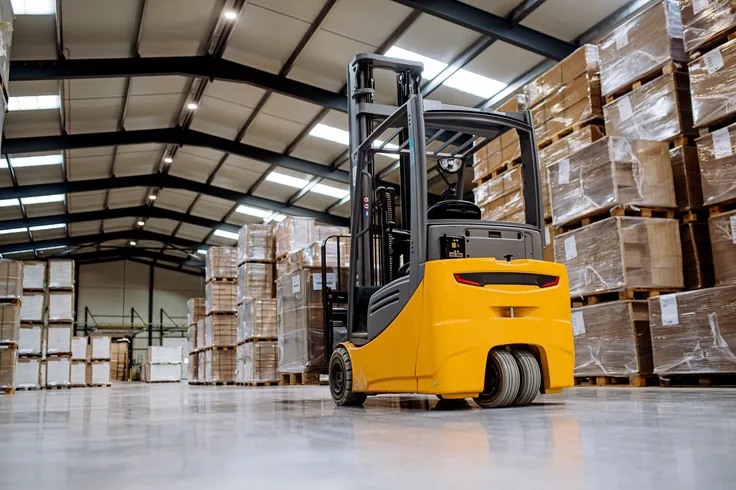
Two Florida conditions push this machine harder than the regulations do. The first is that the work never stops: hours pile onto a unit without the enforced pause a freezing state provides, and an operator roster turns over without any calendar moment that forces a re-evaluation. The second is the ground. Sand and fill over a high water table drains quickly and looks convincing while doing it, but a concentrated outrigger load finds the difference between a surface that is dry and a surface that is compacted. Add an afternoon storm through half the year, a hurricane season on top of that, and the fact that most lifting here happens beside occupied buildings on tight coastal parcels, and the losses come from the ground and the load rather than from anything mechanical.
Common Florida forklift claims we see
- Load released above finished work. Placing into an occupied structure means the damage lands on something already completed.
- Outrigger punching into saturated sand. Bearing that looked adequate at setup and was not once the boom went out.
- Forward tip at reach. Capacity drops as the load moves away from the machine, and the chart is the least consulted document on site.
- Ground worker struck. The workers compensation and liability outcome that costs more than everything else on this class combined.
- Storm damage to a unit left on site. A named-storm plan for where the machine sits is worth writing down before the season starts.
Why Florida forklift owners choose Equipment Guard Insurance
Most brokers rate this machine off its value and move on. We think the more useful conversation is that the floater covers the part of the exposure that is cheapest to fix. What turns a Florida telehandler year expensive is an injured worker or a damaged occupied building, and neither of those is an equipment claim. Writing the equipment line on its own means the unit and its attachments get scheduled properly, with a stated position on storm exposure, without reopening anything else a contractor has arranged — and the markets we place through named on our homepage read a jobsite lifting risk rather than treating a telehandler as indoor equipment on bigger wheels.
Major Florida forklift markets
- Miami. High-rise and coastal construction on parcels with no lay-down area and finished work directly under every pick.
- Fort Lauderdale. Marine-adjacent and mixed-use redevelopment where machines set loads between water, road and occupied structures.
- Tampa. Port and industrial expansion with sustained volume and units that stay assigned to one site for months.
- Orlando. Corridor build-out at scale, hospitality and institutional work, and the heaviest repetitive picking in the state.
- Jacksonville. Large-footprint industrial and river-adjacent projects, with the longest hauls between jobs of any Florida market.
- Fort Myers and Tallahassee. Southwest coastal rebuilding and north-state institutional work, two very different licensing footprints for one fleet.
Related
- Forklift insurance — the machine physics that hold in every state.
- Skid Steer insurance in Florida — the machine that is easy to steal in a state with this much open coastal access.
- All equipment insurance in Florida — the state hub.
- Equipment floater · Rented & leased equipment
Primary sources
- State Plans — Occupational Safety and Health Administration (operator safety)
- Construction Industry licensing — Construction Industry Licensing Board (CILB), Florida Department of Business and Professional Regulation (DBPR) — Florida Department of Business and Professional Regulation (contractor licensing)
Florida forklift insurance FAQs
Is there a Florida agency that enforces forklift operator safety?
Not for private employers. Florida has no approved state plan reaching them, so the powered-industrial-truck training and evaluation duties are the federal standard applied directly, and the inspector, the citation and the contest are federal from start to finish. There is no state safety office in that chain, which is the first thing an owner arriving from a state-plan jurisdiction has to unlearn.
Then what is the Florida-specific part of running this machine?
Where the contractor is allowed to run it. Under Chapter 489 a contractor here is either certified — holding a state certificate of competency valid across Florida — or registered, which is valid only in the local jurisdiction that issued the competency card. The telehandler itself travels wherever a trailer goes. The authority to put it to work does not necessarily travel with it, and that is a distinctly Florida question about a mobile machine.
Does that certified-versus-registered split show up in a claim?
It shows up in the argument after one. A dispute about damage a machine did to a structure tends to become a dispute about who was entitled to be doing the work in that jurisdiction, and a registered contractor operating outside the county that issued the card is in a much weaker position than one holding a statewide certificate. Nothing about the equipment floater turns on it, but a lot about the liability conversation can.
What does a year-round season do to the machine and the crew?
It removes the pause. In a freezing state a rough-terrain forklift comes off the job for months, and that layup forces an inspection, a service and a fresh look at the operator roster whether anyone planned it or not. Florida units simply keep working, so hours accumulate without a natural stopping point and the crew turns over without a scheduled moment to re-evaluate anybody. Storm season is the only interruption, and it is not the kind that produces a maintenance record.
How does Florida ground behave under an outrigger?
It drains fast and it bears poorly. Sand and fill over a high water table gives a surface that can look firm after a downpour and still consolidate under a concentrated load, and the wetter half of the year puts a storm on the site most afternoons. Cribbing and pads matter more here than in states with cohesive soil, and a machine set up on bare sand because the ground felt hard is a claim waiting for the right pick.
Can you write the equipment on its own?
Yes. Equipment Guard Insurance places equipment monoline in Florida, so the telehandler and its attachments go on their own schedule by serial number, with a clear position on where the unit sits during a named storm. Since the safety authority here is federal and the license question is a state and local one, we would rather draw the boundary between the equipment policy and the liability side up front.