
The reach machine on a Georgia site is the one everybody relies on and nobody discusses. It lifts block to a second story, sets a bundle on an unfinished deck, keeps a crew supplied for a whole shift, and stays invisible right up to the moment it sets something down in the wrong place.
The Georgia difference is a mismatch worth naming. Safety enforcement over your operators is entirely federal, yet Georgia is one of the states that does license general contractors itself — with the class you hold tied to financial standing. The regulator that can hurt you is not the one that can cite you. For the machine physics that hold in every state — capacity, reach, bearing, forward tip — see the forklift insurance pillar.
What forklift insurance costs in Georgia
A published premium for this class would be a guess, because the rating turns on people and records rather than on the unit. The Georgia inputs that actually matter are the number of operators on the machine and whether each has an evaluation documented against that model, whether the work is vertical infill or open site development, the reach and configuration you actually use rather than the one on the spec sheet, how far the machine travels between jobs, and your own loss record. The value of the telehandler is one of the smaller terms in that calculation, which is rarely where the conversation starts.
Georgia forklift regulations: who enforces operator safety
Georgia is under federal OSHA for private-sector employers, so the powered-industrial-truck operator training and evaluation requirements are the federal standard applied directly.
The absence of a state safety authority is the plain fact, but on its own it says nothing useful, because it is shared with roughly half the country. What is particular here is the shape of the state that sits behind it. Georgia issues statewide contractor licenses through its own board, with classes separated by scope of work and by financial-responsibility requirements — which puts it in unusual company among states that leave safety enforcement entirely to a federal agency. The result is a contractor who answers to a federal inspector on the operator question and to a state board on the solvency question, with no formal connection between the two proceedings. That connection exists anyway, and it runs through money. A load dropped from height in Georgia produces a liability claim, and a liability claim large enough to move a small contractor’s financial position eventually touches the file that decides what class of work the state will let it bid. Nobody at the board is reading citation records. They do not have to. The damage arrives on its own, dressed as a balance sheet, and it is why the limits above the equipment schedule matter more here than the schedule does.
Common forklift risks in Georgia
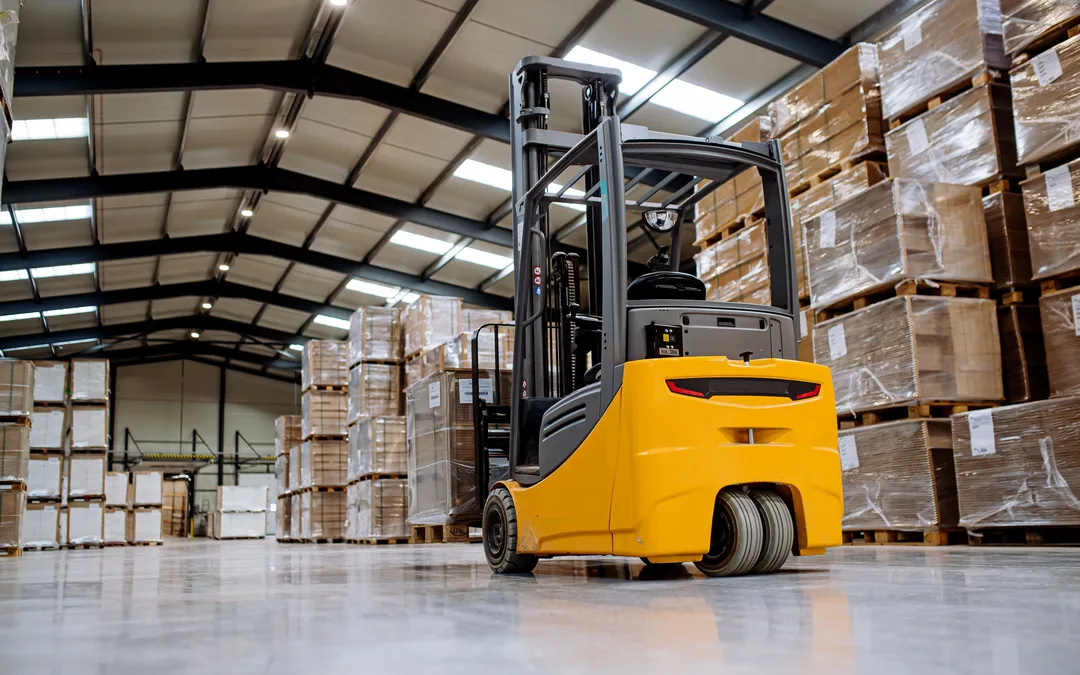
Almost everything expensive about this machine happens outside the machine. A load released at height injures whoever was below and destroys material that was already delivered and already billed, and a boom reaching into a partly finished building damages work somebody else has already paid for. Georgia contributes two of its own conditions. Heat runs long here, and it degrades the attention a load chart assumes an operator is applying. And red clay behaves in two unhelpful ways in sequence: saturated after a storm it will not hold a pad under load, and baked afterwards it looks like competent bearing when it is a crust over softer material.
Common Georgia forklift claims we see
- Bundle released while landing on an unfinished deck. The material and the structure absorb the cost while the machine gets an inspection.
- Forward tip at extended reach. The rating drops away with distance, and the chart is the document nobody revisits mid-shift.
- Injury to a worker below the load path. The dominant exposure on this class, and the one the equipment policy never answers.
- Pad failure on saturated clay after a summer storm. A same-day change in bearing that the morning set-up did not anticipate.
- Damage to installed facade or interior finishes. The point where a routine placement meets completed, invoiced work.
Why Georgia forklift owners choose Equipment Guard Insurance
We are blunt about where the money is on this account: not in the floater. A telehandler that drops a load is usually back at work quickly, while the injured worker and the ruined structure are still being argued about a year later. In Georgia there is no state safety regulator applying pressure in the meantime, and there is a state board that cares about your financial position. We write the equipment monoline so the machine sits on its own schedule without reopening anything, and we place through markets — named on our homepage — that will read a jobsite lifting account properly rather than pricing it off the serial plate.
Major Georgia forklift markets
- Atlanta. The deepest vertical and infill market in the region, where booms work over occupied property and machines are set where they fit rather than where they should be.
- Savannah. Coastal industrial and port-adjacent construction, with humid air on the machine and placements made around operations that never stop.
- Augusta. Institutional, medical and energy-adjacent projects where documented operator evaluation is checked at the gate before a unit is allowed to lift.
- Columbus. Steady military-adjacent and industrial work on the western boundary, with crews and machines that cross a state line as routine.
- Macon. Institutional, campus and plant work spread across the middle of the state, with long hauls between jobs and machines that stay out for weeks.
- Athens. Campus and mixed-use build-out on tight lots, where every placement happens close to something finished or something occupied.
Related
- Forklift insurance — the machine physics that hold in every state.
- Skid Steer insurance in Georgia — the machine on the same schedule whose paperwork lives at the county courthouse.
- All equipment insurance in Georgia — the state hub.
- Equipment floater · Rented & leased equipment
Primary sources
- State Plans — Occupational Safety and Health Administration (operator safety)
- Georgia Rules & Regulations, Chapter 553-1 ORGANIZATION — Rules of State Licensing Board for Residential and General Contractors — State Licensing Board for Residential and General Contractors (SLBRGC), within the Georgia Secretary of State’s Professional Licensing Boards Division (contractor licensing)
Georgia forklift insurance FAQs
Who enforces forklift operator rules on a Georgia jobsite?
Federal OSHA, directly. Georgia operates no approved state plan covering private-sector employers, so the powered-industrial-truck training and evaluation requirements arrive unmediated as the federal standard, and the inspector, the citation and the appeal are all federal. There is no Georgia safety agency in that chain, which is a surprise for contractors arriving from a plan state and expecting a state office to be involved.
So does the state have any leverage over an equipment contractor at all?
Considerable, but through a different door. Georgia does issue statewide contractor licenses through a state board, in classes separated by scope of work and by financial-responsibility requirements. That is unusual company for a federal-enforcement state, and it means the state watches your solvency rather than your safety records. A serious lifting loss touches that file the long way around — through what it does to the business, not through a citation.
Why does that matter for how I insure a telehandler?
Because the machine is the small number. An uninsured or under-limited liability loss from a dropped load can do real damage to a contracting business, and in Georgia the damaged business is also the one holding a license tiered to financial standing. Insuring the iron and leaving the liability side thin gets that relationship exactly backwards.
Where do liens on my equipment get filed here?
Not where most contractors assume. Georgia records equipment security filings through the county Superior Court clerks, indexed centrally rather than filed with the Secretary of State. It has no bearing on operator safety, but it matters when a financed telehandler needs to be identified quickly after a loss, and it is a routine source of confusion for owners who have financed machines in other states.
What does the Georgia climate do to this machine and its operator?
Heat is the honest answer, and it acts on the operator rather than on the hydraulics. Long humid summers wear down concentration in a cab, and concentration is exactly what a load chart and a reach decision depend on. Red clay adds the second half: it holds water, gets slick and loses bearing after a storm, then bakes hard enough to hide how little support is really there.
Will you write the machine without touching my other lines?
Yes. Equipment Guard Insurance writes equipment monoline in Georgia, so the telehandler and its attachments go on their own schedule and nothing else has to be disturbed. We will still walk the liability boundary with you, because in a state with no safety regulator of its own that boundary is the whole conversation.