
A telehandler is the quietest expensive decision on an Illinois site. It walks material up a building, lands a pallet on a deck that is not finished yet, feeds a wall all day, and stays out of every conversation until the morning it puts a load through something that was never meant to take it.
Two things about Illinois shape that risk, and neither is the one contractors expect. Enforcement over a private crew is federal despite the state having an approved plan, and permission to work at all is granted city by city rather than by the state. For how the machine itself behaves — reach, capacity, bearing, the forward-tip pattern — start with the forklift insurance pillar.
What forklift insurance costs in Illinois
No number belongs on a page for this class, because the rating conversation is about operators and records rather than iron. What genuinely moves it in Illinois is how many people run the unit and whether each has a documented evaluation on that machine, whether the work is vertical infill or open site development, how many jurisdictions the crew works across in a season, where the machine sits overnight in the city as opposed to in a yard, and your own claim history. Two identical units with different operator files price differently, and that gap is larger than anything the serial plate explains.
Illinois forklift regulations: who enforces operator safety
Illinois runs an OSHA-approved State Plan that covers only state and local government employees; a private equipment contractor here is under federal OSHA, including the powered-industrial-truck standard.
Both halves of that need holding at once, because keeping only the first is how an Illinois contractor ends up confidently wrong. The plan is real and approved; its coverage is limited to state and local government employers, so a private equipment contractor here is enforced by federal OSHA and nothing else. The inspector, the citation, the abatement date and the contest route are federal. What makes Illinois distinctive is not that absence on its own but the arrangement around it. There is no statewide general-contractor license here, so the authority that decides whether you may work is municipal, and home rule means the city sets its own registration and insurance conditions while surrounding municipalities set theirs. The state credentials particular trades rather than general contracting. Stack those together and you get three layers with no state safety inspector among them: a city that can stop the job, a federal agency that can cite the operator, and a state plan that governs the public employer working alongside you. The paperwork burden lands on the first, the liability lands on the second, and the confusion nearly always comes from the third.
Common forklift risks in Illinois
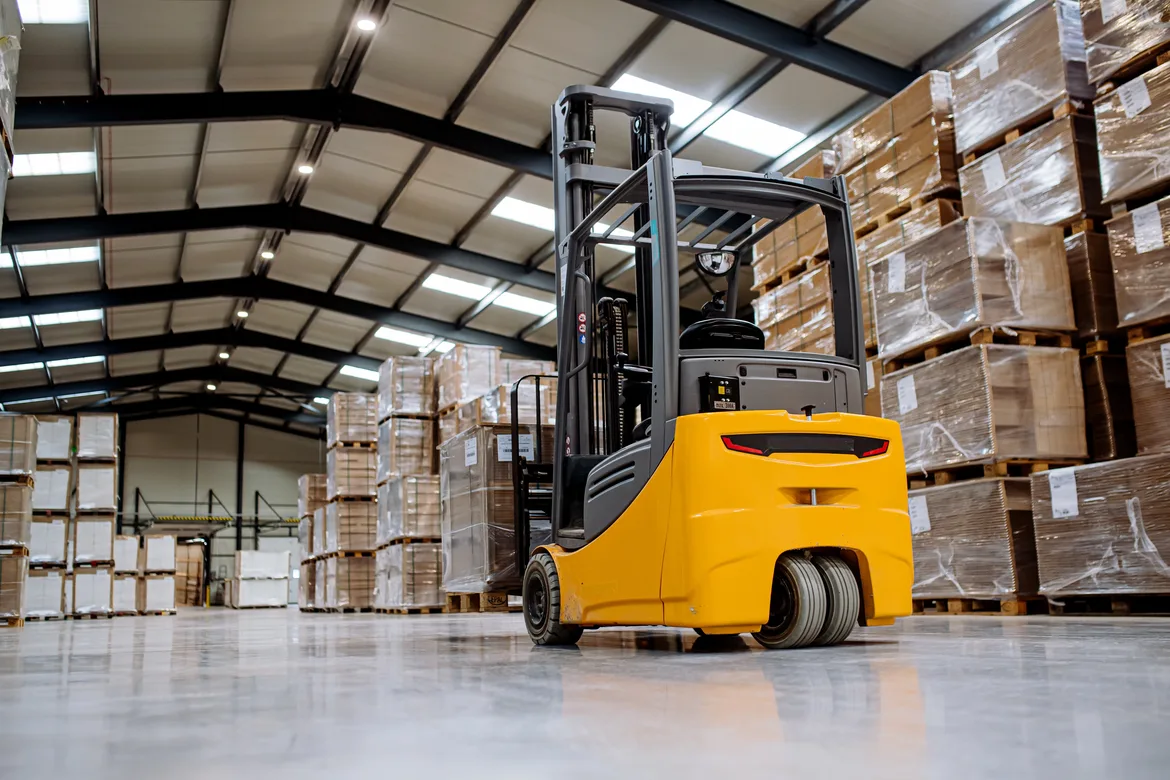
This machine harms people and property far more readily than it harms itself. A boom extended over an occupied structure spends its capacity as it reaches, and a load released at that point lands on somebody else’s building, somebody else’s vehicle, or a worker who had no reason to look up. Illinois sharpens the picture two ways. City work removes the ability to reposition — the footprint is fixed, the machine is set where it fits rather than where it is best, and neighboring property is always inside the arc. And a hard freeze-thaw cycle keeps changing the surface under a rough-terrain unit between one visit to a site and the next, on ground that is often engineered fill in the first place.
Common Illinois forklift claims we see
- Load let go over an occupied property line. The damage belongs to a third party, which is where the cost stops being predictable.
- Tip forward at full extension. Reach consumes the rating faster than the operator believes, and the chart is checked last.
- Worker struck during a placement. The largest exposure on this class, and none of it lands on the equipment schedule.
- Outrigger settling into fill or frost-softened grade. A city-site staple as much as a seasonal one.
- Contact with finished facade or glazing. Reaching into a nearly complete building is where a small error becomes a large invoice.
Why Illinois forklift owners choose Equipment Guard Insurance
Most submissions we see for this machine are priced as if the telehandler were the risk. It is not. The person under the load and the property the load fell on decide whether the year was a good one, and in Illinois that exposure sits under a federal regime a great many owners believe the state plan already answers for. We write equipment monoline, so the machine gets scheduled properly without disturbing arrangements that suit your municipal certificate requirements, and we place through markets — named on our homepage — that will underwrite a jobsite lifting exposure rather than treating a boom machine as ordinary indoor equipment.
Major Illinois forklift markets
- Chicago. Vertical and infill work on fixed footprints, where the boom crosses a property line on almost every placement and the city sets its own conditions.
- Aurora. Sustained suburban commercial and institutional build-out, with a different registration regime a short drive from the last one.
- Joliet. Large-footprint industrial construction on open ground, where machines run long hours and operator turnover is the underwriting question.
- Naperville. Campus, corporate and municipal projects where documented operator evaluation is checked before a unit is allowed to lift.
- Rockford. Manufacturing plant work and maintenance lifting around live operations, often inside buildings that were not designed for reach machines.
- Peoria and Springfield. Regional institutional and public work with long travel between jobs, and units that overwinter on site rather than in a yard.
Related
- Forklift insurance — the machine physics that hold in every state.
- Backhoe insurance in Illinois — the machine that has to satisfy a vehicle code as well as a jobsite.
- All equipment insurance in Illinois — the state hub.
- Equipment floater · Rented & leased equipment
Primary sources
- State Plans — Occupational Safety and Health Administration (operator safety)
Illinois forklift insurance FAQs
Illinois has a state OSHA plan — does it govern my operators?
No, and this is the detail worth being exact about. The approved Illinois plan is limited to state and local government employees, so it reaches the public employer and stops there. A private equipment contractor in Illinois is enforced by federal OSHA, which is where the powered-industrial-truck training, evaluation and refresher obligations come from for your crew. The plan exists; it is simply not the plan you are under.
Then who shows up after a serious lift goes wrong here?
A federal inspector. The citation, the abatement dates and the contest route are federal, and no Illinois safety agency is a party to any of it for a private employer. Contractors sometimes call a state number first after an incident because they know a state plan exists, which costs time in the hours where the incident scene, the machine and the operator file all still need attention.
If the state does not enforce safety here, what does the state do to me?
Almost nothing directly, and that is the peculiar shape of Illinois. There is no statewide general-contractor license, so your right to work is granted municipally — Chicago and the other home-rule municipalities each set their own registration and insurance requirements. The state credentials specific trades rather than general contracting. So the layer that can actually stop your machine working is a city, the layer that can cite you over the operator is federal, and the state plan people have heard of is neither.
Does the municipal patchwork touch my forklift directly?
Through the certificate and the site, more than through the machine. Registration requirements and the insurance evidence attached to them vary between the city, the collar counties and the outlying municipalities, and a crew that works across several of them in a month is producing different paperwork for the same telehandler. It is worth having the schedule and the certificates built so a change of jurisdiction is not a change of policy.
What does a Chicago site do to a rough-terrain machine that an open site does not?
It removes the margin. Infill and vertical work put the boom over occupied buildings, live sidewalks and neighboring property, on footprints where the machine cannot be repositioned once it is set. Loads get placed into partially completed structures rather than onto open ground, and the consequences of a small misjudgment land on somebody else’s property rather than on your own material.
Can you write the machine on its own schedule?
Yes. Equipment Guard Insurance writes equipment monoline in Illinois, so the telehandler and its attachments sit on their own schedule and nothing else in your program has to be reopened. Given how many contractors here believe the state plan covers them, we will also be plain about which authority actually governs the operator, because that assumption shapes what people think their policy is doing.