
The telehandler is the machine a Kansas crew uses to get everything off the ground — decking to a roof line, panels to a wall, forming material to a deck pour — and it does it out in the open, where there is nothing at all between the load and the weather.
The state-level story here is unusual for how little of it there is. Kansas hands operator safety upward to a federal agency and contractor licensing downward to counties and cities, and keeps almost nothing in the middle. For the parts of this machine that behave the same everywhere — the capacity curve, the load chart, ground bearing, how attachments change all of it — start at the forklift insurance pillar.
What forklift insurance costs in Kansas
Any number printed here would be invented, and this class is unusually badly served by invented numbers. The Kansas variables that actually move a quote are the operator count and the strength of the evaluation record behind it, whether the unit is a fixed-mast truck or a telescopic machine placing loads at reach, what the work consists of — panelized and sheet material behave differently in this state than block and pipe do — where the machine stands overnight and whether anything is around it, the attachment schedule, and your record. Storage exposure carries more weight in a Kansas submission than it does in most states.
Kansas forklift regulations: who enforces operator safety
Kansas is under federal OSHA for private-sector employers, so the powered-industrial-truck operator training and evaluation requirements are the federal standard applied directly.
The unusual part is not that sentence, which twenty-odd states could say. It is that Kansas declines the other half of the job as well. There is no statewide general-contractor license here; competency licensing belongs to individual counties and cities, and the only step most contractors take at state level is registering the business itself. Put those two facts together and the state has stepped out of both the safety question and the qualification question, delegating one upward and one downward, which leaves a gap in the middle that something has to fill. What fills it is the contract. On any Kansas project of consequence the general contractor or the owner runs a prequalification review, and that review asks for exactly what a safety regulator would ask for — who is trained on this machine, when they were evaluated on this machine, what happened the last time something went wrong. The difference is the remedy. A regulator issues a citation and you argue about it; a general contractor declines to let the machine on site and you lose the work. Contractors who treat the training file as a compliance chore in a state with no compliance authority tend to discover its commercial value at the worst possible moment.
Common forklift risks in Kansas
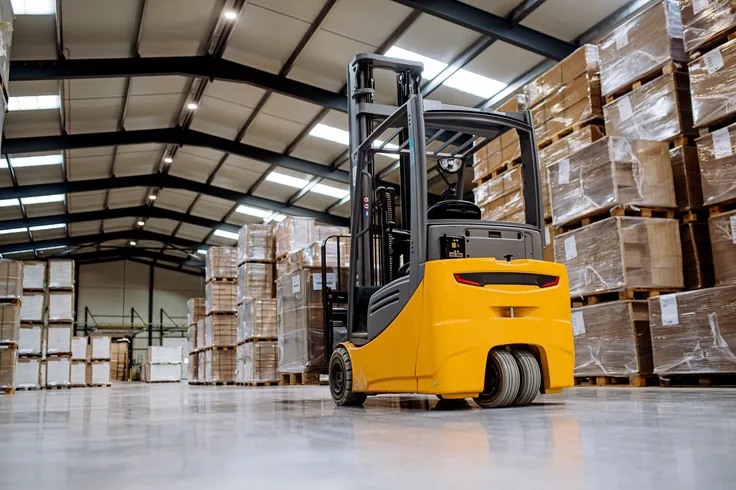
Two things drive losses on this class here, and only one of them is common to every state. The universal half is the capacity curve: extending the boom moves the load away from the machine and spends stability the operator started with, and the ground an outrigger sets on is usually graded rather than engineered. The Kansas half is air. This machine spends its day holding flat things — deck sheets, wall panels, bundles of sheathing — up where the wind is, on sites that have no windbreak because nothing here does. A load with surface area behaves like a sail at exactly the reach where the machine has the least in reserve, and the chart in the cab was calculated in still air. Add the storm season, which damages parked machines wholesale rather than one at a time, and a winter that freezes and thaws the pads everything is set up on.
Common Kansas forklift claims we see
- Panel or sheet load caught by wind at reach. The Kansas signature — the lift was within the chart and the air was not part of the calculation.
- Forward tip with the boom extended. Stability spent on reach, with no state authority involved in what follows.
- Struck-by injury to a worker on the ground. The severe outcome, and the one a prequalification review is really trying to prevent.
- Storm damage to a machine parked in the open. Glass, lights and boom electronics, usually across several units in one night.
- Outrigger settling into unengineered pad fill. Freshly graded ground on a wide site that has not been compacted for a point load.
Why Kansas forklift owners choose Equipment Guard Insurance
We would rather tell a Kansas owner something useful than something flattering, so here it is: the floater is the least of this account. The expensive outcomes are the injured operator, the person under the load and the material that never was worth less than the machine carrying it, and those sit in liability and workers compensation. Because the meaningful audit in this state is a prequalification packet rather than an inspection, the records that get your machine through a general contractor’s gate are the same records that make you a better submission, and we build the file with that in mind. We write the equipment monoline so the machine can be scheduled properly on its own, and we place through markets — named on our homepage — that will read an open-site lifting exposure instead of averaging it into a fleet.
Major Kansas forklift markets
- Wichita. Aviation and heavy-industrial plant work, with lifting done inside and around production that never stops for it.
- Overland Park. The densest commercial build-out in the state, under county-level licensing that has no counterpart elsewhere in Kansas.
- Olathe. Fast suburban and light-industrial growth on freshly graded ground with wide, wind-exposed setup areas.
- Topeka. Capital and public-institutional projects where a managing contractor performs the qualification review the state does not.
- Lawrence. University construction on the steepest ground in the eastern half of the state, where setup position decides the lift.
- Manhattan. Campus and agricultural-industrial work with long distances between jobs and machines that stay put between them.
Related
- Forklift insurance — the machine physics that hold in every state.
- Backhoe insurance in Kansas — the machine this state does define in its own statute, unlike the one on this page.
- All equipment insurance in Kansas — the state hub.
- Equipment floater · Rented & leased equipment
Primary sources
- State Plans — Occupational Safety and Health Administration (operator safety)
- Construction | Kansas Business Center One Stop — None statewide; general-contractor licensing is handled by cities and counties (state role limited to Secretary of State business registration) (contractor licensing)
Kansas forklift insurance FAQs
Is there a Kansas agency that oversees forklift operators?
No. Private-sector employers here are under federal OSHA, so operator training, machine-specific evaluation and refresher requirements arrive as the federal standard, and any inspection or citation is federal. There is no state safety authority to register with, to notify, or to appeal to at any point in the process.
Does the state license contractors instead?
It does not. Kansas has no statewide general-contractor license; that authority sits with individual cities and counties, and for most contractors the only step at state level is registering the business entity. So both the safety layer and the competency layer are absent from the state — one delegated upward to a federal agency, the other delegated downward to whichever jurisdiction issues the permit.
Then who actually checks that my operator is qualified?
Whoever hired you. In a state with no safety regulator and no competency license, the prequalification packet is where operator qualification is genuinely tested — a general contractor asking for training records before your machine comes on site, an owner setting conditions in the contract, an insurer asking at renewal. That review is private, contractual and enforced by exclusion rather than by penalty, and it is stricter on a large project than a regulator would be.
Why does wind keep coming up on a forklift page?
Because this machine holds flat objects in the air. A sheet of decking, a wall panel, a bundle of sheathing or a stack of forming material presents a surface to the wind, and it does so at the end of an extended boom where the machine has the least capacity in reserve. Sustained plains wind and the gusts that come with a front are a Kansas working condition rather than a weather event, and the load chart in the cab does not have a column for it.
What about hail and severe storms?
They matter mostly for machines standing still. A telehandler parked in the open on an unfenced site through a Kansas storm season is exposed in ways the working machine is not — glass, lights, hydraulic lines and boom-mounted electronics take damage that is inconvenient rather than catastrophic but happens to whole fleets at once. Where the machine sleeps is a real underwriting question in this state, not a formality.
Can the machine go on its own policy?
Yes. Equipment Guard Insurance writes equipment monoline in Kansas, so the telehandler and its attachments sit on a schedule of their own. Where the enforcement is contractual rather than governmental, we would rather help you carry documentation that satisfies a prequalification review than paperwork nobody will ever ask for.