
The telehandler is the machine a Kentucky crew stops seeing. It sets block up a wall, lands bundles on a deck, carries material across a site nobody has graded yet, and asks for nothing — which is precisely why the day it puts a load down badly is the day nobody was watching it.
Two Kentucky facts sit behind that, and they pull in opposite directions. The state runs the safety program itself, so it takes a close interest in how operators are trained and evaluated, while it does not license general contracting at all. And the ground here is limestone country, which has a habit of being firmer at the surface than it is underneath. For the machine physics that hold anywhere — reach against capacity, boom geometry, bearing pressure — the forklift insurance pillar covers it properly.
What forklift insurance costs in Kentucky
Publishing a rate for this class would be making one up, because the drivers sit around the machine rather than in it. In Kentucky what moves a quote is the operator roster and whether every evaluation on file names the specific unit, the split between fixed-mast trucks and telehandlers placing at reach, the kind of ground the work puts the machine on, whether the unit stays on a site or returns to a secured yard, and the losses on record. What the telehandler is worth is the input that matters least, which is the opposite of what most owners expect walking in.
Kentucky forklift regulations: who enforces operator safety
Kentucky operates its own OSHA-approved State Plan covering private-sector employers, so powered-industrial-truck operator training, evaluation and enforcement run through the state program rather than federal OSHA directly.
The substance does not move; the counterparty does. An approved program has to hold up against the federal benchmark before it is recognized, so nobody should read a state-run scheme as a lighter one on operator training, evaluation or refresher duties. What changes is who is on the other side of the table: a state compliance officer, a state citation, a state appeal route, and a state file. That matters more here than it would elsewhere, because Kentucky does not license general contracting at all — only the electrical, plumbing and HVAC trades hold state licenses, and everything else is handled locally. So for a general contractor running lifting equipment in this state, the occupational safety program is very close to the only state authority with a direct, continuing interest in the business. The practical effect is that the operator evaluation file is not just a compliance record; it is the principal document by which the state knows how the work is run. A contractor crossing into a federally enforced state on the next job keeps the same duties and starts a completely separate relationship to satisfy them.
Common forklift risks in Kentucky
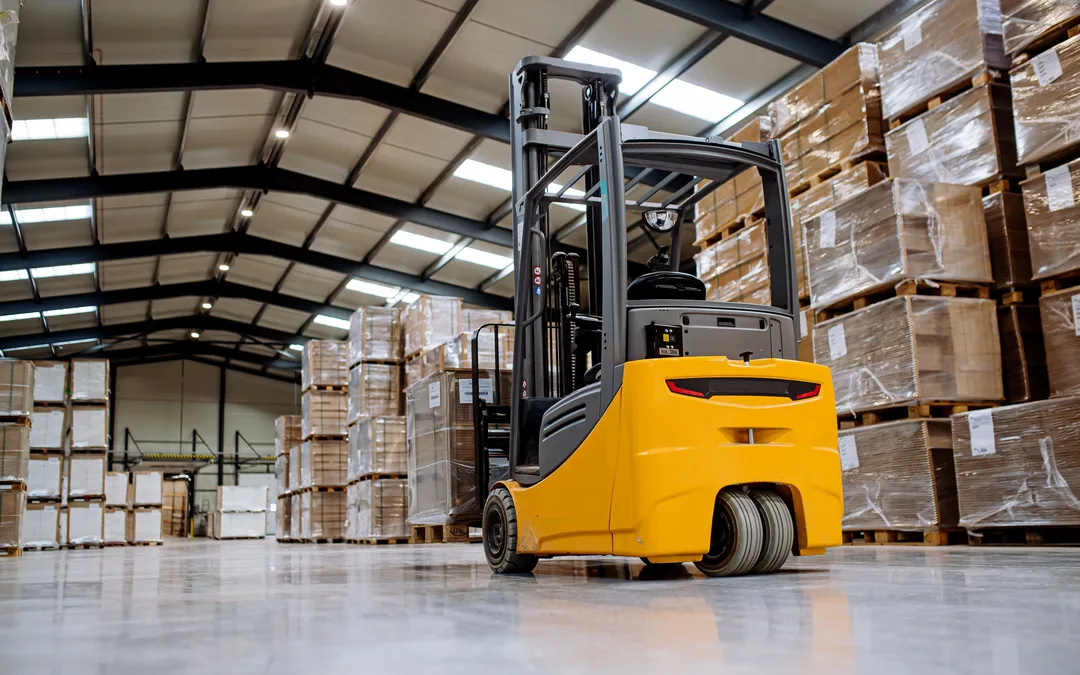
The ground is the Kentucky variable. A rough-terrain forklift puts a great deal of weight through four small contact points, and across much of this state the rock below the soil is limestone that water has been working on for a very long time — dissolving seams, opening voids and occasionally collapsing into a sinkhole. Ground of that kind can be perfectly firm where a machine tests it and unsupported a short way beneath, and the failure when it comes is sudden rather than gradual. Layer the ordinary physics on top of that — capacity leaving as the boom extends, a load moving away from the machine faster than the operator estimates — and the losses in this state cluster on setup and on reach rather than on anything mechanical.
Common Kentucky forklift claims we see
- Pad failure under an outrigger. Firm at the surface, unsupported below, and the machine finds out at full extension.
- Load released at reach. Material and whatever it lands on carry the cost, and the unit rarely does.
- Worker struck beneath a raised load. Workers compensation and liability, and the outcome that dominates this class.
- Damage while placing into completed construction. Reaching into a finished building means damaging work that was already signed off.
- Machine rolled on unimproved access. Getting to the pick is its own exposure on rural and hillside sites here.
Why Kentucky forklift owners choose Equipment Guard Insurance
A broker who quotes this machine off its value has answered the easy question. The harder and more useful one is what a bad Kentucky year on a telehandler is actually made of, and the answer is an injured person and a damaged structure — liability and workers compensation, not the floater. We write the equipment line monoline so the unit and every attachment get scheduled properly without reopening anything else a contractor has arranged, and we place through markets — named on our homepage — that understand a machine lifting from ground nobody surveyed rather than from a slab.
Major Kentucky forklift markets
- Louisville. River-city industrial and institutional work at volume, with lifting staged around live operations and constrained yards.
- Lexington. Bluegrass commercial and campus construction, and the equine and agricultural building work that keeps units on rural ground.
- Bowling Green. The heart of the state’s cave country, where what lies under a working pad is a genuine engineering question.
- Owensboro. Western river industrial and process projects with long distances between jobs for a single machine.
- Covington and the northern river corridor. Dense cross-river commercial work where a crew may run the same unit under two different enforcement authorities in a week.
- Elizabethtown. Interstate-corridor industrial build-out on large parcels, with repetitive picking and units assigned to one site for months.
Related
- Forklift insurance — the machine physics that hold in every state.
- Excavator insurance in Kentucky — the machine that has to notify before it opens ground this state cannot always vouch for.
- All equipment insurance in Kentucky — the state hub.
- Equipment floater · Rented & leased equipment
Primary sources
- State Plans — Occupational Safety and Health Administration (operator safety)
- Department of Housing, Buildings and Construction (Kentucky) — No statewide general contractor license; the Kentucky Department of Housing, Buildings and Construction licenses electrical, plumbing, and HVAC trades; general contracting is regulated locally (contractor licensing)
Kentucky forklift insurance FAQs
Who enforces forklift operator safety in Kentucky?
The state. Kentucky operates an approved occupational safety program covering private-sector employers, so a compliance officer employed by the state carries out the inspection, the citation is issued by the state, and any contest goes through the state route. A contractor who also works in a federally enforced state is answering to two different bodies on the same machine doing the same job, with two sets of correspondence and two appeal timetables.
Does Kentucky license general contractors?
Not at the state level. Only the electrical, plumbing and HVAC trades are licensed by the state here; general contracting is a local matter. That leaves the occupational safety program as the main state-level relationship a general lifting contractor actually has — so on a Kentucky site the state agency most likely to have an opinion about a business is the one looking at how it runs its machines.
What does karst geology have to do with a forklift?
Everything about setup. A rough-terrain forklift concentrates a great deal of weight onto four small footprints, and across much of Kentucky the rock beneath the topsoil is limestone that dissolves over time into voids, seams and sinkholes. That produces ground which is genuinely firm at the surface and unsupported some distance below it, and a proof test done by driving the machine across a pad tells you about the top few inches only. Cribbing, spreading the load and treating unknown ground as suspect are not overcautious here.
Does a state-run program make the rules easier?
It does not. An approved program has to stand up against the federal benchmark to be recognized, so operator training, evaluation and refresher obligations should not be read as lighter. The real difference is procedural — the identity of the office, the wording on the citation, the people who answer the telephone and the route an appeal follows are Kentucky rather than federal.
What does a Kentucky forklift claim usually look like?
The load and the ground, and rarely the machine. A pad that gives under an outrigger, a load released while the boom is out, and a worker struck below account for the losses that matter, while the telehandler is often back at work within days. Because the expensive part is an injured person or a destroyed structure, this class runs through workers compensation and liability far more than through the equipment floater.
Will you insure the machine without touching my other lines?
Yes. Equipment Guard Insurance writes equipment monoline in Kentucky, so the telehandler and its attachments are scheduled by serial number on their own. The operator exposure is a workers compensation and liability discussion we are glad to have beside it, but it is not a reason to disturb a program that is working.