
A telehandler earns its keep by making a crane unnecessary. It sets steel, feeds a deck, carries block to the third floor and asks almost nothing of anyone until the day it puts a load down somewhere that cannot hold it.
In Louisiana the regulatory story around that machine is short, and its shortness is the point: the safety authority belongs to the federal government, and the state has never taken it. Where Louisiana is genuinely distinctive is in what it does control — who may hold the contract, and where the paperwork on a financed machine lives — and in ground that behaves unlike ground almost anywhere else. For how the machine itself works, from load charts to boom geometry, read the forklift insurance pillar.
What forklift insurance costs in Louisiana
Any premium quoted from a web page for this class would be invented, because the rating conversation is about people and documentation rather than about steel. In Louisiana the things that move it are the size of the operator group and whether their evaluations are on file for the specific unit, the split between fixed-mast trucks and telehandlers working at reach, how much of your work sits inside controlled industrial sites versus open ground, where the fleet goes when a storm closes a job, and your own claim history. What the machine would cost to replace matters least of all of it.
Louisiana forklift regulations: who enforces operator safety
Louisiana is under federal OSHA for private-sector employers, so the powered-industrial-truck operator training and evaluation requirements are the federal standard applied directly.
Say that plainly and the useful consequence follows: there is no Louisiana safety agency in this picture, and looking for one wastes the first hours after an incident, which are the only hours in which a scene can still be documented properly. What the state does own sits one layer over — the license. Authority to hold the work is graded by the scale of the project and issued centrally, so Louisiana decides whether you may bid a job while the federal government decides how the machine on it must be run. Two gates, neither of them looking at the other. Underneath that, the state distributes its commercial record-keeping in a way outsiders never expect: a financing statement on a financed machine is filed at a parish Clerk of Court and flows into the statewide index from there, so the loss payee on an equipment schedule and the party actually of record can drift apart if nobody checks. None of that is a safety rule, and all of it decides how quickly a serious claim on this machine gets resolved. The federal training and evaluation obligation is real, it applies to every operator you employ, and it is the same obligation carried in twenty-two other states — it is not what makes running a telehandler here different.
Common forklift risks in Louisiana
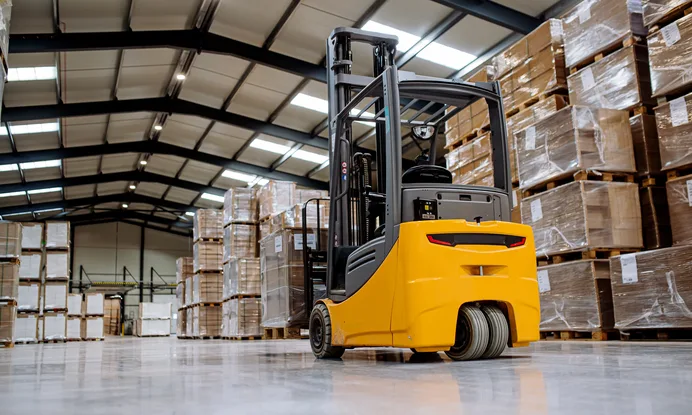
The machine survives most of its own accidents. What does not survive is the load, the structure it was being placed into, and anyone standing beneath it — and in Louisiana the ground is the accomplice. Soft alluvial soil over a shallow water table gives an outrigger far less to push against than a crew coming from firmer country expects, and a pad that felt solid at the start of a shift can be taking water by the end of it. Add heat that shortens attention through the afternoon, sites that shut down and reopen around storm season, and industrial work where a boom reaches over live process equipment, and the pattern is less about mechanical failure than about a machine being asked to work at reach on ground and in conditions that keep changing underneath it.
Common Louisiana forklift claims we see
- Outrigger settling into saturated soil. The signature Louisiana loss on this class, and it happens under load rather than at rest.
- Load dropped while placing at reach. The material and whatever it lands on carry the cost; the machine is usually back at work the next day.
- Forward tip as the boom extends. Capacity falls with reach, and the chart in the cab is the document least often reread.
- Injury to a worker beneath the load. A liability and work comp event, and the most expensive way this machine can fail.
- Storm-season damage or theft at a shut-down site. Machines parked somewhere unfamiliar while a job is closed are machines nobody is watching.
Why Louisiana forklift owners choose Equipment Guard Insurance
We would rather be blunt about where the money goes on this account. Repairing a telehandler is the small half; the half that ruins a year is the injured operator and the material destroyed, and in a state with no safety agency of its own there is nobody local to arbitrate any of it. Writing the equipment monoline lets us schedule the machine and its attachments accurately without reopening a program built around Louisiana work, and we place through markets — named on our homepage — that will read a lifting exposure on soft ground for what it is instead of pricing it from a table built for level indoor floors.
Major Louisiana forklift markets
- New Orleans. Dense rebuilding and elevation work on soft ground, with loads set inside tight historic street grids.
- Baton Rouge. Industrial corridor projects where site owners run their own contractor-qualification gates before a machine is allowed inside the fence.
- Lake Charles. Southwest industrial construction and long rebuild cycles, with fleets that must be moved or secured when a storm approaches.
- Lafayette. Energy-services yards and regional commercial work, where machines cover long distances between jobs.
- Shreveport. Northern commercial and institutional building on firmer ground, with a different rental market from the southern parishes.
- Bossier City. Steady municipal and mixed-use work across the river, typically on smaller sites with fewer machines available to share the load.
Related
- Forklift insurance — the machine physics that hold in every state.
- Skid Steer insurance in Louisiana — the machine whose lien paperwork goes to a parish courthouse rather than to one central office.
- All equipment insurance in Louisiana — the state hub.
- Equipment floater · Rented & leased equipment
Primary sources
- State Plans — Occupational Safety and Health Administration (operator safety)
- Types of Licenses — Louisiana State Licensing Board for Contractors (contractor licensing)
Louisiana forklift insurance FAQs
If a telehandler injures somebody on a Louisiana site, who investigates?
Federal OSHA. Louisiana has never taken over enforcement for private employers, so there is no parish or state safety office in that chain — the investigator, the citation and any contest of it run through the federal system. Contractors who move here from a state that runs its own program keep looking for a state number to call, and there is not one.
So what does Louisiana actually control about my equipment operation?
The right to hold the work. The state licensing board issues authority graded by the size and type of the project, so whether you can legally bid a job is a state question even though how you run the machine on it is a federal one. It is a genuinely strong gate, just aimed at the contract rather than at the operator.
Does the lien on a financed telehandler get filed differently here?
Yes, and it catches lenders from out of state. Louisiana takes the financing statement at a parish Clerk of Court, which feeds the statewide index, rather than at a single central office the way most states do. It matters for insurance because the loss payee named on a schedule should match what was actually filed, and a machine financed through a filing nobody can locate slows a total-loss settlement badly.
How does Louisiana ground change what happens under an outrigger?
It removes the margin you are used to. Much of the buildable land here is soft alluvial soil sitting over a water table close to the surface, so a pad that carried the machine in the morning can take water through the afternoon and give way under load. Mats and a deliberate setup are not a formality on this ground — they are the difference between a lift and a tip-over.
Does storm season affect how the machine should be insured?
It affects where the machine is when nothing is happening. Work stops, sites are secured and a telehandler often waits somewhere it does not normally sit, which is precisely when wind, flooding and theft find it. Underwriters ask about storage and evacuation habits here in a way they do not elsewhere, and an honest answer about where the fleet goes when a job shuts down is worth having ready.
Can you write the machine on its own without touching the rest?
Yes. Equipment Guard Insurance places equipment monoline in Louisiana, so the telehandler and its attachments are scheduled by themselves. With safety authority federal and the state gate sitting on the license, we would rather set out plainly which obligation belongs to whom before a claim than reconstruct it afterward.