
A rough-terrain forklift is the machine a crew stops noticing. It lifts material to a second story, sets trusses, feeds a mason, and does it all day without anyone treating it as dangerous — right up until it puts a load somewhere nobody expected.
What is specific to Michigan is not the rule but the regulator. This state runs its own approved safety program, so the enforcement identity behind that machine is a state agency, and the practical consequences run through inspections, citations and how a claim is investigated. For how the machine itself behaves — load charts, the boom, ground bearing, the tip-forward geometry — see the forklift insurance pillar.
What forklift insurance costs in Michigan
There is no premium worth printing for this class, because the number is driven by the people around the machine rather than by the machine. What moves it in Michigan is how many operators you run and how their training is documented, whether the unit is a fixed-mast forklift or a telehandler placing loads at reach, the sites you work and the ground they sit on, where the machine winters, and your own loss record. Two identical telehandlers, one with a documented evaluation for every operator and one without, are not the same risk to anybody underwriting them.
Michigan forklift regulations: who enforces operator safety
Michigan operates its own OSHA-approved State Plan covering private-sector employers, so powered-industrial-truck operator training, evaluation and enforcement run through the state program rather than federal OSHA directly.
The consequence is administrative rather than substantive, and it is worth being exact about because owners routinely get it backwards. An approved state program must be at least as effective as the federal one, so nobody should read a state plan as a softer standard — the operator training, evaluation and refresher obligations are not a place to find relief. What changes is the identity of the enforcer: the inspector is a state employee, the citation is a state citation, the appeal runs through a state process, and a contractor who also works across the state line is dealing with two different agencies for the same machine doing the same job. That last point is the one that catches crews out, and it is a scheduling and documentation problem long before it is an insurance problem.
Common forklift risks in Michigan
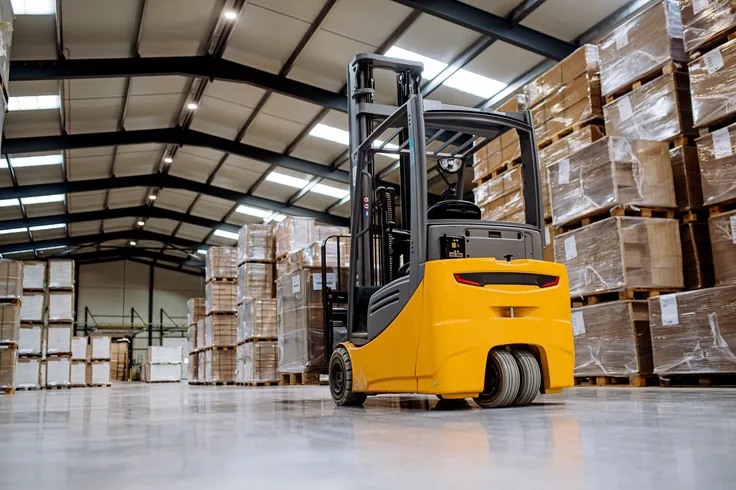
This class hurts people and property far more often than it hurts the machine. A telehandler that drops a load or tips forward may need little more than an inspection, while the pallet of material, the structure it was reaching into, or the worker underneath it generate the claim. The two mechanical habits behind most of it are constant: extending the boom moves the load away from the machine and quietly consumes the capacity the operator started with, and the ground under a rough-terrain unit is never as level or as firm as it looks. Michigan adds the freeze-thaw cycle, which rearranges that ground between one visit and the next, and a compressed season that puts more machines in play at once.
Common Michigan forklift claims we see
- Load dropped from height. The defining claim — the material and whatever it lands on cost far more than the machine.
- Forward tip with the boom extended. Capacity falls away as reach increases, and the load chart is the part nobody rereads.
- Struck-by injury on the ground. A workers compensation and liability event, not a floater one, and the most expensive outcome on this class.
- Outrigger or wheel sinking into soft or thawing ground. Seasonal in this state rather than occasional.
- Damage to a finished structure during placement. Reaching into a building is where the machine meets work that is already paid for.
Why Michigan forklift owners choose Equipment Guard Insurance
Most brokers price this machine as a smaller version of something else and stop there. We would rather be straight that the floater is the cheap half: the exposure that decides a bad year on a telehandler is the operator and the person standing underneath the load, which lives in liability and workers compensation. We write the equipment monoline so the machine can be scheduled properly without disturbing a program built around Michigan work, and we place through markets — named on our homepage — that will read a jobsite lifting exposure rather than treating it as warehouse equipment.
Major Michigan forklift markets
- Detroit and the southeast metros. Dense redevelopment and industrial work where machines place loads close to occupied structures.
- Warren and Sterling Heights. Heavy industrial and plant work with tight yards and constant material handling around live operations.
- Grand Rapids. The west-side construction economy, with sustained commercial build-out and a deep rental market for reach machines.
- Ann Arbor. Institutional and campus work on constrained sites where a boom regularly reaches over something expensive.
- Lansing and Flint. Public and institutional projects where documented operator evaluation is checked before a machine is allowed to work.
- Kalamazoo. Regional industrial and agricultural handling, with long distances between jobs and machines that overwinter on site.
Related
- Forklift insurance — the machine physics that hold in every state.
- Skid Steer insurance in Michigan — the other compact machine that lifts more than its size suggests.
- All equipment insurance in Michigan — the state hub.
- Equipment floater · Rented & leased equipment
Primary sources
- State Plans — Occupational Safety and Health Administration (operator safety)
- Residential Builders — LARA Bureau of Construction Codes, Licensing Section — Michigan Department of Licensing and Regulatory Affairs (LARA) (contractor licensing)
Michigan forklift insurance FAQs
Who actually enforces forklift safety on a Michigan jobsite?
The state does. Michigan operates its own approved occupational safety program covering private-sector employers, so the inspector who arrives after an incident works for the state rather than for the federal agency, and the citation is a state citation. In practice that means a different office, different contacts and a different appeal path from the one a contractor working across the state line deals with.
Does a state-run program mean the rules themselves are different?
Not in the sense most owners assume. An approved state program has to be at least as effective as the federal one, so the substance of operator training, evaluation and refresher requirements is not somewhere a contractor should expect a lighter touch. What genuinely differs is administration — who inspects, who cites, and how the program interacts with the rest of your state obligations.
Is a telehandler on a jobsite treated the same as a warehouse forklift?
For operator qualification purposes, the powered-industrial-truck requirements reach it — but the risk profile is not comparable. A rough-terrain machine works on grade, on fill, on ground that changes with the weather, and it places loads at height where a warehouse unit places them on a level slab. The training that matters here is the part about the specific machine and the specific site, which is also the part most often skipped.
What is the exposure that actually shows up on a Michigan forklift claim?
People and property far more than the machine itself. A telehandler that tips or drops a load rarely writes off the unit, but it can injure a worker on the ground, damage a structure, or destroy what it was carrying — and those are liability and workers compensation questions rather than floater ones. Insuring the iron alone leaves the expensive half of this class uncovered.
Does Michigan winter work change the underwriting?
Yes, in two directions. Frost and thaw move the ground a rough-terrain machine stands on, so a pad that was solid in December is not in March, and the season also compresses the work into fewer months with more machines running at once. A telehandler stored outdoors through the winter is also a machine nobody has inspected for months before it lifts its first load in spring.
Can you write the machine without touching my work comp?
Yes. Equipment Guard Insurance places equipment monoline in Michigan, so the telehandler goes on its own schedule. The operator exposure is a workers compensation and liability conversation we will have alongside it — but it is not a reason to move a program you are happy with.