
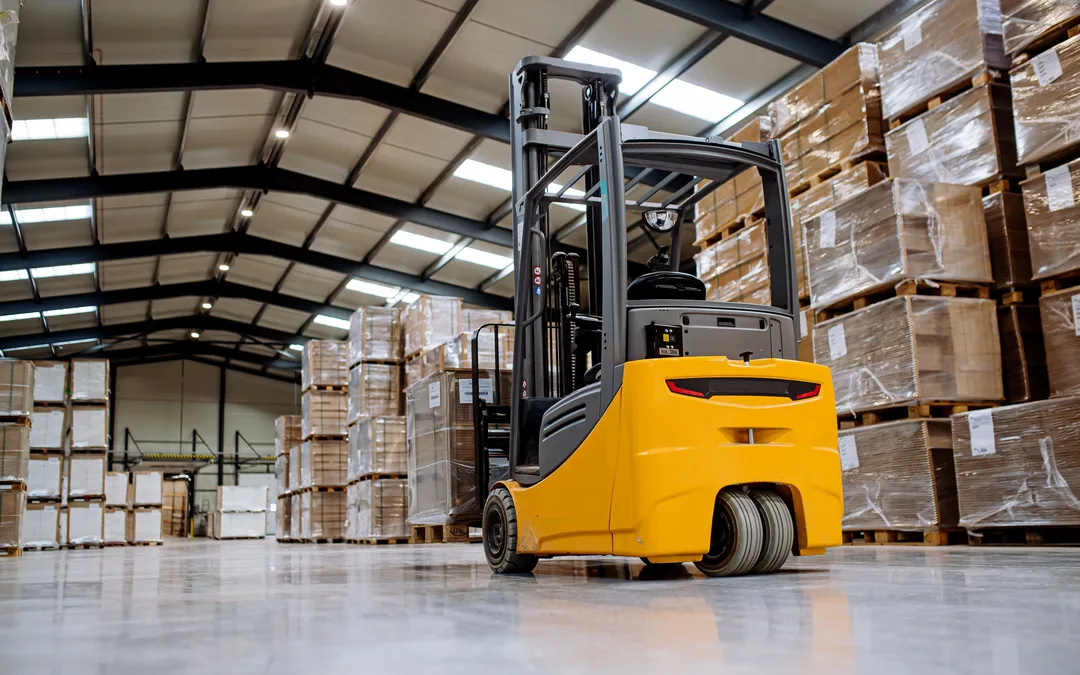
A rough-terrain forklift is the machine a Minnesota crew plans the day around without ever discussing. It lands sheathing on a deck, feeds a mason, moves steel across a site that has not been paved yet, and keeps working in weather that shuts other equipment down — right up until a load goes somewhere it was never going to hold.
The state has a direct hand in how that machine is run, which is not true everywhere. Minnesota operates its own approved safety program covering private employers, so the enforcement identity behind an operator is the state itself. And the ground story here runs against the usual instinct: cold makes a working surface more dependable, not less. For the mechanics behind all of it — reach against capacity, boom geometry, bearing pressure — the forklift insurance pillar is the reference.
What forklift insurance costs in Minnesota
A published rate for this class would be fiction, because the machine is not what is being priced. The Minnesota inputs are the size of the operator roster and how specific each evaluation record is to the actual unit, whether the fleet is fixed-mast trucks or telehandlers working at reach, how much of the season the machine runs and how much of it the machine sits, where it sits when it does, and the losses already recorded against the business. A unit that overwinters outdoors and comes back into service without a documented inspection is not the same risk as one that does, whatever the two are worth.
Minnesota forklift regulations: who enforces operator safety
Minnesota operates its own OSHA-approved State Plan covering private-sector employers, so powered-industrial-truck operator training, evaluation and enforcement run through the state program rather than federal OSHA directly.
The obligations themselves do not soften — an approved program has to measure up against the federal benchmark to be recognized, so training, evaluation and refresher duties are not somewhere to look for relief. What moves is the whole administrative relationship: a state compliance officer arrives, the citation is issued in the state’s name, the appeal follows a state route, and the file is held here rather than federally. That is worth setting beside the other way Minnesota deals with contractors, because the contrast is instructive. The state licenses residential building contractors through the Department of Labor and Industry, while commercial general contracting is handled through code and permitting rather than a state license — so a business that does both carries two very different state relationships depending on which job it is on. The safety program is the one thing that does not vary with the work. The same operator evaluation file answers for the same machine whether it is setting trusses on a house or feeding a plant expansion, and it is the document the state will ask for first in either case.
Common forklift risks in Minnesota
Minnesota inverts the seasonal argument that applies further south. Deep frost is an asset to a machine that concentrates its weight on four small footprints: frozen subgrade carries an outrigger load that the same site will not carry in midsummer, and a great deal of heavy work here is scheduled into the cold for exactly that reason. The danger is that the support is borrowed and it is repaid from the top down. Through the thaw a pad presents a firm crust over saturated, unsupported material, so the surface that a crew has trusted all winter fails without any of the warning signs they have learned to read. Every other exposure on this machine — capacity leaving as the boom extends, a load traveling further from the machine than the operator judged, a worker standing beneath it — then arrives on top of ground nobody can vouch for.
Common Minnesota forklift claims we see
- Outrigger through a thawing crust. The distinctive spring loss here, and it gives no warning because the surface still looks right.
- Load dropped from height. The material and whatever is below it set the number, not the telehandler.
- Forward tip at extension. The chart says exactly what happens as reach increases, and nobody rereads the chart.
- Ground worker struck. A workers compensation and liability claim, and the most expensive result available on this class.
- First lift after a winter layup. Months outdoors with nobody looking at it, then straight back into service under load.
Why Minnesota forklift owners choose Equipment Guard Insurance
We would rather lead with the awkward fact than the flattering one: the equipment policy protects the part of this exposure that is least likely to cost real money. A hard Minnesota year on a telehandler comes from a person under a load or a finished structure the boom reached into, and both of those sit in liability and workers compensation. Writing the equipment line monoline lets the unit and every attachment be scheduled properly, with the winter storage question actually asked, and without reopening arrangements a contractor has built around this state — and the markets we use, named on our homepage, read a jobsite lifting exposure for what it is.
Major Minnesota forklift markets
- Minneapolis and Saint Paul. Metro infill and redevelopment on constrained parcels, where machines place loads beside occupied buildings.
- Rochester. Sustained medical campus expansion, with lifting staged around facilities that cannot be interrupted and gates that check operator records.
- Duluth. Port and heavy industrial work on steep ground, in the harshest operating conditions the state offers.
- Bloomington. Commercial and institutional projects around the airport corridor, with tight staging and constant repositioning.
- St. Cloud. Granite and aggregate country plus regional commercial build-out, where units work unimproved ground routinely.
- Mankato. Southern agricultural and industrial building work, with long hauls and machines that stay on a site for the whole season.
Related
- Forklift insurance — the machine physics that hold in every state.
- Backhoe insurance in Minnesota — the machine whose Minnesota rules follow it off the site and onto the highway.
- All equipment insurance in Minnesota — the state hub.
- Equipment floater · Rented & leased equipment
Primary sources
- State Plans — Occupational Safety and Health Administration (operator safety)
- Residential contractor licensing | Minnesota Department of Labor and Industry — Minnesota Department of Labor and Industry (DLI) (contractor licensing)
Minnesota forklift insurance FAQs
Does Minnesota or the federal agency inspect a forklift incident here?
Minnesota does. The state operates its own approved program covering private-sector employers, so the inspection, the citation and the appeal are all handled at the state level and the file stays in a state office. For a contractor whose work crosses into a federally enforced state, the same telehandler doing the same job answers to two separate authorities with two sets of paperwork and two sets of deadlines.
Is the standard itself different under a state program?
Not meaningfully, and treating it as a softer regime is a mistake worth avoiding. Recognition requires the state scheme to measure up against the federal benchmark, so operator training, evaluation and refresher obligations carry the same weight. The genuine differences are procedural — the office, the inspector, the appeal path and the correspondence are all Minnesota.
How does Minnesota licensing sit alongside the safety program?
Unevenly, which is the interesting part. The state licenses residential building contractors through the Department of Labor and Industry, while commercial general contracting is regulated through code and permitting rather than by a state license. A contractor working both sides therefore holds two quite different state relationships depending on the job. The safety program is the one that does not change: it reaches the same operators and the same machines regardless of which kind of work they are on that week.
Why would frozen ground be safer for a telehandler than summer ground?
Because frost turns a soft subgrade into a hard one. Deep frost gives a surface that carries a concentrated outrigger load better than the same site does in July, which is why so much heavy work here is deliberately scheduled into the cold. The risk is that the reliability is temporary and it disappears from the top down. During the thaw the surface looks solid while the material below it is saturated and unsupported, and that is the pad that fails without warning.
What actually generates a Minnesota forklift claim?
The load, the ground and the person under both. A bundle released from height, a forward tip as the boom reaches, a worker struck on the ground, and an outrigger settling through thawing subgrade cover most of it. The machine is usually serviceable afterward; the material, the structure and the injured operator are what carry the cost, which is why liability and workers compensation matter more on this class than the equipment policy does.
Can the machine go on its own schedule?
Yes. Equipment Guard Insurance writes equipment monoline in Minnesota, so the telehandler and its attachments are listed by serial number without touching anything else in your program. We will want to know where the unit overwinters, because a machine that sat outdoors from November has not been inspected by anybody before it makes its first lift of the spring.