
On a New Mexico site the telehandler is often the only machine that can reach where the work is, and it earns that position by being asked to do slightly more than it was built for. Long carries over open ground, loads placed at extension, wind that was not there an hour ago.
The regulatory frame around it is the opposite of what most owners assume. This state kept the safety program for itself, so an inspection here is a state inspection — while the permit governing the ground the machine is standing on is a federal one. Getting that pairing straight is most of what a page like this can usefully do. The behavior of the machine itself, which is the same in any state, is set out on the forklift insurance pillar.
What forklift insurance costs in New Mexico
There is no honest number to publish for this class, because underwriters are pricing the crew and the paperwork rather than the machine. What moves it in New Mexico is the number of operators and whether each has a documented evaluation on the specific unit, the mix of fixed-mast trucks and telehandlers working at reach, how far the fleet travels between jobs and how much of that is open country, whether the machines work energy sites or town projects, where they sit when nobody is on them, and your loss history. What the unit is worth on a dealer lot is the least of it.
New Mexico forklift regulations: who enforces operator safety
New Mexico operates its own OSHA-approved State Plan covering private-sector employers, so powered-industrial-truck operator training, evaluation and enforcement run through the state program rather than federal OSHA directly.
The useful consequence is about identity rather than stringency, and it is worth being exact. An approved program has to be at least as effective as the federal baseline, so nobody should read the state’s involvement as a lighter touch on training, evaluation or refresher obligations. What genuinely changes is that the inspector works for New Mexico, the citation is a state citation, and the appeal is heard in a state process — a shorter chain than the federal one, with people who can be reached. Now hold that against the rest of the picture, because this is where the state confounds expectations. The stormwater permit covering the disturbed ground your machine drives across is issued by the federal environmental agency, not by a New Mexico department, which is the reverse of the usual arrangement. Contractor licensing, meanwhile, runs centrally through the state’s construction industries division rather than through towns and counties. Put it together and you get a state that holds the file most states hand up, hands up the file most states hold, and keeps the credential centrally — so an owner working from intuition will guess wrong on at least one of the three. The federal training rule itself is the same everywhere and is not the distinguishing fact; who reviews your compliance with it here is.
Common forklift risks in New Mexico
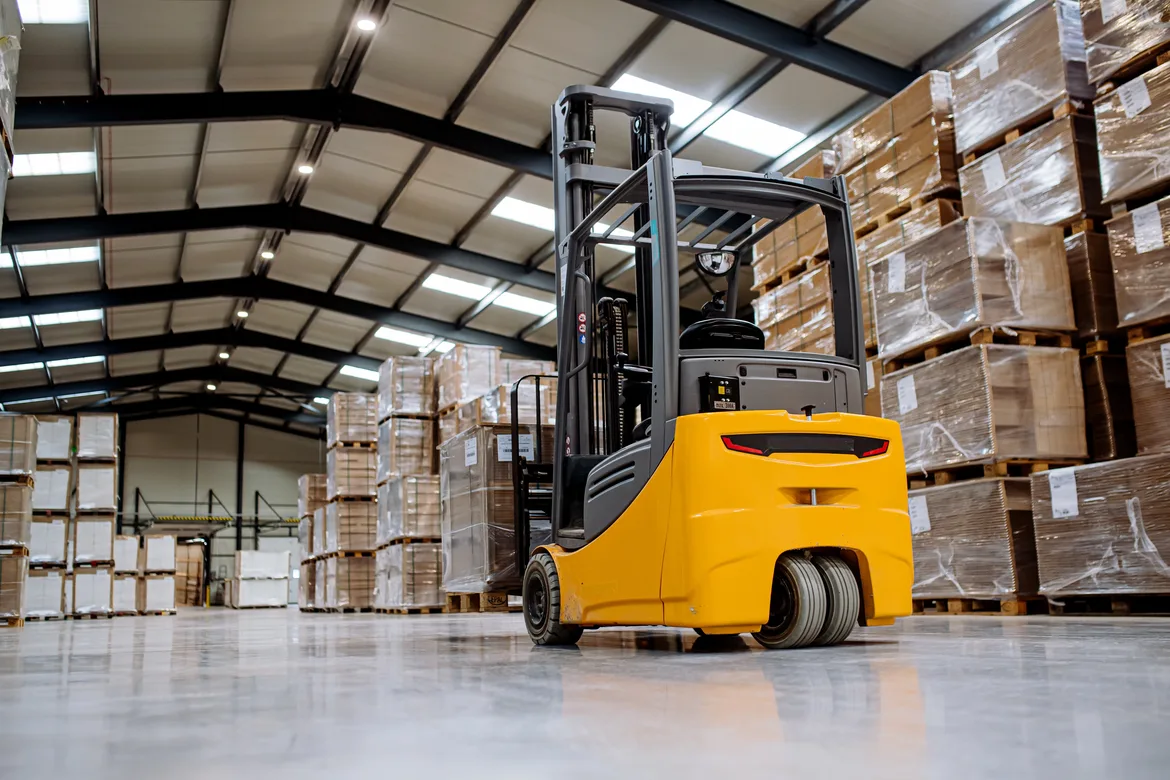
Almost nothing that goes badly wrong with this machine is paid to the machine. The load, the finished work it was placed into and the person underneath carry the cost, and New Mexico supplies its own set of ways to get there. Wind is first: open high desert builds gusts through the afternoon, and a load held at full extension gives them something to push against, which the operator experiences as capacity vanishing. Ground is second, and it is deceptive — caliche and hardpan feel like rock and invite a casual setup, while a thin crust or a channel scoured out by a monsoon-season storm waits underneath. Then distance: machines travel long stretches between jobs and sit for weeks at sites nobody visits daily, with dust working into cylinders and pivots the whole time.
Common New Mexico forklift claims we see
- Load lost at extension in a gust. The wind and the reach spend the same capacity, and only one of the two shows on an instrument in the cab.
- Outrigger breaking through a hard crust. Ground that sounds like rock under a boot is not always ground that carries a loaded machine.
- Worker injured beneath a raised load. The most serious outcome this machine offers, and it belongs to liability and work comp.
- Damage to finished or live installations during placement. Reaching into completed work is where the machine meets things already paid for.
- Theft or vandalism at a remote site. Machines left on distant jobs between visits are machines with nobody nearby.
Why New Mexico forklift owners choose Equipment Guard Insurance
Our starting point on a New Mexico account is the split — a state program over your operators, a federal permit over your ground, a state credential over your company — because a broker who has that backwards gives advice that is confidently wrong. From there the priorities are obvious: the floater repairs the machine, and the exposure that actually decides a bad year is the person near the load and the work the boom was reaching into. We write the equipment monoline so a telehandler can be scheduled properly on its own, and we place through markets — named on our homepage — that will underwrite lifting in open, windy, remote country as its own exposure rather than as indoor equipment sent outdoors.
Major New Mexico forklift markets
- Albuquerque. The state’s deepest construction market, with infill and institutional work that puts loads beside occupied buildings.
- Rio Rancho. Fast residential and commercial expansion on open ground, where wind is a scheduling factor rather than an occasional nuisance.
- Santa Fe. Historic, institutional and government projects on constrained sites, where a boom regularly reaches over work that cannot be replaced.
- Las Cruces. Southern growth and border-corridor logistics construction, with long travel and heat that shortens the productive part of the day.
- Hobbs. Southeastern energy-country work, where machines run at remote sites for extended stretches between visits.
- Farmington. Northwest energy services and regional building, with distance, elevation and dust all working on the fleet at once.
Related
- Forklift insurance — the machine physics that hold in every state.
- Excavator insurance in New Mexico — the machine New Mexico makes you reaffirm your line locates for, over and over, on a long job.
- All equipment insurance in New Mexico — the state hub.
- Equipment floater · Rented & leased equipment
Primary sources
- State Plans — Occupational Safety and Health Administration (operator safety)
- Construction Industries - NM Regulation and Licensing Department — New Mexico Regulation and Licensing Department (RLD), Construction Industries Division (CID) (contractor licensing)
New Mexico forklift insurance FAQs
Who investigates a forklift incident on a New Mexico site?
A state investigator. New Mexico operates an approved program that reaches private-sector employers, so the powered-industrial-truck training, evaluation and enforcement obligations are administered here rather than by federal OSHA directly. The citation is a state citation and the appeal is heard inside the state system, which is a shorter and more local process than the federal one.
Does a state program mean the rules are looser than the federal ones?
No. An approved program has to be at least as effective as the federal baseline, so nothing about operator training, evaluation or refresher timing is a softer requirement here. The difference is administrative — a state office, state contacts, a state file — and administrative differences are exactly what you want to understand before an incident rather than during one.
If the state runs safety, does it also run the stormwater permit?
It does not, and that surprises people. New Mexico is one of the few states where the construction stormwater permit is issued by the U.S. EPA rather than by a state department, so the ground your machine is working sits under a federal permit while the operator running the machine sits under a state program. The intuition most contractors carry into this state is exactly inverted.
What does wind do to a telehandler out here?
It takes capacity you were counting on. A load carried at full boom extension presents a surface to gusts that build through the afternoon across open high desert, and the machine feels that as instability rather than as weather. Crews that work the open country learn to plan lifts around the wind rather than around the schedule, and it is one of the first things an underwriter asks about here.
Does the ground itself behave differently in New Mexico?
Yes, in a way that is easy to misread. Caliche and compacted desert soils feel like rock, so setups get casual, and then a thin crust over loose material or a channel cut by a monsoon-season downpour gives way under an outrigger. Sand and dust also work into cylinders and pivots faster than crews expect, which shows up as maintenance long before it shows up as a claim.
Can the machine go on its own schedule?
Yes. Equipment Guard Insurance writes equipment monoline across New Mexico, so a telehandler and its attachments are scheduled by themselves without disturbing anything else. Given how the authority is split here, we would rather set out which obligation belongs to the state and which to the federal government before a loss than argue it afterward.