
The telehandler is the machine that gets a job unstuck. It puts material where a crane is too much and a crew is not enough, works quietly for years, and then one afternoon sets a load somewhere the ground or the chart could not support — with somebody standing where it comes down.
New York complicates the aftermath more than the operation. A private lifting contractor here reports to a federal safety authority, holds whatever license a municipality requires, and frequently shares a site with public employees governed by a state program that does not touch its own crew. For the mechanics underneath all of that — capacity against reach, boom geometry, ground bearing — the forklift insurance pillar is the place to start.
What forklift insurance costs in New York
Nobody can put a defensible figure on this class from a web page, because the drivers are human and documentary rather than mechanical. In New York the inputs that move a quote are the operator count and the quality of the evaluation record behind each one, the split between fixed-mast trucks and telehandlers reaching to place, how much of the work happens on constrained sites next to occupied buildings, whether the machine is stored on site or returns to a yard, and the loss history you already have. The replacement value of the unit matters least of all of them.
New York forklift regulations: who enforces operator safety
New York runs an OSHA-approved State Plan that covers only state and local government employees; a private equipment contractor here is under federal OSHA, including the powered-industrial-truck standard.
Both halves of that need saying out loud, because half of it on its own is misleading in opposite directions. Yes, this state administers an approved program — and no, it is not the program governing a private lifting contractor, because its jurisdiction stops at the government payroll. The practical map is layered rather than simple. Licensing of the contractor is a municipal matter here, since no statewide contractor license exists and the most demanding regime is the one New York City runs. Enforcement of operator safety on a private site is federal, from the first compliance officer through the citation and any contest. And the state program is the authority over the agency crews on the far side of the tape from you on a public job. Three separate bodies, three separate files, and none of them forwards anything to the others. The operator evaluation records that a federal inspector will ask for first are the one document that answers to none of the licensing questions and matters more than all of them on the day it is requested.
Common forklift risks in New York
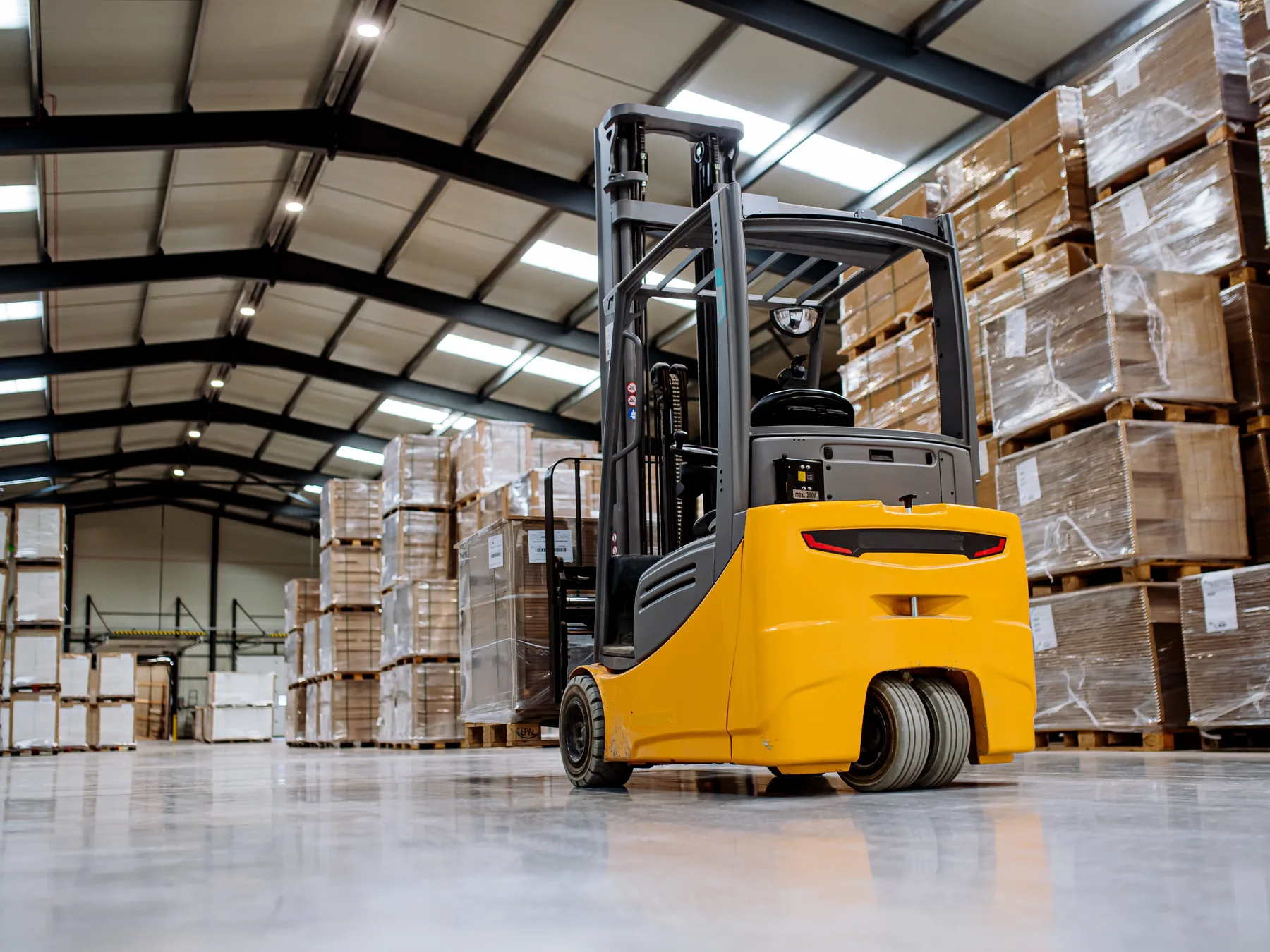
Reach and confinement are the two multipliers in this state. Extending a boom trades capacity for distance in a way the chart describes exactly and an operator under time pressure estimates badly, and New York work rarely leaves room to set up somewhere better. Loads travel over open sidewalks, past scaffold and shed, and into floors of buildings that are occupied above and below the one being served. Add a winter that heaves and softens made ground on an infill parcel, and the pad an outrigger trusted in November has changed by the time the same crew returns in March. The unit itself absorbs very little of what goes wrong.
Common New York forklift claims we see
- Load released over a public way. Everything below an open sidewalk is third-party exposure, and it is the loss this state produces most.
- Tip forward at full extension. The chart is right and the estimate is wrong, which is a training and supervision failure long before it is a mechanical one.
- Operator or ground worker injured. Workers compensation and liability, and the single most expensive outcome available on this machine.
- Strike on an occupied facade. Placing into a live building means damaging work that is finished, tenanted and already invoiced.
- Outrigger settlement on infill. Urban redevelopment ground is made ground with a history nobody on site has read.
Why New York forklift owners choose Equipment Guard Insurance
We are not going to pretend the floater is the interesting part of this account. It repairs a machine that was rarely the casualty. What decides a serious New York year is the person underneath the load and the finished building the boom touched, and those answer to liability and workers compensation while the safety file sits with a federal office and the license sits with a city. Writing the equipment line on its own lets us schedule the telehandler and every attachment properly without unpicking arrangements built around this state, and the markets we use — named on our homepage — read a constrained-site lifting risk for what it is.
Major New York forklift markets
- New York City. No lay-down room, live pedestrian traffic below, and municipal licensing on top of the federal safety standard.
- Buffalo. Industrial and institutional work with a lake-driven winter that decides how many usable lifting days a season contains.
- Rochester. Campus, medical and plant projects where documented operator evaluation is checked before a machine is let through the gate.
- Yonkers and New Rochelle. Dense Hudson-corridor infill on parcels with one approach and no second position for the machine.
- Syracuse. Central-state commercial build-out on large-footprint shells, with long hauls between sites for a single unit.
- Albany. State and institutional campuses, the clearest place to see private crews and public crews working under different authorities.
Related
- Forklift insurance — the machine physics that hold in every state.
- Backhoe insurance in New York — the machine that has to satisfy the vehicle code the moment it crosses the property line.
- All equipment insurance in New York — the state hub.
- Equipment floater · Rented & leased equipment
Primary sources
- State Plans — Occupational Safety and Health Administration (operator safety)
- CONSUMER ALERT: NYS Department of State's Division of Consumer Protection Provides New Yorkers with Tips for Avoiding Home Improvement Scams — No statewide licensing agency — the New York Department of State does not license contractors; licensing is by local jurisdiction (e.g., NYC Department of Consumer and Worker Protection and various counties). (contractor licensing)
New York forklift insurance FAQs
New York has its own occupational safety plan. Does it govern my operators?
Not if you are a private contractor. The approved plan here is limited by design to state and local government employees, so a construction employer and its operators fall to federal OSHA and the powered-industrial-truck training, evaluation and refresher duties arrive as the federal standard. Both statements are true at once, and skipping the second half is how owners end up looking for a state office that has no authority over them.
So which agency is which, in practice?
Three sit near a lifting contractor here and only one of them is looking at the machine. A municipality — most visibly New York City — is where a contractor licensing question lands, because there is no statewide contractor license to hold. Federal OSHA is who inspects and cites a private jobsite. The state program is the one covering the public agency crews you sometimes work alongside. None of those three answers the other two on your behalf.
Does working for a public owner pull me into the state program?
No. The line is drawn on who employs the worker, not on who is paying for the project. A municipal or state agency workforce on that job is inside the state plan; your operators on the same site remain under the federal standard because they are on a private payroll. It is worth knowing which side of that line every person near the machine sits on before an incident forces the question.
What makes a telehandler harder to run on a New York site than anywhere else?
Room. A great deal of the lifting work in this state happens on parcels with no lay-down area, over sidewalks that stay open, and against structures that are occupied above the floor being served. That removes the operator’s ability to reposition, which is the single most useful correction available when a pick looks wrong — and a pick made from a bad position because there was no better one is the origin of a large share of this machine’s losses.
Where does the money actually go when this machine has a bad day?
Into people and finished work. A rough-terrain forklift that drops a pallet or tips forward under reach is usually repairable and back in service quickly, while the injured worker, the destroyed material and the damaged facade drive the claim. Those belong to liability and workers compensation rather than to the equipment floater, which is why insuring only the unit leaves the expensive side of this class open.
Will you write the machine on its own schedule?
Yes. Equipment Guard Insurance places equipment monoline across New York, so the telehandler and its attachments are scheduled by serial number without anyone reopening the rest of your program. With the safety authority federal and the licensing question municipal, we would rather be explicit about which policy answers for which half of an incident than leave it to be discovered.