
Ask who governs a telescopic handler in this state and the honest answer is a subtraction: no state program reaches private employers, so there is nothing between the contractor and the federal standard. That is true, and on its own it is not very useful. What matters is the reason the answer looks like that.
This is a large, thin, cold place, and distance is the fact underneath everything else — including the one that decides what a serious lifting injury actually costs. The page below is about that, and about what winter does to a machine nobody has a building for. For the equipment considered by itself, from rated capacity through boom geometry to what an attachment does to both, see the forklift insurance pillar.
What forklift insurance costs in North Dakota
No figure belongs on a page for this class, and here the spread between two similar-looking accounts is unusually wide because location does so much work. An underwriter is weighing the operator roster and the evaluation records behind it, reach and rated capacity, what mounts to the carriage, how remote the working sites are and how long a machine sits unattended on them, the distances traveled between jobs, whether the unit winters outdoors, and the loss history read for injury severity rather than repair cost. Two identical machines on identical schedules can price differently on nothing but where they spend their nights.
North Dakota forklift regulations: who enforces operator safety
North Dakota is under federal OSHA for private-sector employers, so the powered-industrial-truck operator training and evaluation requirements are the federal standard applied directly.
Read plainly, that means there is nobody at state level in this conversation, and the page would be finished there if enforcement were the only thing distance affects. It is not. The reason no state program administers this ground is the same reason everything else about the ground is hard: it is a long way between places, and the western energy country is a long way from most of them. That geography sets the severity of the loss this machine is actually capable of. A worker caught under a dropped load has an outcome largely determined by the interval before real trauma care, and on a remote pad that interval is a drive, then often a flight. Nothing in an equipment policy shortens it, and no adjuster can reverse it afterward. What fills the vacuum is therefore not another regulator but the crew itself — trained responders on site, a communication plan that works where signal does not, an accurate location for every pad, and pre-lift discipline that assumes no help is close. Meanwhile the state does hold an opinion about you: a contractor license is required through the Secretary of State in classes by project value. It decides whether you may take the job. It says nothing about how the machine on it is run, and it never will.
Common forklift risks in North Dakota
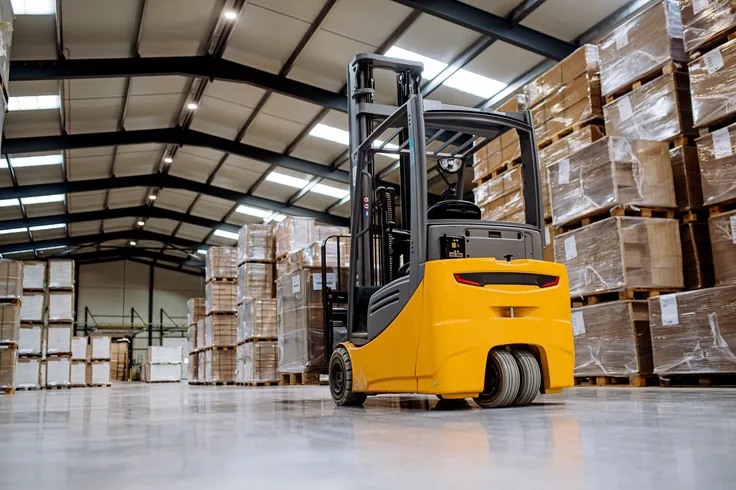
Cold is the mechanical half. A telescopic handler that has been standing at prairie temperatures is stiff, slow and intolerant: hydraulic oil moves badly before it warms, hoses and seals lose their margin against shock loading, tires harden, and steel that is very cold does not forgive a load applied suddenly. Nothing about the machine is stored indoors, because there is generally nowhere to store it, so the first lift of a winter morning is the one that finds the fault. The site is the other half. Gravel pads are built to a footprint and the edges of that footprint are softer than the middle; material arrives as pipe, matting, tanks and bundles that are heavy, awkward and prone to rolling; and the frost-free building season is short enough that everything is compressed into fewer months with more machines and longer days. Compression is where the pre-lift check gets skipped.
Common North Dakota forklift claims we see
- Crush or struck-by on a remote site. The claim whose cost is set by the drive to care rather than by anything the machine did.
- Component failure on a very cold first lift. A hose or seal that had no margin left, discovered with a load in the air.
- Wheel off the edge of a gravel pad. The built footprint holds; the shoulder that looks identical does not.
- Rolling or shifting tubular load. Pipe and bundled material behave differently on forks than a squared pallet ever does.
- Theft or damage on an unattended site. Machines sit alone for long stretches a long way from anyone who would notice.
Why North Dakota forklift owners choose Equipment Guard Insurance
We would rather talk about the injury exposure than the machine value, because in this state the injury exposure is the one geography has already made worse. Repairing a telescopic handler is a predictable expense; a serious operator or ground-worker injury on a remote site is not, and it lands in liability and workers compensation rather than in the floater. Writing the equipment monoline lets us schedule the iron and the attachments accurately without disturbing arrangements built around how you actually work out here, and our markets — named on our homepage — will underwrite a remote lifting operation rather than flinching at the word.
Major North Dakota forklift markets
- Williston. The heart of the western energy country, with remote pads, long response distances and machines that stay out for weeks.
- Dickinson. The southern service base for the same work, with heavy tubular and equipment handling in and out of yards.
- Minot. Airbase-adjacent and regional construction spread thinly across a large service area.
- Bismarck. Government, institutional and river-corridor building, with the most conventional jobsites in the state.
- Fargo and West Fargo. The largest sustained commercial and residential build, on flat valley ground that turns soft in spring.
- Grand Forks. Campus, agricultural-industrial and civil work with a short, intense construction season.
Related
- Forklift insurance — the machine physics that hold in every state.
- Skid Steer insurance in North Dakota — the small machine most likely to leave an unattended pad on somebody else’s trailer, where ownership is settled in a filing cabinet.
- All equipment insurance in North Dakota — the state hub.
- Equipment floater · Rented & leased equipment
Primary sources
- State Plans — Occupational Safety and Health Administration (operator safety)
- Contractors — North Dakota Secretary of State (contractor licensing)
North Dakota forklift insurance FAQs
Is there a North Dakota agency I would deal with after a lifting incident?
Not for private-sector work. The state has no approved plan reaching private employers, so the powered-industrial-truck training and evaluation requirements are the federal standard applied directly and the inspection, citation and appeal are all federal. Contractors arriving from a state-plan jurisdiction spend a while looking for the state office in that chain. There is not one, and knowing that in advance is better than discovering it during a bad week.
Nobody is likely to walk onto a remote pad. Does the standard really matter out there?
It matters for a reason that has nothing to do with the odds of an inspection. The evaluation record is what a serious injury claim is examined against months later, by an adjuster, a plaintiff’s counsel and your own carrier in turn, and its absence is far more damaging in that setting than on a routine site visit. The remoteness that makes enforcement unlikely also removes every other check that would have caught the problem earlier.
What does distance actually do to a crush or struck-by claim?
It sets the severity. The outcome of a person caught under a load is determined largely by how quickly they reach real trauma care, and on a remote site that interval is a drive before it is anything else — sometimes a drive to an aircraft. Nothing in an insurance policy shortens it. What does change it is what your own crew can do in the meantime, which is why trained responders on site, a working communication plan and an accurate location for a pad are not administrative extras here.
How much does the cold change the machine?
Enough that a winter operator is running a different machine from the one in the manual. Hydraulic oil is thick and slow before it warms, seals and hoses lose their tolerance for shock loading, tires harden and grip differently, and steel that is very cold is less forgiving of a sudden load. Add a machine that lives outdoors because there is no building to put it in, and the first lift of a January morning is the one that finds whatever is wrong.
The state licenses me but does not inspect me. What am I meant to make of that?
It is a genuine split and worth naming. A contractor license is required here through the Secretary of State, issued in classes by the value of the job, so the state does form a view about whether you may take the work. It then has no role at all in how the machine on that work is operated. The credential and the conduct are held by two different governments, and only one of them is going to ask about the operator.
Can the machine be scheduled on its own?
Yes. Equipment Guard Insurance writes equipment monoline in North Dakota, so a telescopic handler and its attachments go on their own schedule without reopening anything else. Given how much of the exposure here is the injury rather than the iron, we will be explicit about where the equipment policy ends and what needs to sit beside it.